


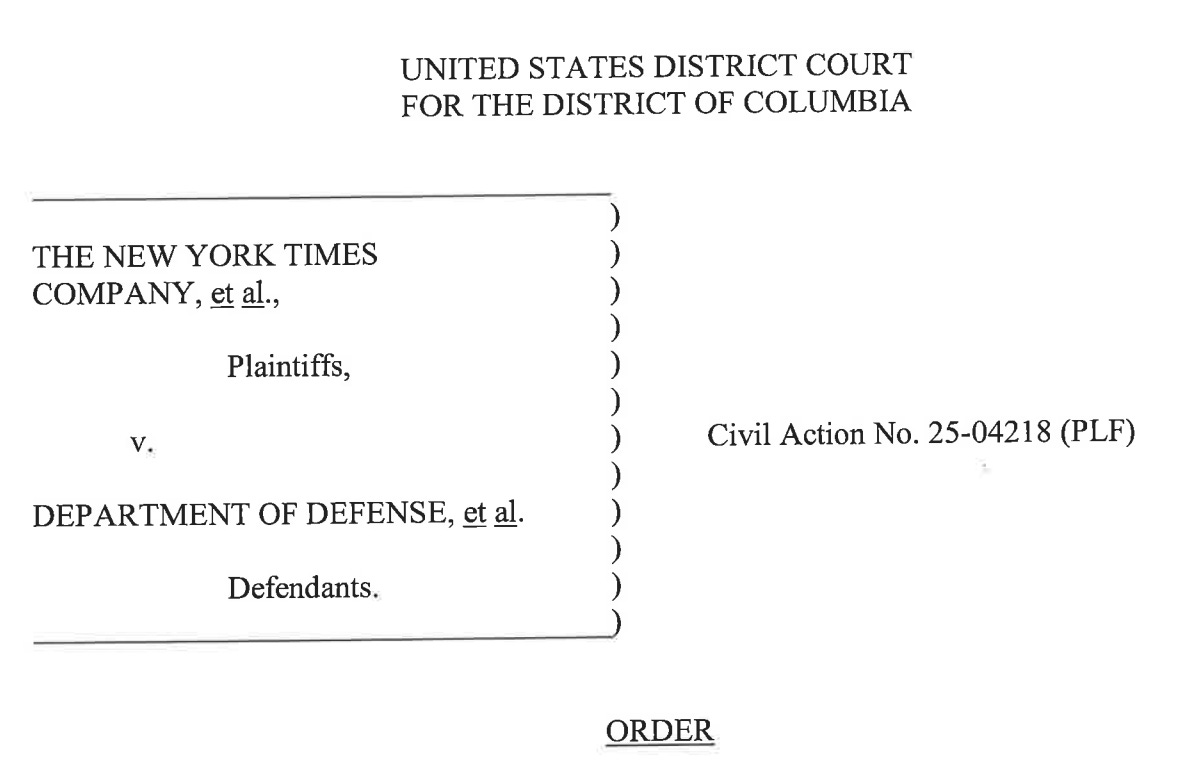
A federal judge on Thursday found that the Pentagon had violated his earlier court order blocking key parts of the Defense Department’s new, restrictive press policy.
The Defense Department’s effort to sidestep U.S. District Judge Paul Friedman’s March 20 order was rebuffed by Friedman, a senior status Clinton appointee, in an opinion that accused Defense Secretary Pete Hegseth’s department of “a blatant attempt to circumvent a lawful order of the Court.”
After Friedman issued his March order, the Pentagon announced an “interim policy” on March 23, which The New York Times challenged as violating the order through the filing of a motion to compel compliance with the March order.
Summarizing the motion, Friedman wrote, “The plaintiffs challenge two aspects of the Interim Policy: the prohibition on the ‘inducement of unauthorized disclosure’ and the closure of the Correspondents’ Corridor coupled with the escort requirement.“
Friedman did not mince words in his 20-page opinion. Calling the department’s characterization of his March 20 ruling “[n]onsense,” the judge went through the evidence and arguments presented by both sides and concluded that “the Department’s abrupt closure of the Correspondents’ Corridor and its ban on credentialed journalists traveling unescorted through the Pentagon are not security measures or efforts to make good on prior commitments but rather transparent attempts to negate the impact of this Court’s Order.“
As to the the “inducement of unauthorized disclosure” provision, Friedman wrote, “the Interim Policy amounts to—in the Department’s words—a ‘clarification[]’ of the prohibitions contained in the original Policy that this Court held to be unconstitutional.“
However, he continued, “The Department cannot simply reinstate an unlawful policy under the guise of taking ‘new’ action and expect the Court to look the other way.”
As to the corridor closure, Friedman explained:
Nor can the Department take steps to circumvent the Court’s injunction and expect the Court to turn a blind eye. But that is exactly what the defendants have done by closing the Correspondents’ Corridor and imposing an escort requirement. The Court’s Order requires the Department to restore the plaintiffs’ access to the Pentagon. Rather than comply with that Order, the Department has cut off all PFAC holders’ meaningful access to the Pentagon.
In summing up the problems with the interim policy, Friedman wrote:
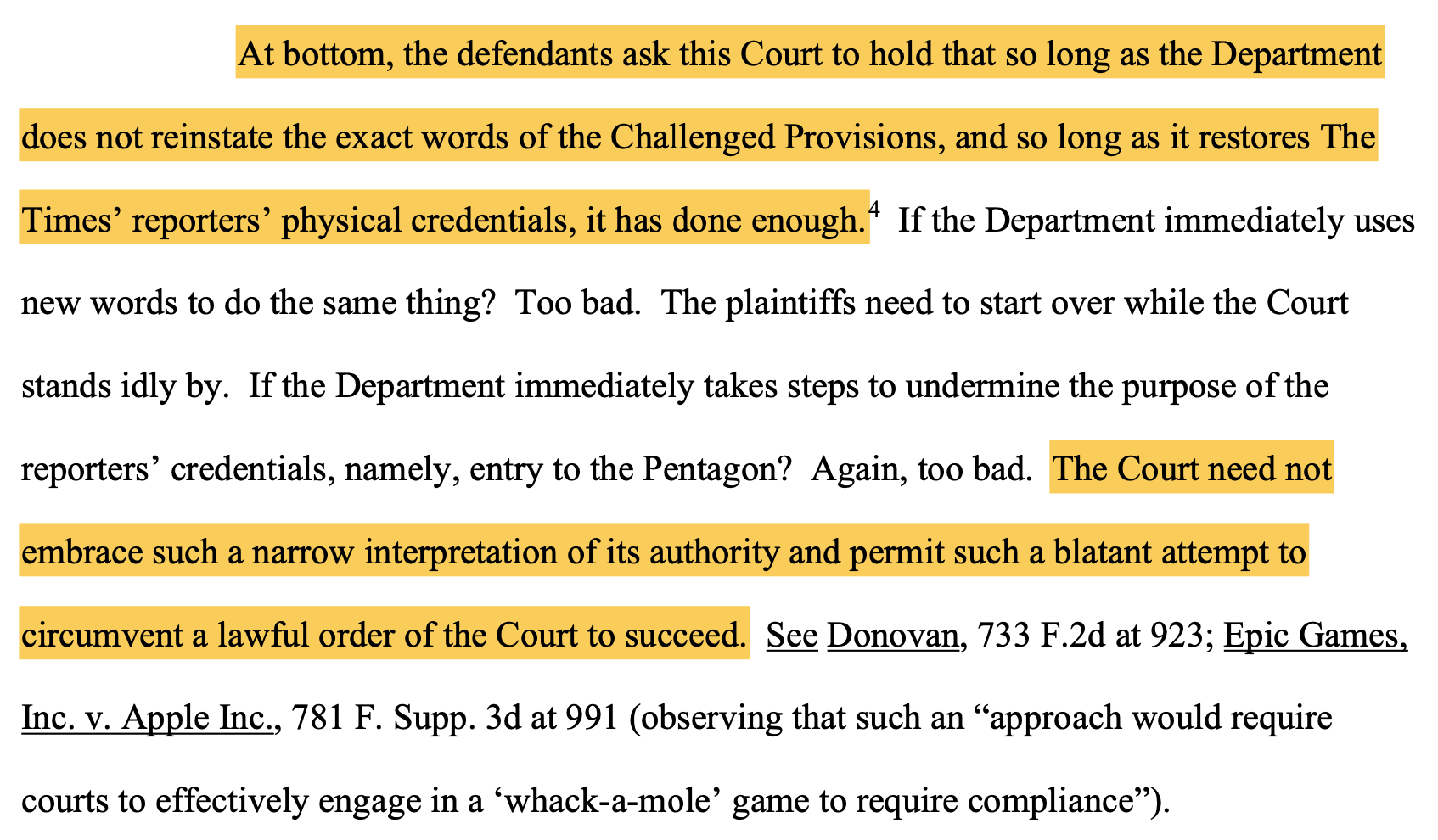
As such, Friedman wrote, “[T]he Court concludes that the defendants have failed to comply with its Order.“
Reminding all that this case is about more than press passes, Friedman returned to what he said this case is “really about” at the end of his opinion:
The Court cannot conclude this Opinion without noting once again what this case is really about: the attempt by the Secretary of Defense to dictate the information received by the American people, to control the message so that the public hears and sees only what the Secretary and the Trump Administration want them to hear and see. The Constitution demands better. The American public demands better, too.
He concluded it as thus:
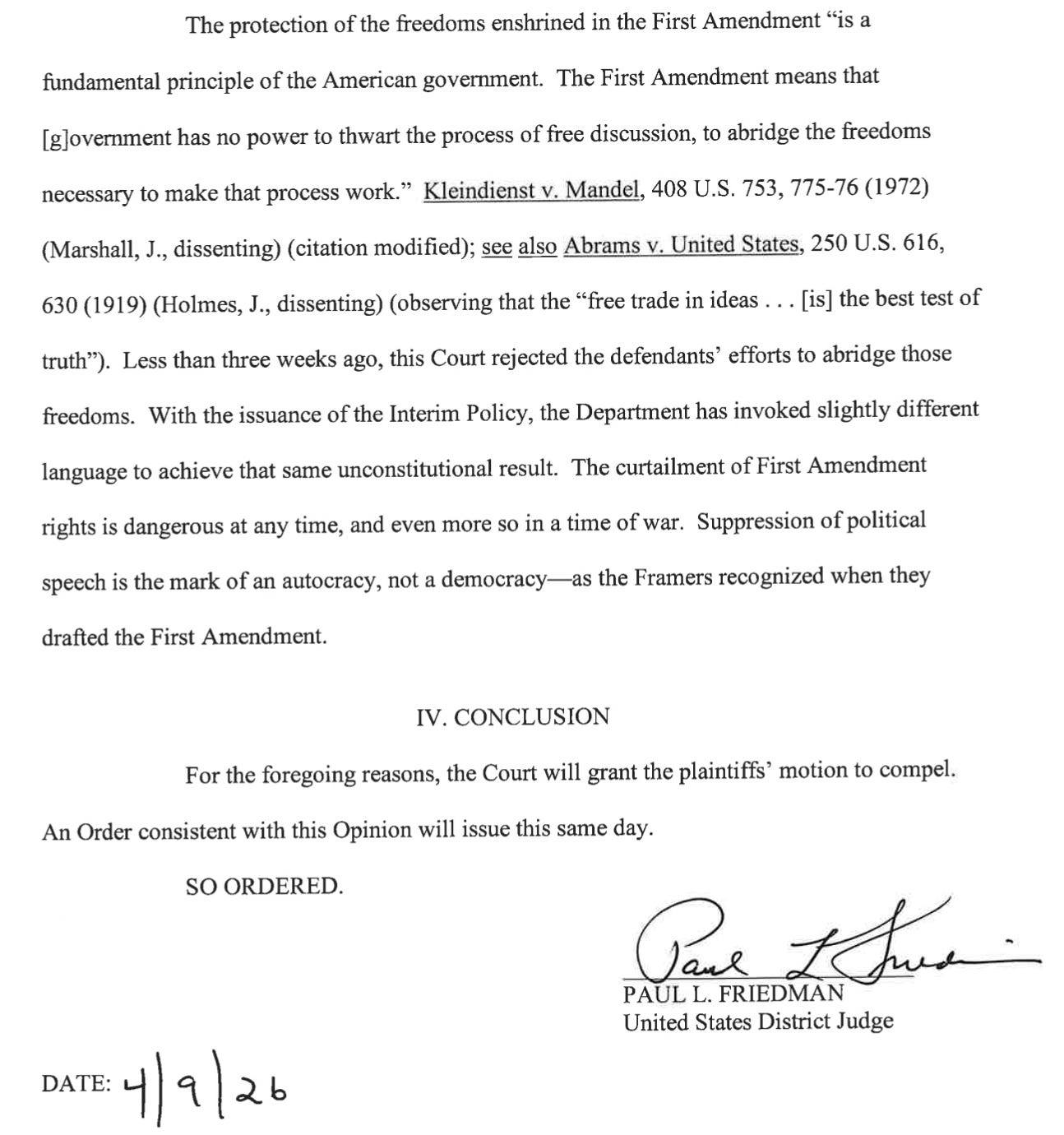
Friedman’s order filed with the opinion found the defendants “in violation of” the March 20 order, detailed the provisions in the interim policy that violate the March 20 order, bars any further similar efforts to restrict Pentagon access against The New York Times plaintiffs, and required the government to submit a status report detailing compliance steps by April 16.
Fifth Circuit passes on further review of mandatory detention policy, setting up Supreme Court review
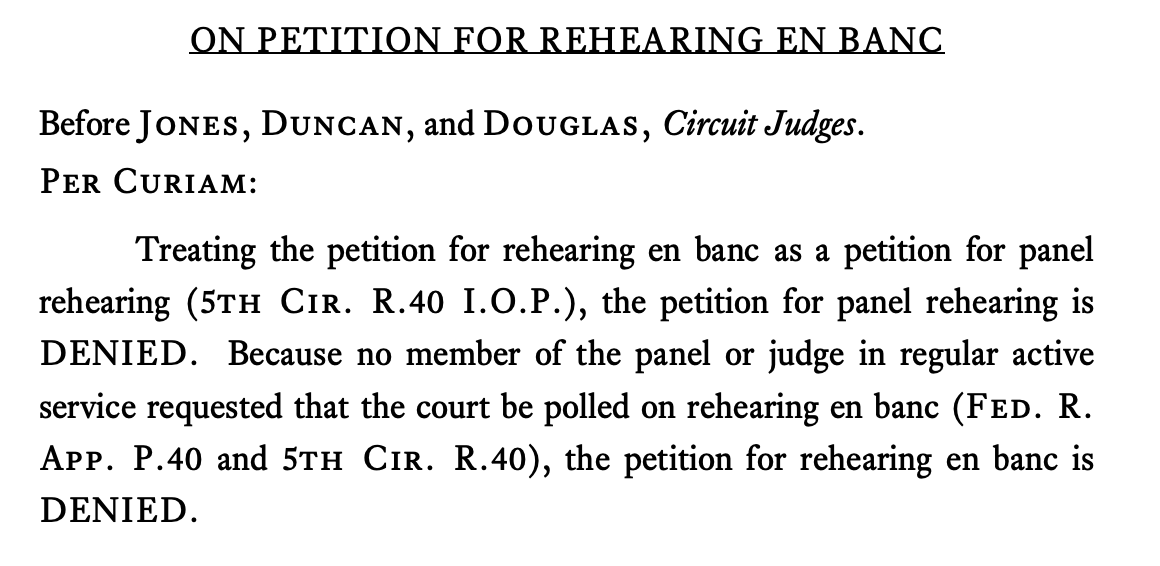
On Thursday afternoon, the U.S. Court of Appeals for the Fifth Circuit announced that it had denied the request for en banc review by the full court of the February 2-1 decision by a panel of the court allowing the Trump administration to implement a mandatory detention policy that could apply to millions of people.
As Law Dork has covered previously, the Trump administration unilaterally decided in 2025 to reinterpret federal immigration law to allow mass and mandatory detention under a 1996 law that has always been interpreted to allow bond hearings for undocumented immigrants within the country as part of any removal proceedings.
Thurssday’s ruling means the only option to stop the mandatory detention policy in Texas, Mississippi, and Louisiana is to seek Supreme Court review.
Todd Schulte, the president of FWD.us tweeted how these circumstances are “massive and shocking and outrageous” as a result of the policy and the ruling, adding that he assumes the case “will go to the Supreme Court.“
Aaron Reichlin-Melnick, who spoke with Law Dork recently about this and other immigration disputes arising out of the Trump administration’s policies, similarly posted, “This case will be heard by the Supreme Court next term, mark my words.”
Explaining how extreme the Trump administration’s position is, he added, “The Trump admin’s claim, endorsed by the 5th Circuit, that everyone had been reading a 1996 law wrong and most undocumented immigrants are actually ineligible to seek bond, has caused massive chaos in federal courts.“
Law Dork all over
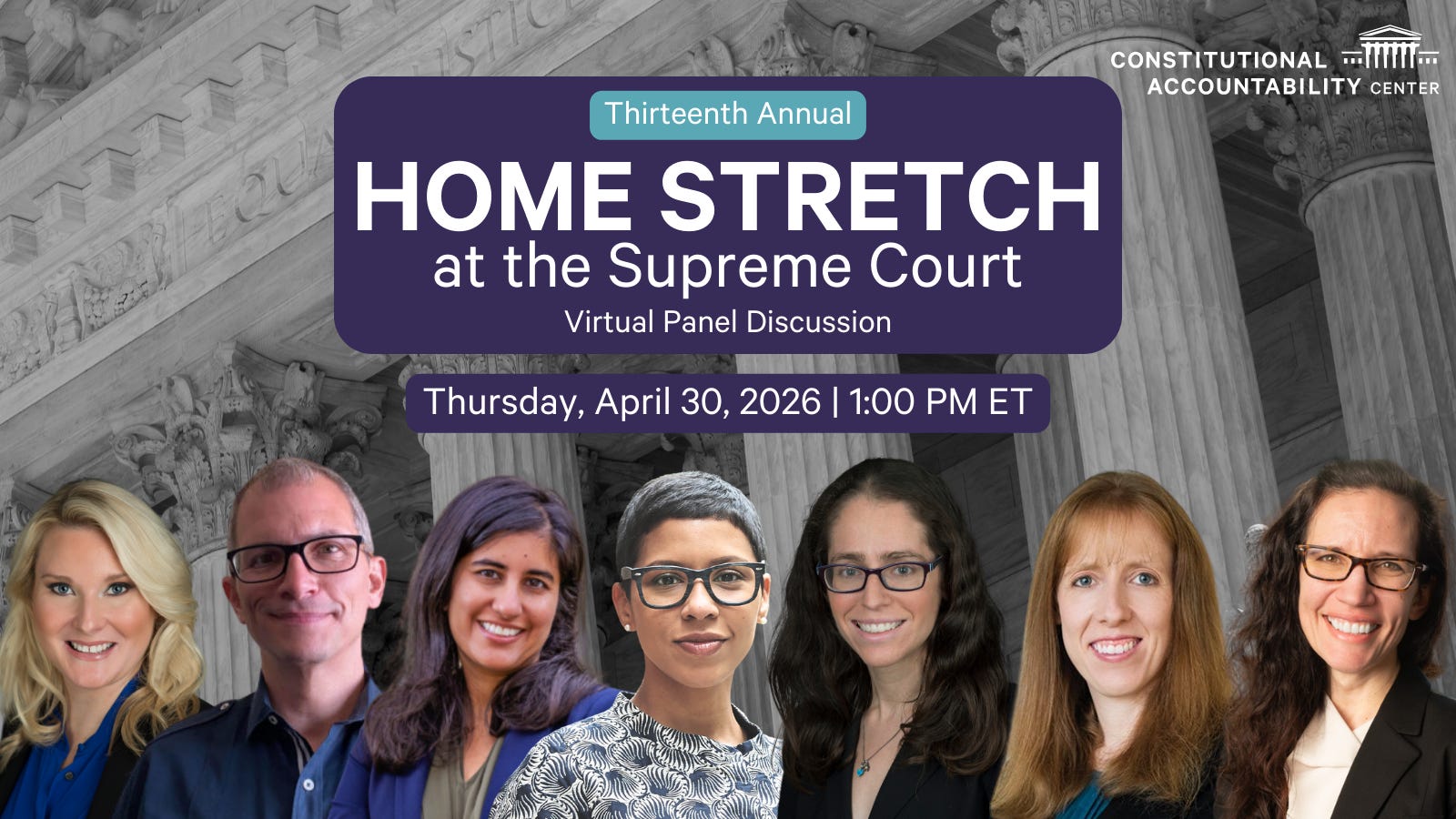
I am thrilled to moderate the Constitutional Accountability Center’s “Home Stretch” panel at the end of the month, the day after the U.S. Supreme Court hears its final oral arguments of the term.
The panelists are set to be:
Kelsi Brown Corkran, Supreme Court Director at the Institute for Constitutional Advocacy & Protection and Senior Lecturer at Georgetown University Law Center; Easha Anand, Assistant Professor of Law and Co-Director of the Supreme Court Litigation Clinic at Stanford Law School; Melissa Murray, Frederick I. and Grace Stokes Professor of Law at New York University School of Law, co-host of the Strict Scrutiny podcast, and author of The U.S. Constitution: A Comprehensive and Annotated Guide for the Modern Reader; Jennifer Bennett, Principal of Gupta Wessler LLP; and CAC’s … Chief Counsel Brianne Gorod.
It’s an incredible panel, and it’s virtual, so be sure to sign up and join us on April 30!
Also, earlier this week, I joined the Bay Area’s KALW for Your Call to discuss this week in the Trump administration, including the Twenty-Fifth Amendment, impeachment, and more.
I also joined Chicago’s WCPT 820 for Driving It Home with Patti Vasquez to discuss Trump, the Supreme Court, the midterms, and more.
Check them out, and be in touch — especially as June approaches, with the many Supreme Court opinions and Pride Month — if you want to book me for your panel, another speaking engagement, or for a TV, radio, or podcast appearance.
Administration violates order. Judge angry. Rinse/repeat.
After over a year of this, the usual practice should be sanctions or at least the general conclusion that an order alone isn't enough. They will try to find a way around it or simply violate it.
Over and over again, call in people to explain. Make special efforts to ensure compliance. Require status reports upfront. (Some district court judge was called out for requiring a senior official to do this, and it was bulls---) And whatever else they can do.
yeah, I’m really glad federal judges are holding the line on individual scuffles, but when is one of them actually going to paint the bigger picture of insurrection and seditious conspiracy, at least something a little more broadly damaging than “no”? The courts can't keep pretending these cases are all unrelated coincidences; they're trying to dismantle the Constitution