

On heading into year two of the second Trump administration, and the necessity of pushback
The Minnesota pushback to "Operation Metro Surge" shows the power that the people maintain in the face of Trump's authoritarianism.

President Donald Trump has not even been back in office for a full year.
And yet, America is transformed.
The nation’s status in the world has shifted. And, as to basic expectations at home — in government, yes, but in health, business, media, and other realms as well — the country is, simply put, in a different place.
And, in nearly every situation, America is less free, less secure, less stable — or some combination of all three.
This weekend has been a seemingly horrifying thought exercise that is, instead, reality of two intermingled questions about how NATO member nations will respond to the president’s threats against Greenland and whether the president and his underlings will continue expanding their assault on Minnesota as a result of opposition to his deadly, extreme immigration enforcement efforts.
And, in the midst of that, the U.S. Supreme Court will be hearing arguments on Wednesday over Trump’s attempt to fire Lisa Cook as a governor of the Federal Reserve Board — even as the Justice Department is investigating Jerome Powell, the chair of the Fed.
Despite all of that, I am not without hope.
This is the lashing out of a man and administration that — while they have significant powers — lack credibility, an actual plan, or public support.
As CNN’s Ariel Edwards-Levy, Jennifer Agiesta, and Edward Wu put it on January 16, “Public opinion on nearly every aspect of President Donald Trump’s first year back in the White House is negative, a new CNN poll conducted by SSRS finds …. A majority, 58%, calls the first year of Trump’s term a failure.“
So, we get federal immigration agents shooting people, members of the military in Alaska on alert for possible deployment to Minnesota, global invasions with threats of more, and the embarrassing-for-all-involved Nobel Peace Prize hell.
The result of that — and the thing that gives me the most hope — is very real and very broad pushback.
People in the streets; lawyers in the courts; and, in one particularly stark example, U.S. District Judge William Young in Massachusetts, a Reagan appointee, calling Trump an “authoritarian” from the bench, as Reuters’s Nate Raymond reported this week.
The Minnesota litigation pushback
On Friday night, January 16, U.S. District Judge Katherine Menendez — in issuing an order limiting the Trump administration’s actions in Minnesota — wrote that the Trump administration would not face “irreparable harm” if “require[d] … to honor the constitutional rights of those who peacefully protest and observe law enforcement activities.”
In all, three major lawsuits are proceeding against the administration’s actions in the state.
In a lawsuit filed on January 12 by Minnesota, Minneapolis, and St. Paul, the plaintiffs are seeking a temporary restraining order to block the immigration enforcement surge — “Operation Metro Surge” — altogether. (In a January 16 filing, the plaintiffs asked the court to keep current consideration to the TRO and not convert the TRO motion to a preliminary injunction motion in part because their TRO does not include elements they would include in a PI motion.)
In another lawsuit filed days later by the ACLU and others, the plaintiffs are seeking a preliminary injunction to address the immigration stops, detentions, and arrests — and specific practices engaged in by immigration agents in taking those steps — in a class-action lawsuit.
And, in the lawsuit referenced above, filed on December 17, another group of Minnesota residents brought a class-action First and Fourth amendments case seeking to address “unconstitutional conduct and retaliation” in “Operation Metro Surge.” The plaintiffs there sought a TRO, which was converted to a preliminary injunction request at a December 19 hearing, and the government filed its opposition on January 5. Menendez (who is also hearing the Minnesota case) then issued her preliminary injunction in the case, Tincher v. Noem, on January 16.
In her 83-page opinion, Menendez found that, on this record, multiple plaintiffs were likely to succeed in their First Amendment retaliation claims. In one notable part, she wrote of the Trump administration’s argument:
Defendants … suggest that no chilling has occurred as a result of these [adverse] actions [taken against the plaintiffs] because protests, speech, observation and recording continue, and the named Plaintiffs themselves continue to engage in such conduct. But the test of “chilling” is an objective one. … The Court finds that a variety of Defendants’ conduct would chill a person of ordinary firmness from engaging in further protected activity. … That conduct includes the drawing and pointing of weapons; the use of pepper spray and other non-lethal munitions; actual and threatened arrest and detainment of protesters and observers; and other intimidation tactics.
And, in finding that plaintiffs are likely to succeed in their Fourth Amendment claims, Menendez wrote as to the plaintiffs who were stopped for following immigration enforcement officers in vehicles:
There may be ample suspicion to stop cars, and even arrest drivers, engaged in dangerous conduct while following immigration enforcement officers, but that does not justify stops of cars not breaking the law.
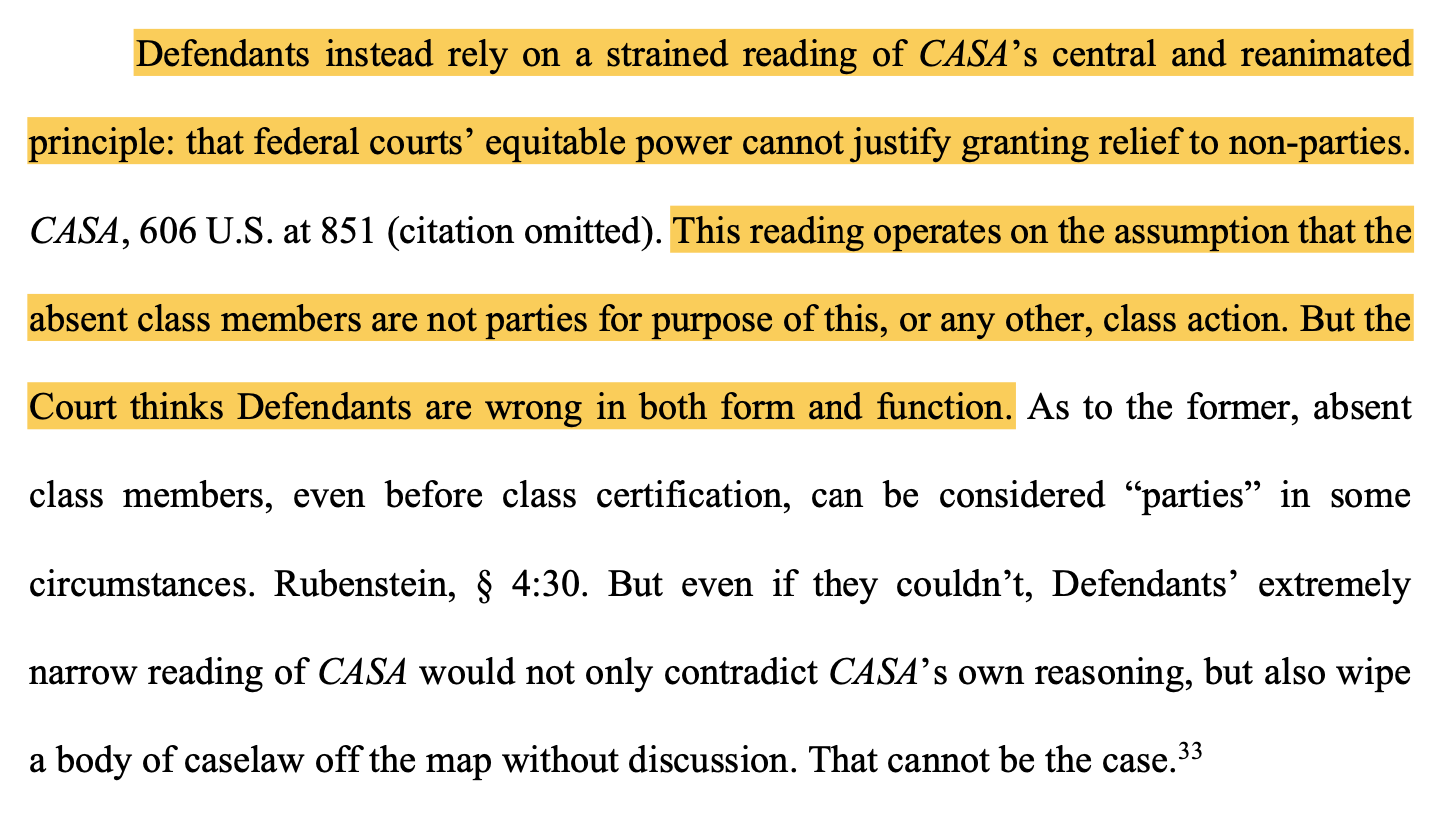
Notably, in granting class-wide relief, Menendez also addressed the government’s argument that 2025’s CASA Supreme Court decision ending universal injunctions also did something significant to class actions (found in Rule 23 of the Federal Rules of Civil Procedure).
Despite being a proposed class-action lawsuit, DOJ had argued that “the injunction violates CASA because it goes beyond providing targeted relief to the named Plaintiffs specifically.”
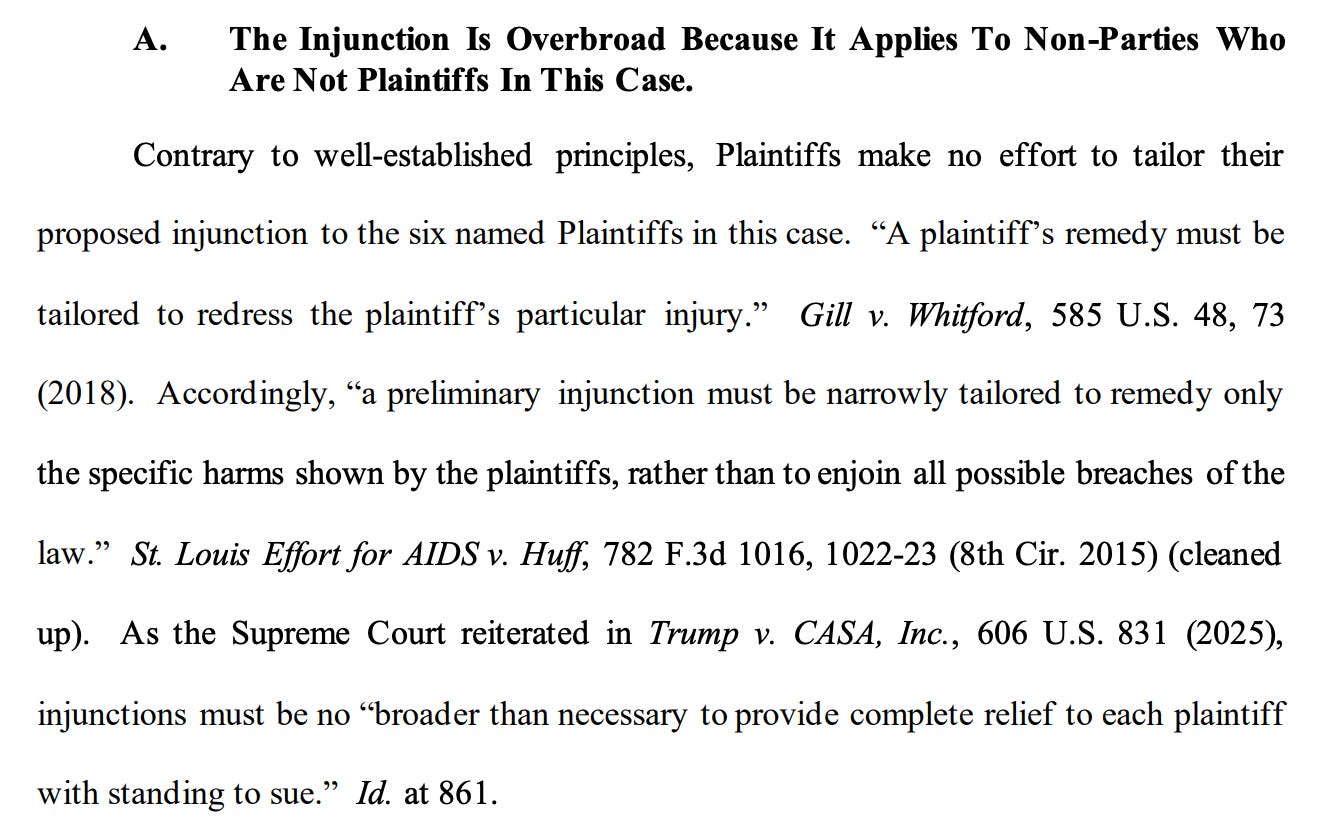
Menendez was not OK with this broad of a claim.
“[N]owhere does CASA suggest that issuance of class-wide relief in a preliminary injunction is improper. Instead, its reasoning affirms class actions and their remedies,“ she wrote. “CASA implicitly blesses class actions as an appropriate alternative to universal injunctions for widespread relief, again distinguishing the two. CASA, 606 U.S. at 849 (discussing why Rule 23 class actions are a more appropriate avenue for broad relief).“
She continued:
Ultimately, Menendez granted relief to a class consisting of: “All persons who do or will in the future record, observe, and/or protest against Operation Metro Surge and related operations that have been ongoing in this District since December 4, 2025.“
Although it didn’t work before Menendez, it is important to see how quickly and aggressively DOJ is seeking to move CASA beyond CASA — making arguments that would make it nearly impossible for the people to challenge government actions, no matter how illegal or even unconstitutional they are, outside of every person affected needing to sue (or getting a final Supreme Court ruling on a matter, which could still necessitate follow-up litigation for others seeking relief).
This DOJ argument will come up elsewhere — and, almost surely, on appeal here.
Lessons learned — and looking ahead
Each step of pushing back against Trump’s authoritarianism has its risks.
That is the nature of authoritarianism.
And yet, and in part because of that, each step of pushing back is necessary.
Individuals protesting the Trump administration and protecting their neighbors, legislators standing up and requiring answers, state and local officials countering federal actions, plaintiffs and lawyers challenging lawless actions — all are essential.
Over the weekend, Jamelle Bouie ended a column about seeing this moment through the lens of American history with a discussion of force:
One way to read the occupation of Minnesota is as a flex — a demonstration of the government’s power and authority. That, perhaps, is how [Stephen] Miller and Kristi Noem see the situation. I smell, on the other hand, a stench of desperation, an attempt to do with force what they can’t accomplish through ordinary politics. Faced with an angry public but committed to a rigid agenda of nativist brutality, the president and his coterie of ideologues are playing the only move they seem to have: wanton violence and threats of further escalation. They think this will break their opposition.
But looking at the ironclad resolve of ordinary Minnesotans to protect their homes and defend their neighbors, I think the administration is more likely to break on their opposition and learn, as the British did in Boston, that Americans are quite jealous of their liberties.
I think Bouie is right — as illustrated both by the action of multiple hotels kicking ICE out of their rooms on Sunday (for whatever claimed reasons and however belatedly done) and by the response online to my simply reposting the news.
This is one small example of literally thousands of examples of the administration going too far and someone — or many someones — saying no in the past year.
Not only do I think Bouie is right about Americans, but, diving a little deeper, it is notable how jealously Americans are guarding our liberties despite — or, perhaps, because of — the failures of the other branches to jealously guard their own roles in our constitutional structure against this out-of-control executive branch, a subject I’ve written on previously.
Whatever the cause, it is good to see — and needed — and the best outcome would be members of those other branches waking up to that fact as we move into the second year of the second Trump administration.
And, if they don’t? More pushback will be needed — against all three branches of government — to protect the freedom, security, and stability of America.
As for me, heading into year two, I will keep doing what I have been doing, what I told you I would do in this new administration on January 19, 2025: “It’s going to be a rough ride, but remembering — and acting on — our values will be key.”
I’m with you. I have hope, too! I’m in Oregon, but lived many years in Minneapolis and have lots of family there. As someone said, DHS sent ICE to Minnesota, which has lots of descendants of the Vikings, in winter! Minnesota is showing them!
As always, thank you for your analysis and for your thoughts!