

Minnesota's effort to end the surge is rejected as journalists are arrested, but pushback continues
A judge denied Minnesota's ambitious request — a day after Don Lemon and Georgia Fort were arrested. But, in Texas, a judge orders 5-year-old Liam Ramos and his dad released.

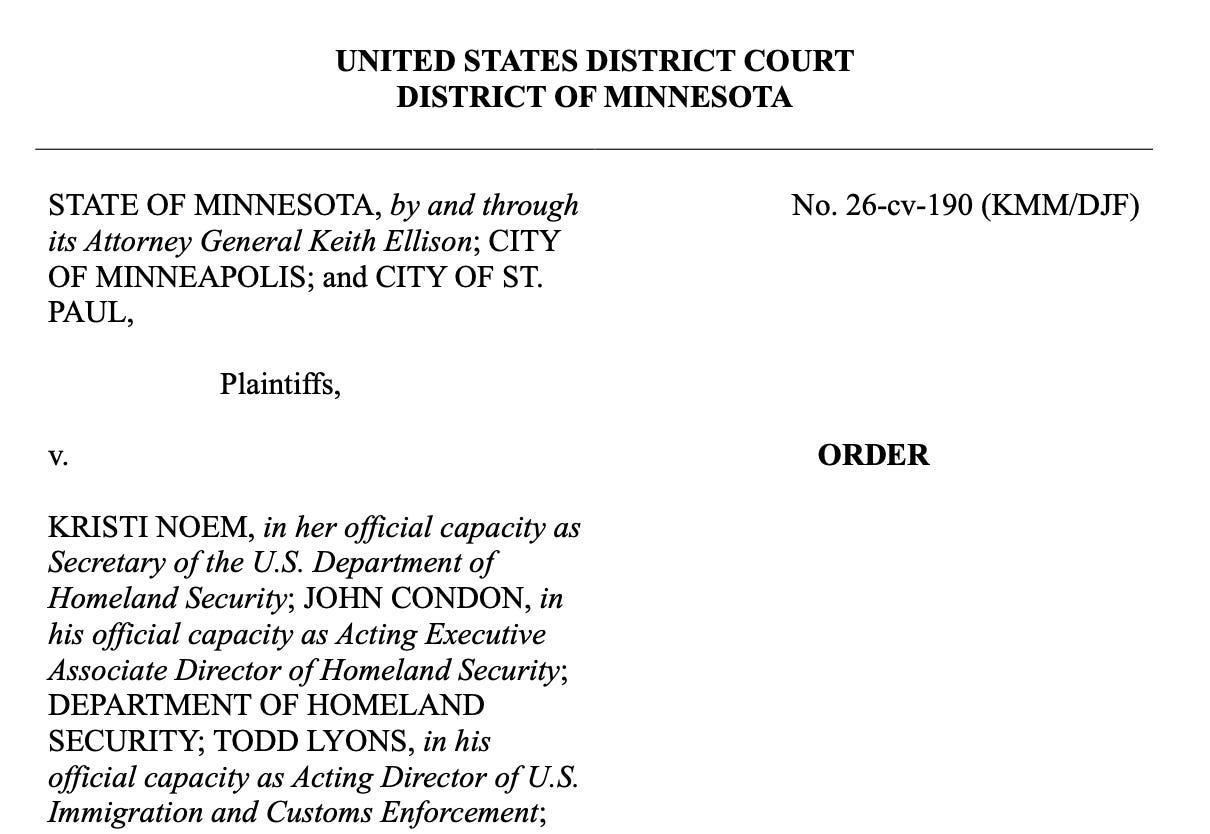
As Operation Metro Surge continued on the streets of the Twin Cities, a federal judge on Saturday rejected a request from Minnesota, Minneapolis, St. Paul to end the Trump administration’s extreme immigration enforcement effort immediately.
Under the surge, the Department of Homeland Security has sent about 3,000 federal officials to Minnesota this winter — upending life in the Twin Cities and prompting extensive pushback. Among the countless harms, the federal agents deployed to the state have killed Renee Good and Alex Pretti.
The ambitious case featured an argument that, through the surge and in light of Trump administration’s statements about it, the federal government was violating the Tenth Amendment’s anti-commandeering principle and Minnesota’s constitutional right to equal sovereignty.
U.S. District Judge Katherine Menendez, a Biden appointee, noted the limited contexts in which the Tenth Amendment has been employed by the U.S. Supreme Court before concluding that, for now, she was unwilling to “extend existing precedent to a new context where its application is less direct—namely, to an unprecedented deployment of armed federal immigration officers to aggressively enforce immigration statutes.”
As to the state’s argument that the Trump administration’s statements regarding the surge provide sufficient evidence for a finding that the surge is impermissible coercion under the Tenth Amendment, Menendez concluded that “the inferences to be drawn regarding the allegedly coercive purpose of Operation Metro Surge are not as one-sided as Plaintiffs suggest.”
As Menendez wrote:
Plaintiffs argue that Defendants are carrying out Operation Metro Surge in brazenly lawless ways specifically to coerce Plaintiffs into modifying or repealing their “sanctuary” laws and ordinances and otherwise cooperate with the Executive, thereby commandeering Plaintiffs’ legislative processes. Plaintiffs certainly have put forth evidence to support this theory, including Attorney General [Pam] Bondi’s letter to Governor [Tim] Walz, which states as much, and other statements by Defendants and other Executive Branch officials.
Despite that, Menendez continued, “there is also support that cuts the other way,“ specifically “other motivations behind Operation Metro Surge,” including a carefully caveated statement from Menendez: “Based on the record before the Court, a factfinder could reasonably credit that Plaintiffs’ sanctuary policies require a greater presence of federal agents to achieve the federal government’s immigration enforcement objectives than in a jurisdiction that actively assists ICE.”
From there, Menendez concluded, “Because there is evidence supporting both sides’ arguments as to motivation and the relative merits of each side’s competing positions are unclear, the Court is reluctant to find that the likelihood-of-success factor weighs sufficiently in favor of granting a preliminary injunction.“
After finding that, as she called it, “the improper-influence” claim was not likely to succeed at this time, Menendez more quickly concluded the same of a secondary “resources” Tenth Amendment claim and the equal sovereignty claim.
Additionally, and reiterating a point she pressed on in court earlier in the week, she wrote, “Plaintiffs have provided no metric by which to determine when lawful law enforcement becomes unlawful commandeering, simply arguing that the excesses of Operation Metro Surge are so extreme that the surge exceeds whatever line must exist. A proclamation that Operation Metro Surge has simply gone ‘so far on the other side of the line’ is a thin reed on which to base a preliminary injunction.
In addition to the expansive nature of the argument — which the Minnesota Attorney General’s Office had argued was the result of the unprecedented nature of Operation Metro Surge itself — Menendez, in denying Minnesota’s request, repeatedly pointed to the fact that the U.S. Court of Appeals for the Eighth Circuit, where any appeal would go, had just issued a stay of a more narrow injunction that Menendez had issued in another surge-related case.
“The Eighth Circuit Court of Appeals recently vacated [sic] a much more circumscribed injunction which limited one aspect of the ongoing operation, namely the way immigration officers interacted with protesters and observers,” Menendez wrote of the First and Fourth Amendment case, Tincher v. Noem. “If that injunction went too far, then the one at issue here—halting the entire operation—certainly would.“
Putting aside (the admittedly important question of) whether Menendez made the right decision on the likelihood of Minnesota’s success on its Tenth Amendment improper-influence claim, Menendez is right on two key fronts: The case was forging new ground, making a preliminary injunction (or temporary restraining order) more difficult to obtain, and the extremely conservative appeals court has signaled it is looking skeptically at district court orders for judicial overreach.
Executive overreach as journalists are arrested
The concern about judicial overreach might understandably seem out of place in this moment — both broadly and specific to the federal court in Minnesota on Saturday.
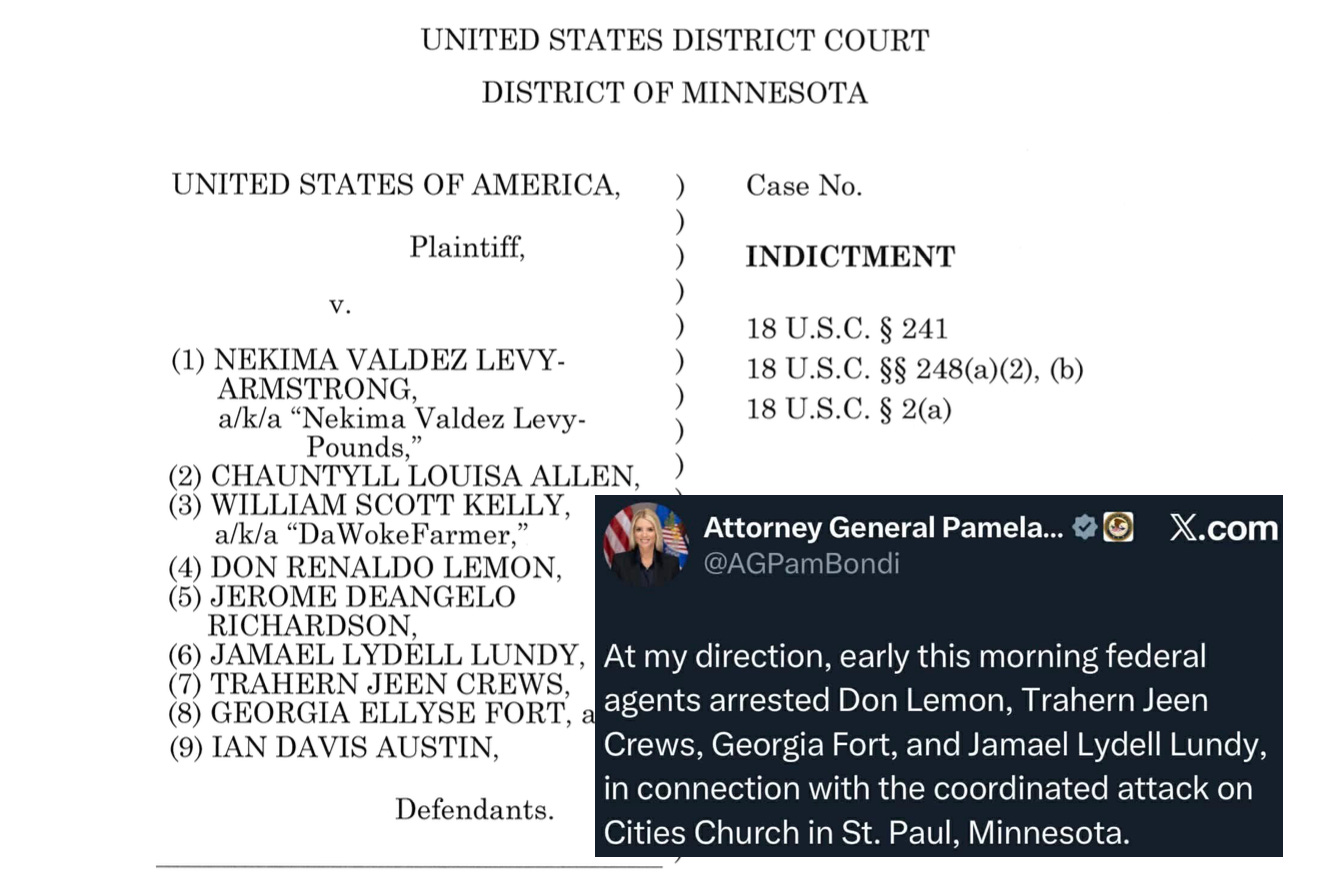
The Saturday ruling came one day after the Justice Department arrested multiple people — including two journalists — a part of the Justice Department’s effort to bring charges related to a recent Minnesota church protest related to Operation Metro Surge.
After an earlier attempt to arrest Don Lemon was rejected by judges in Minnesota, the Justice Department took the case to a grand jury and, on Friday morning, arrested Lemon and Georgia Fort, two independent journalists, and others.
Both Lemon and Fort covered the January 18 protest at Cities Church, where one of the pastors — David Easterwood — is the acting head of the Minnesota ICE field office.
The Lemon and Fort arrests were a multi-faceted escalation of many of the Trump administration’s authoritarian aims — attacking reporters and the First Amendment, diminishing the authority of the courts, threatening those seeking to hold the administration accountable for their actions, and using extreme methods to advance the administration’s anti-immigrant efforts.
By the end of the day Friday, the pair of journalists were both released after making initial appearances in court — Lemon in Los Angeles and Fort in Minneapolis. Others arrested Friday also were released, including Jamael Lydell Lundy, a candidate for state senate.
And yet, the nine — including Lemon and Fort — will, for now at least, continue to face felony federal criminal charges. The indictment involves the same charges as the Justice Department brought via complaint against three people last week — alleging violations of the FACE Act — an abortion clinic access law that includes a religious worship protection section — and a related conspiracy charge.
After the magistrate judge refused to sign off of the complaint as to others and neither the chief judge of the district court nor U.S. Court of Appeals for the Eighth Circuit would reverse that decision, the Justice Department took the case to a grand jury in Minnesota and secured the full set of indictments on Thursday.
Gabe Rottman, vice president of policy for the Reporters Committee for Freedom of the Press, noted in a statement on Friday, “To our knowledge, it’s unprecedented for the Justice Department to deploy the federal laws it has previously cited in this case against journalistic activity.“
As Quinta Jurecic wrote at The Atlantic, “On the basis of the record available so far, the case against them appears factually weak, legally shoddy, and marred by a baffling series of procedural irregularities that raise serious questions about the Justice Department’s ability to win in court.“
Specifically as to Lemon and Fort, she explained, “Again and again during the livestream, Lemon explained that he was there as a reporter, not an activist. Similarly, in an Instagram post after the protest, Georgia Fort emphasized, ‘My job as a journalist is to document what’s happening.’”
The Trump administration does not want that. President Donald Trump does not want that, Attorney General Pam Bondi does not want that, Homeland Security Secretary Kristi Noem does not want that. The leadership and employees of U.S. Customs and Border Protection and U.S. Immigration and Customs Enforcement do not want documentation of their lawlessness by anyone, least of all journalists with a large platform.
While the cases are weak and DOJ’s efforts on Friday even to have courts hold detention hearings were rejected as judges ordered those facing charges to be released own their own recognizance, the Trump administration undoubtedly considers Friday a success. They almost surely believe this — and Bondi’s unprofessional, unusual live-posting of arrests — will chill some others from engaging in journalism that they decide could put them at odds with the Trump administration.
It also should not be lost that the administration took this action against two Black journalists — and against independent journalists who lack the institutional support that others with traditional employers might have in this situation. Lemon is obviously well known nationally, and his lawyer Abbe Lowell is as well (most recently seen at counsel’s table in the U.S. Supreme Court representing Lisa Cook, the Federal Reserve Board governor challenging Trump’s effort to fire her), but the targeting of two independent Black journalists should not be lost in all of this.
At the same time, I couldn’t help but look at this — and at Bondi’s childish behavior — as another sign of how precarious the administration’s grip on power is.
The response to Lemon and Fort’s arrests, like the killings of Good and Pretti, have been to crystallize and clarify the lawlessness with which officials in the Trump administration would like to operate. They are actions that should not happen, but they are actions that only come from the desperation of the Trump administration to exert control where it has none.
People will continue — and have continued — challenging ICE and other DHS actions, and journalists will continue — and have continued — covering all of it.
“The Great Writ“
Continue, the challenges to the Trump administration will.
On Saturday, as this longest of months comes to a close, a federal judge in Texas granted a writ of habeas corpus ordering the release of 5-year-old Liam Ramos and his father, Adrian Conejo Arias.
“[T]he Court finds that the Constitution of these United States trumps this administration’s detention of petitioner Adrian Conejo Arias and his minor son, L.C.R.,” U.S. District Judge Fred Biery wrote in Saturday’s opinion. “The Great Writ and release from detention are GRANTED pursuant to the attached Judgment.
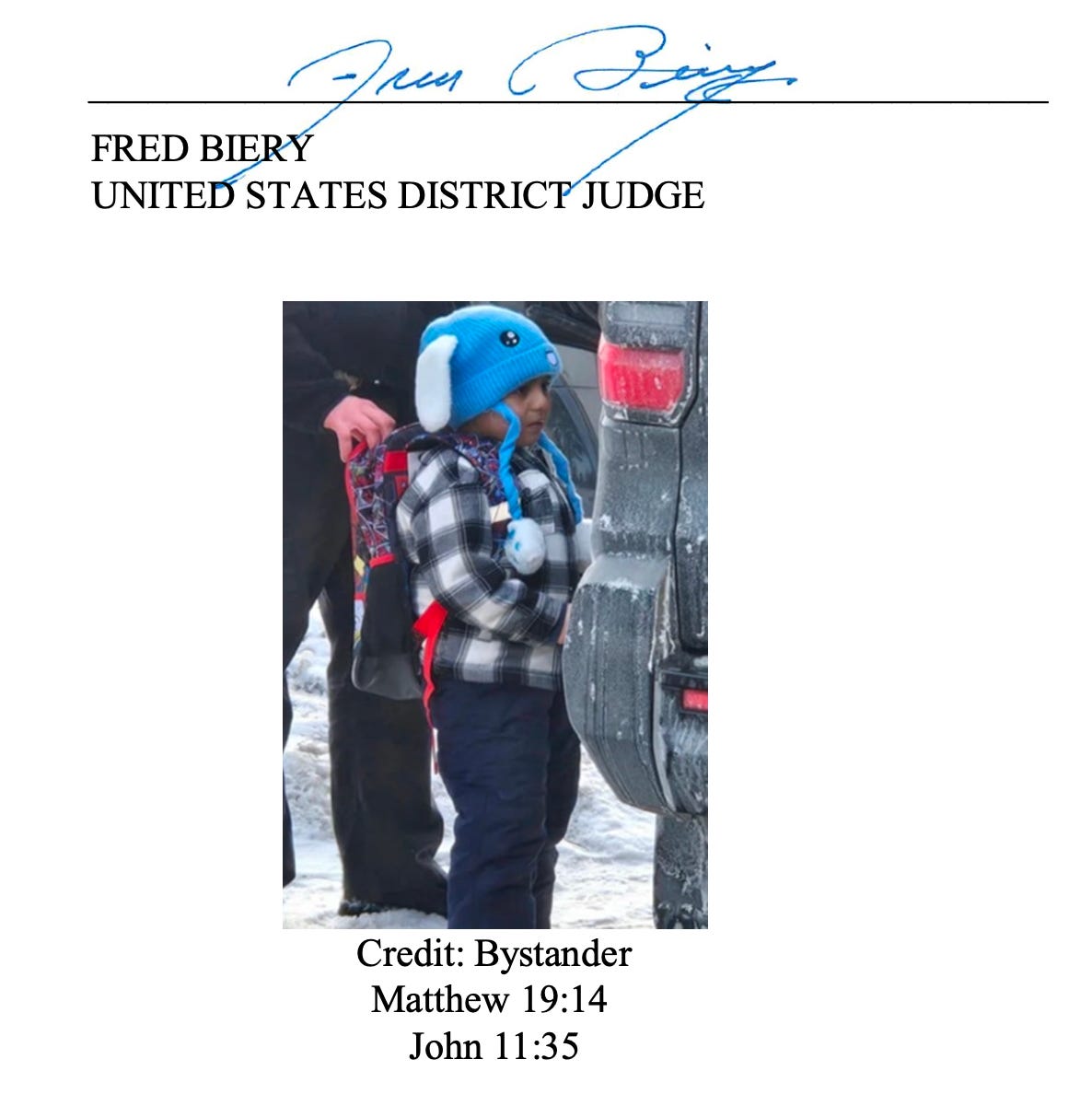
The viral photograph of the small Ramos in a blue hat in the Minnesota winter wearing a bookbag being gripped by a federal agent led to outrage, and it has become a symbol of the meaningless cruelty of the administration's extreme immigration enforcement efforts.
Biery, a Clinton appointee, included the photograph in his ruling, which excoriated the Trump administration for “the ill-conceived and incompetently-implemented government pursuit of daily deportation quotas, apparently even if it requires traumatizing children.“
Under the judgement entered by Biery, Ramos and his father are to be released “to a public place as soon as practicable, but in any event, no later Tuesday, February 3, 2026,“ with advance notice being given to their lawyer.
January has really been a slog! I’m glad of the details about the Menendez ruling you explained. It doesn’t seem as awful as just the headline would indicate. All this jockeying! But then, it’s heartwarming to know that Liam and his dad are going home! Thank you for writing this explanation so that non-lawyers can know what’s going on.
Adding a note to Chris' description of the Lemon/Fort indictments, they are signed by DC political appointees, and by Dan Rosen, the US Attorney for Minnesota. Rosen's background is 30 years in commercial litigation; apparently he has no experience in criminal prosecution or defense.
Rosen's office is seriously understaffed on both the criminal and civil sides. "The office is supposed to have 50 criminal prosecutors on staff, but at the moment, there are only “about 17 prosecutors” left, ...." https://www.politico.com/news/magazine/2026/01/28/minnesota-ice-law-enforcement-crisis-column-00750137