

Challenging the "unprecedented" Operation Metro Surge — as the ground shifts by the hour
A morning hearing over Minnesota's lawsuit, an alarming Eighth Circuit afternoon order, and news that Bovino is set to leave town. And, for paid subscribers: Closing my tabs.

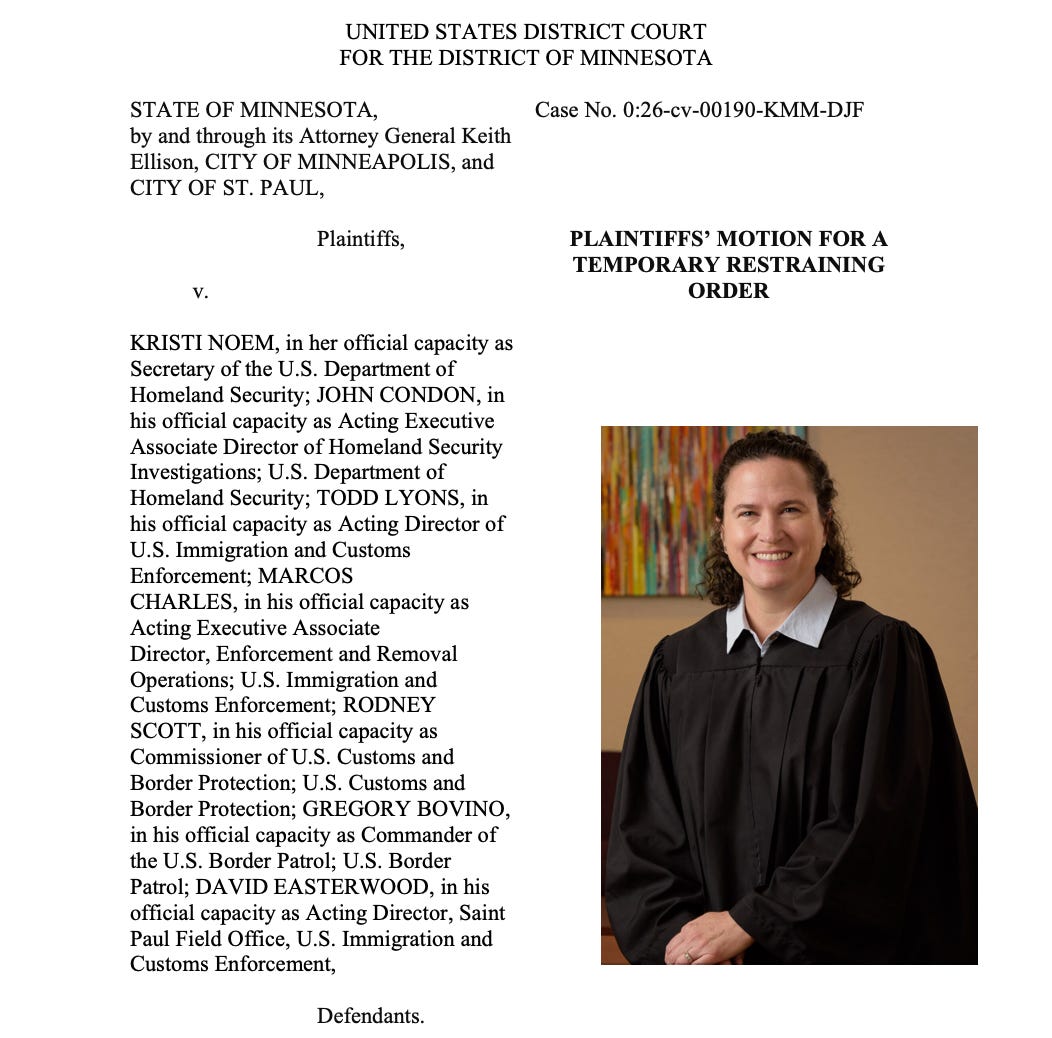
On Monday morning, Minnesota’s lawyers were in court detailing the “unprecedented” nature of Operation Metro Surge in urging a federal judge to order an end to the deadly Trump administration policy with an argument that the operation violates the state’s sovereignty.
If the operation “is not stopped, right here, right now,” Minnesota Attorney General’s Office Special Counsel Brian Carter told U.S. District Judge Kartherine Menendez that he didn’t think anyone who is seriously looking at what is going on “can have much faith in” what is going to happen in America in the future.
Coming just two days after federal immigration agents killed Alex Pretti, Menendez, a Biden appointee, had probing questions for Carter and the Justice Department lawyer representing the administration, Brantley Mayers.
A key reason for her caution with the case, throughout arguments, and even with a request for supplemental briefing after the arguments was made clear in the hours after the arguments were concluded.
An appeals court ruling
Judge Menendez previously entered a classwide injunction setting limits on the Trump administration’s treatment of protesters and observers during the surge in a case alleging First and Fourth Amendment violations based on what has happened over the past month in the Twin Cities.
Before the close of business on Monday, however, a three-judge panel of the U.S. Court of Appeals for the Eighth Circuit stayed that injunction pending appeal. (A panel previously administratively stayed the injunction on January 21, so the injunction had not been in effect over the weekend.)
The panel on Monday held that the federal government was likely to succeed because “the grant of relief to such a broad uncertified class is just a universal injunction by another name“ — an alarming overreading of this past June’s CASA Supreme Court decision — and because “the injunction is too vague.”
In doing so, the panel according also rejected the request from the plaintiffs — made following the killing of Pretti — for the panel to lift the administrative stay.
The unsigned, per curiam opinion was issued for Judge Bobby Shepherd, a George W. Bush appointee, and Judge David Stras*, a Trump appointee, as well as — in part — Judge Raymond Gruender, another George W. Bush appointee.
Gruender dissented in part, disagreeing with the post-CASA part of the court’s order and writing, “[W]e are not the court to resolve [this question], especially not on an emergency motion for a stay pending appeal.“
He also disagreed that a stay should have been entered as to the part of Menendez’s injunction “prohibit[ing] Covered Federal Agents from ‘[u]sing pepper-spray or similar nonlethal munitions and crowd dispersal tools against persons who are engaging in peaceful and unobstructive protest activity.’”
The three Republican appointees are emblematic of the Eighth Circuit — a court made up of 10 Republican appointees and one Democratic appointee. All of the senior status judges are also Republican appointees.
Back to the Monday morning hearing
In the lawsuit filed by Minnesota, Minneapolis, and St. Paul on January 12, the state and cities are seeking a temporary restraining order — which Menendez is considering treating as a request for a preliminary injunction. DOJ is opposing the request.
Of particular concern to Menendez on Monday was a letter sent from Attorney General Pam Bondi to Minnesota Governor Tim Walz in the aftermath of Saturday’s killing of Alex Pretti by federal immigration agents that provided three steps — “common sense solutions,“ Bondi wrote, to “help bring back law and order to Minnesota.” The steps, however, included items far afield from the direct concerns that allegedly prompted Operation Metro Surge.

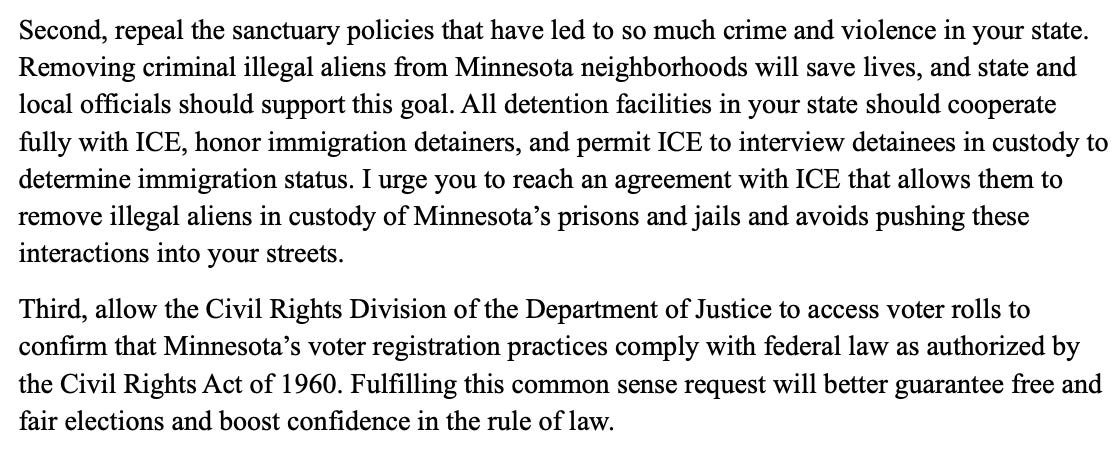
Summing up her concerns to Brantley Mayers, the Justice Department lawyer defending the Trump administration on Monday, Menendez asked, “How am I supposed to interpret [Bondi’s letter]” other than that if the state and cities change these policies, “then this will end?”
In a back and forth, Mayers argued that even if those policy changes led to an end of the surge, it wouldn’t be a violation of the Tenth Amendment — which protects states and individuals’ rights — because the stated reason for the surge is a valid enforcement of federal law.
This was not a winning argument. Noting ongoing litigation over all three proposed steps, Menendez continued, “Is the executive trying to achieve a goal through force that it can’t achieve through the courts?”
To that end, Menendez ordered follow-up briefing from the Trump administration, directing a response to plaintiffs' argument that the purpose of Operation Metro Surge is to punish plaintiffs for their sanctuary policies, coerce policy changes, compel information sharing, and cause more local resources to be expended on keeping people detained for immigration purposes.
That brief is due by 6 p.m. CT Wednesday, meaning a ruling isn’t expected until sometime after that is filed.
Although Menendez’s questioning to DOJ was tough, things weren’t easy for Minnesota, the Twin Cities, and Carter, either.
For Menendez, the main question to Carter was: Where is the line?
What if there were as many agents in the Twin Cities, but there was no question about whether they were operating lawfully? What if there were a far fewer number of agents, but they were acting as plaintiffs allege is going on under the surge? How many agents is enough to violate the Tenth Amendment?
Carter fought back against her hypotheticals at first — calling them “counterfactuals” — but eventually settled on what amounted to an argument that there are no cases directly on point because no one has tried this before.
Menendez told Carter, "I don't know what the line is,” asking him “Is it the scope? Is it the illegality?"
When Carter responded that it violates the Tenth Amendment "when pressure turns into compulsion," Menendez replied, "That's a great phrase," but asked what that actually means for her as a judge.
Carter said, “Ultimately, it's a factual question” of where to draw the line, but the extreme nature of the Trump administration’s actions in Minnesota meant the court would not need to draw that line to hold that the administration has far overstepped the line — wherever it might be — here.
To that, when discussing the remedy if she did decide in the plaintiffs’ fact, Mayers argued that the plaintiffs would need to show "how many officers and when the line was crossed" in order to craft a remedy.
To that, Menendez pushed back: "You all named it [Operation Metro Surge].” If she issued an order to stop the surge, she said, presumably the federal government knows its scope.
Mayers insisted that would be difficult to implement.
It was a cautious morning — followed by more caution with the request for supplemental briefing. And though the need for quick action was urged by the plaintiffs, in addition to wanting to get it right, Menendez knows the eventual appeal of her ruling will go to the Eighth Circuit.
At the same time, the request could be overtaken by events.
In addition to the Eighth Circuit order in the First and Fourth Amendment case, as the business day came to a close, there was big news regarding the Border Patrol’s Gregory Bovino — the man who the Trump administration chose to make the face of its city-by-city extremist immigration enforcement and a man who eagerly took on that role.
The Fox News reporter who has regularly been given key leaks from federal officials regarding the Minnesota operation announced that “multiple sources confirmed … Border Patrol commander Greg Bovino & some, not all Border Patrol agents, will be leaving the state of Minnesota imminently.”
The Associated Press soon thereafter confirmed that report.
Update, 7:25 p.m.: Later reporting from The Atlantic suggested the change could be even more sharp:
Gregory Bovino has been removed from his role as Border Patrol “commander at large” and will return to his former job in El Centro, California, where he is expected to retire soon, according to a DHS official and two people with knowledge of the change.
Tom Homan, Trump’s border czar, is to arrive in Minneapolis on Tuesday and is reportedly taking charge of ICE in the region.
Update, 9:30 p.m.: The administration’s effort appears to be aimed at removing Bovino from the public story immediately. Per CNN:
The Department of Homeland Security also suspended Bovino’s access to his social media accounts effective immediately, according to a source familiar with the matter.
It’s not clear what difference all of this will make to implementation of policy on the ground — and it certainly doesn’t solve the problem — but it is clear that senior administration officials realized, or were told, that they had to do something.
* = The wrong judge’s name was included initially. It was corrected at 8:10 p.m.
Closing my tabs
For those who don’t know what this is, it’s my effort to give a little thank you to paid subscribers. “Closing my tabs” is, literally, me looking through the stories and cases open — the tabs open — on my computer and sharing with you all some of those I was unable to cover during the week but that I nonetheless want to let you know that I have on my radar. Oftentimes, they are issues that will eventually find their way back into the newsletter as a case discussed moves forward or something new happens that provides me with a reason to cover the story more in depth.
This Monday, these are the tabs I am closing:
