

Mifepristone is back at the Supreme Court in case over mailing the medication abortion drug
After a Fifth Circuit ruling Friday that would end mailing of the mifepristone, drugmakers asked the justices to act immediately to keep the FDA policy allowing mailing in place.

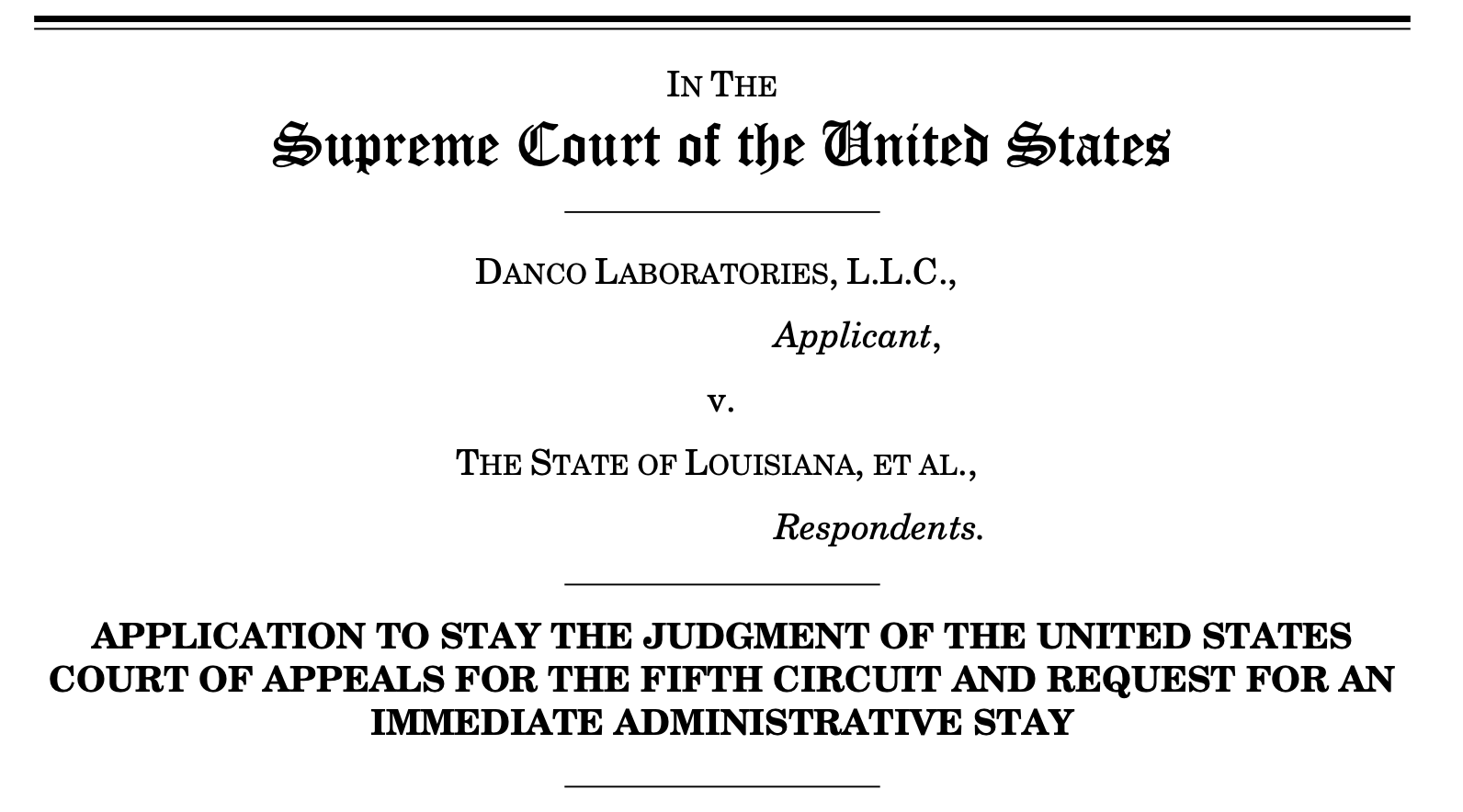
On Saturday, the makers of Mifeprex went to the U.S. Supreme Court, asking it to immediately block the Friday ruling from the U.S. Court of Appeals for the Fifth Circuit that would block a U.S. Food and Drug Administration rule nationwide that allows the mailing of the medication abortion drug.
In Saturday’s filing at the Supreme Court, the Hogan Lovells’s lawyers for Danco Laboratories argued that the appeals court ruling by Judge Kyle Duncan “is not an application of neutral principles,” but rather “an abdication of lower courts’ duty to adhere to decisions of th[e Supreme] Court.”
The Fifth Circuit’s ruling, they wrote, “injects immediate confusion and upheaval into highly time-sensitive medical decisions—and it forces Danco, FDA, certified Mifeprex providers, patients, and pharmacies all to guess at what is allowed and what is not.“
[UPDATE, 6:10 p.m.: GenBioPro, the maker of generic mifepristone, is also at the Supreme Court.
GenBioPro asked for the court to vacate the Fifth Circuit’s order, or stay it.
Additionally, as with the Danco application, they alternatively asked for the Supreme Court to immediately take the case up on the merits.]
[UPDATE, May 4:
Law Dork will have more as circumstances warrant.]
The case involves not the original approval of mifepristone — or, not directly, the other recent case challenging mifepristone — but, rather, the 2023 Risk Evaluation and Mitigation Strategies (REMS) that the FDA put in place for the prescription and use of mifepristone. In the 2023 REMS, among other changes, the FDA ended the in-person dispensing requirement for the drug, allowing it to be mailed.
In a lawsuit filed in October 2025, Louisiana claimed that it was facing harm because, “[t]hrough the 2023 REMS, the Biden Administration attempted to undermine Dobbs by facilitating the mailing of mifepristone into every pro-life state.“
The lawsuit came after the U.S. Supreme Court unanimously rejected another lawsuit out of the Fifth Circuit challenging the drug, with the Supreme Court holding that the challengers there — anti-abortion doctors and medical associations — lacked standing to bring the suit. But, within the Fifth Circuit, the appeals court had, earlier in that case, agreed with a lower court that the in-person dispensing requirement should be reinstated. Because the Supreme Court had only ruled on standing, it had not directly addressed — let alone rejected — the Fifth Circuit’s 2023 reasoning.
After finding that Louisiana had standing to bring the challenge, unlike the medical organizations and providers at issue in the prior case, the district court in Louisiana’s challenge found that the state is likely to succeed in its challenge to the 2023 REMS.
Nonetheless, U.S. District Judge David Joseph, a Trump appointee, declined to immediately block the rule under the Administrative Procedure Act (5 U.S.C. 705)1 in large part because of the FDA’s own ongoing review of the mifepristone REMS — itself an action that has altered the federal government’s litigation posture during the Trump administration and raised questions about what the administration is going to do regarding access to the drug.
Here, in part because of that and because of the nationwide effect of blocking the 2023 REMS during litigation, Joseph wrote:
Given the length of time the 2023 REMS has been in effect, reliance interests on that scheme throughout the nation, the sweeping effect any remedy would have across states with differing abortion laws, and most importantly, FDA’s recognition of its own shortcomings in regulating mifepristone and ongoing fulsome review of the mifepristone REMS, the Court will afford the agency a timelimited period of deference to complete its review and carry out the responsibilities assigned to it by Congress.
Louisiana appealed the ruling to the Fifth Circuit, and, on Friday, a three-judge panel of all Republican appointees disagreed with Joseph’s ruling.
The opinion by Duncan, another Trump appointee, joined by Judges Leslie Southwick (George W. Bush) and Kurt Engelhardt (Trump), declared there was no need for such judicial humility.
After holding that Louisiana had shown both “sovereign” and financial injury sufficient to have standing to challenge the 2023 REMS and that the reasoning of the prior appeals court opinion applied here as to the question of Louisiana’s likelihood of success on the merits, the appeals court parted ways with the district court.
First, Duncan — who worked at the Becket Fund for Religious Liberty and on several key cases that expanded religious people’s legal protections under the law before becoming a judge — concluded about the “balance of harms” that courts analyze when considering whether to grant interim relief:
Danco’s potential financial losses pale beside Louisiana’s sovereign interest in its laws protecting the unborn and the public’s interest in not exposing women to unsafe medical procedures.
Then, dismissing the reliance interests that Joseph had carefully assessed, he wrote:
The district court raised various concerns about the equities and public interest. We do not find that any of them tip the balance against Louisiana, however.
Although Duncan mentions three of those “various concerns,” he did not once mention the reliance interests of people across the nation that have developed over the five years since the end of the in-person dispensing requirement. (Although the 2023 REMS is challenged here, the policy actually began in 2021 with an agency pandemic-related notice that it would not be enforcing in-person dispensing requirement.)
The closest Duncan came to acknowledging the effect of the appeals court’s Friday decision is a simple sentence quoting Joseph’s acknowledgement of humility — “It is true, as the district court noted, that a § 705 stay ‘would, as a practical matter, have a nationwide effect.’“ — before wiping it aside and doing just that.
Less than three hours after the Fifth Circuit issued its decision, Danco Laboratories filed a motion at the Fifth Circuit seeking a temporary administrative stay so that it court seek relief from the Supreme Court.
With no word from the Fifth Circuit, Danco went to the Supreme Court on Saturday.
“It bears emphasis how unprecedented the Fifth Circuit’s order is,” the lawyers wrote. “Never before has a federal court purported to immediately enjoin a several years’ old drug approval; restrict a distribution system for that drug that manufacturers, providers, patients, and pharmacies have all been using for years; or reinstate conditions that FDA determined do not meet the mandatory statutory criteria.”
Danco’s lawyers, led by Hogan Lovells partner Jessica Ellsworth, argued that the case should have been dismissed for the same reasons that the Supreme Court unanimously rejected the prior challenge: Louisiana lacks standing.
They wrote:
Like the Alliance plaintiffs, Louisiana is not required to “prescribe or use mifepristone” or to “do anything or to refrain from doing anything” as a result of FDA’s actions. … In fact, Louisiana largely prohibits the termination of pregnancy. The Fifth Circuit nevertheless found that Louisiana has standing to challenge FDA’s 2023 changes to mifepristone’s conditions of use based on “$92,000 it paid in Medicaid costs from two women who needed emergency care in 2025 from complications caused by out-of-state mifepristone.” … But this Court rejected the idea that a plaintiff can claim Article III standing based on an assertion that “FDA’s relaxed regulation of mifepristone may cause downstream economic injuries.”
In explaining the problems created by the Fifth Circuit’s ruling, the application poses three questions in the introduction:
What happens when patients arrive for scheduled appointments this weekend and beyond, or walk into pharmacies in New York, Minnesota, Washington, and many other states today to obtain Mifeprex that was prescribed by a provider yesterday? What should a patient do if she cannot obtain an in-person appointment immediately? And what are Danco’s obligations as Mifeprex’s sponsor?
As such, they wrote, “The resulting chaos for patients, providers, pharmacies, and the drug-regulatory system is a quintessential irreparable harm that underscores the need for emergency relief from this Court.”
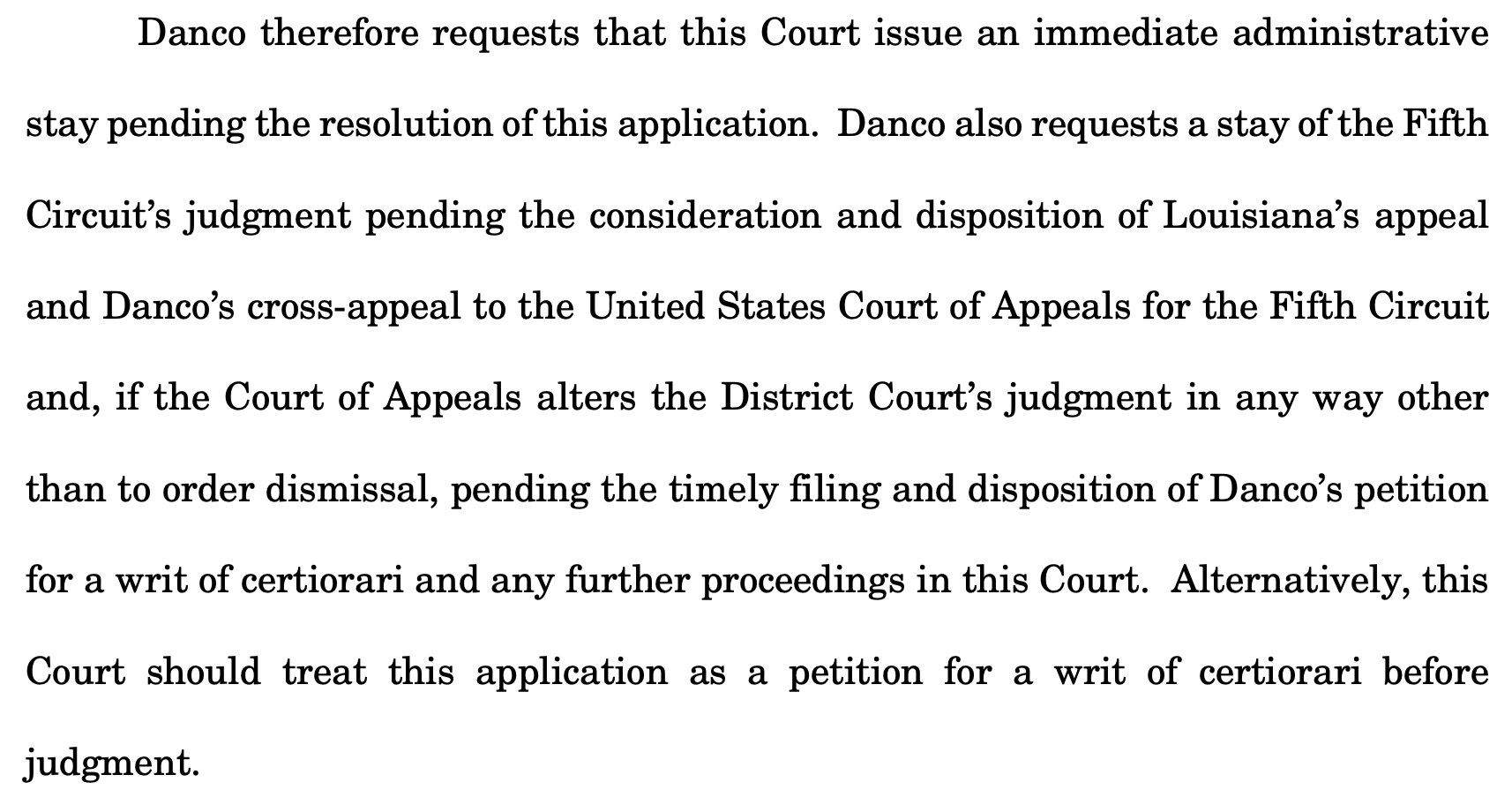
The company asked the Supreme Court, in effect, to block the Fifth Circuit from being able to put a ruling in this case into effect until the Supreme Court itself has a chance to issue a ruling — either by staying the effect of any ruling until then or by the Supreme Court taking up the case now.
Law Dork will have more on this litigation as circumstances warrant.
In an Administrative Procedure Act case like this one, the remedy is to stay and then vacate the rule — which would have nationwide effect. Despite the Supreme Court’s ruling last term regarding “universal injunctions,” there are actually still multiple ways for challengers to get a ruling with nationwide effect, the APA being one of them.
They, the pious right, keep dangling glittering prizes before SCOTUS, don’t they? Here’s abortion, here’s gerrymandering, here’s …
Thank you for providing current info on most vital legal issues. I always know that you’ll have trustworthy & current info. Given what is happening, it’s also frequently infuriating.