


BREAKING UPDATE, JULY 10:
U.S. District Judge James Boasberg on Friday, from D.C., denied the request from the World Professional Association for Transgender Health, or WPATH, for a temporary restraining order blocking the Federal Trade Commission from proceeding with its enforcement action against WPATH in the Northern District of Texas.
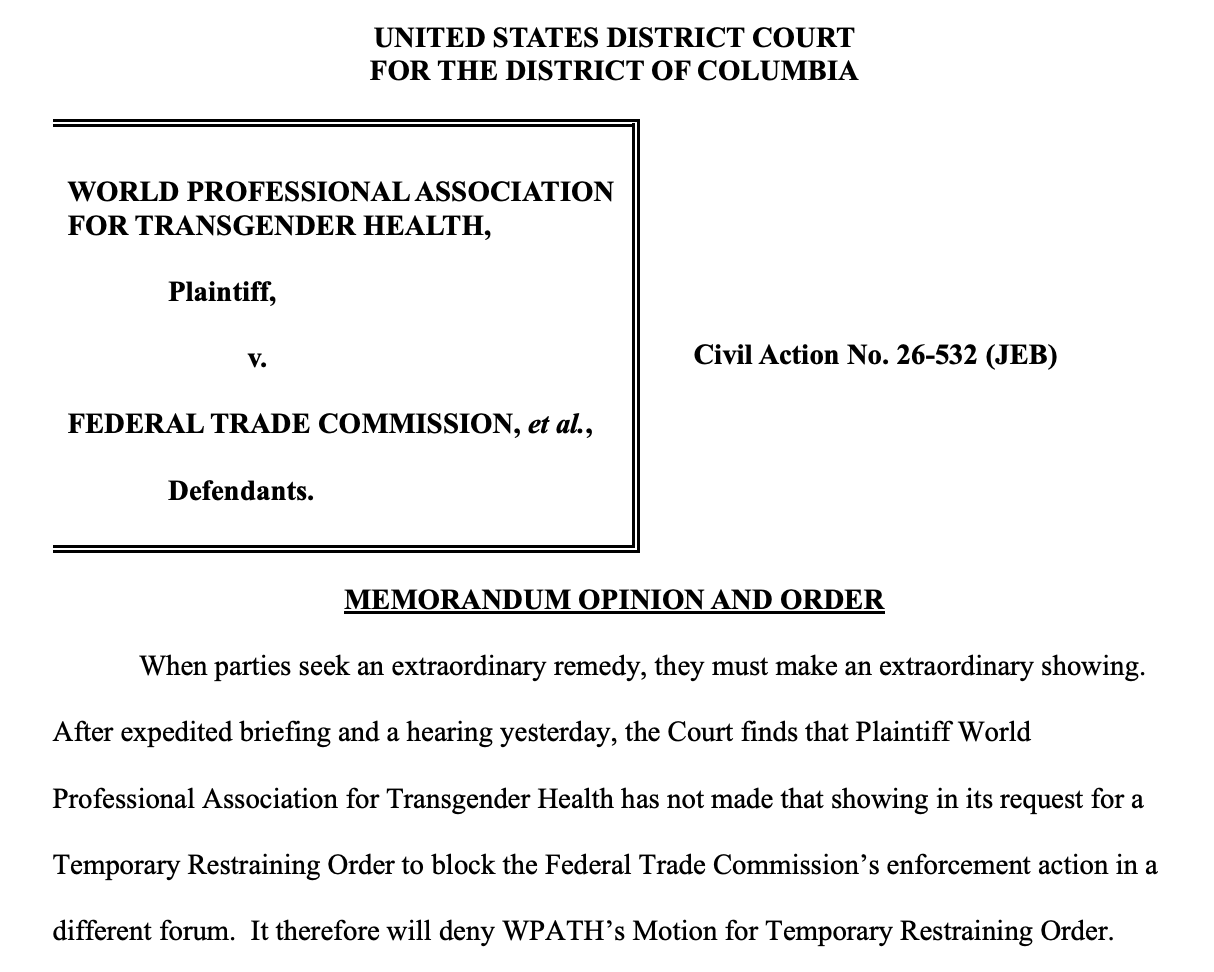
Boasberg found that WPATH had not shown that the Texas action needs to be blocked to protect Boasberg’s jurisdiction over an order he issued previously protecting WPATH from needing to respond to an FTC Civil Investigative Demand or because that D.C. case and Texas action would be sufficiently duplicative.
Additionally, Boasberg found that that WPATH had not shown they will face irreparable harm if forced to litigate related matters in both D.C. and Texas.
The ruling is not a ruling on the merits of the FTC’s action filed in Texas, and Boasberg did not address that. It is, instead, solely an order on WPATH’s request to block the FTC from proceeding with the action in Texas.
That said — and the reason why this request was so hard-fought by both parties — the FTC action in Texas is before U.S. District Judge Reed O’Connor, a far-right judge with a history of anti-LGTBQ rulings. Further still, any appeals of O’Connor’s rulings go to the U.S. Court of Appeals for the Fifth Circuit, one of the more far-right appeals courts in the nation.
Given prior agreement between Boasberg and O’Connor on consideration of dueling requests going into the Fourth of July weekend, the parties are now to update O’Connor of Boasberg’s ruling.
O’Connor will then be free to proceed with considering the FTC case as he wishes.
This updated report was originally posted at 4:45 p.m. July 10 and expanded after initial publication, with the final edit at 5:15 p.m. July 10.
Original report:
On Thursday afternoon, U.S. District Judge James Boasberg heard arguments in the federal courthouse in Washington, D.C. over whether he should temporarily block the Federal Trade Commission from continuing a lawsuit in the Northern District of Texas targeting the World Professional Association for Transgender Health, or WPATH.
It was the latest high-profile dispute over the Trump administration’s efforts to “end” the provision of gender-affirming medical care for transgender minors even in states where such care is allowed or even explicitly protected by taking actions against those providing or supporting such care.
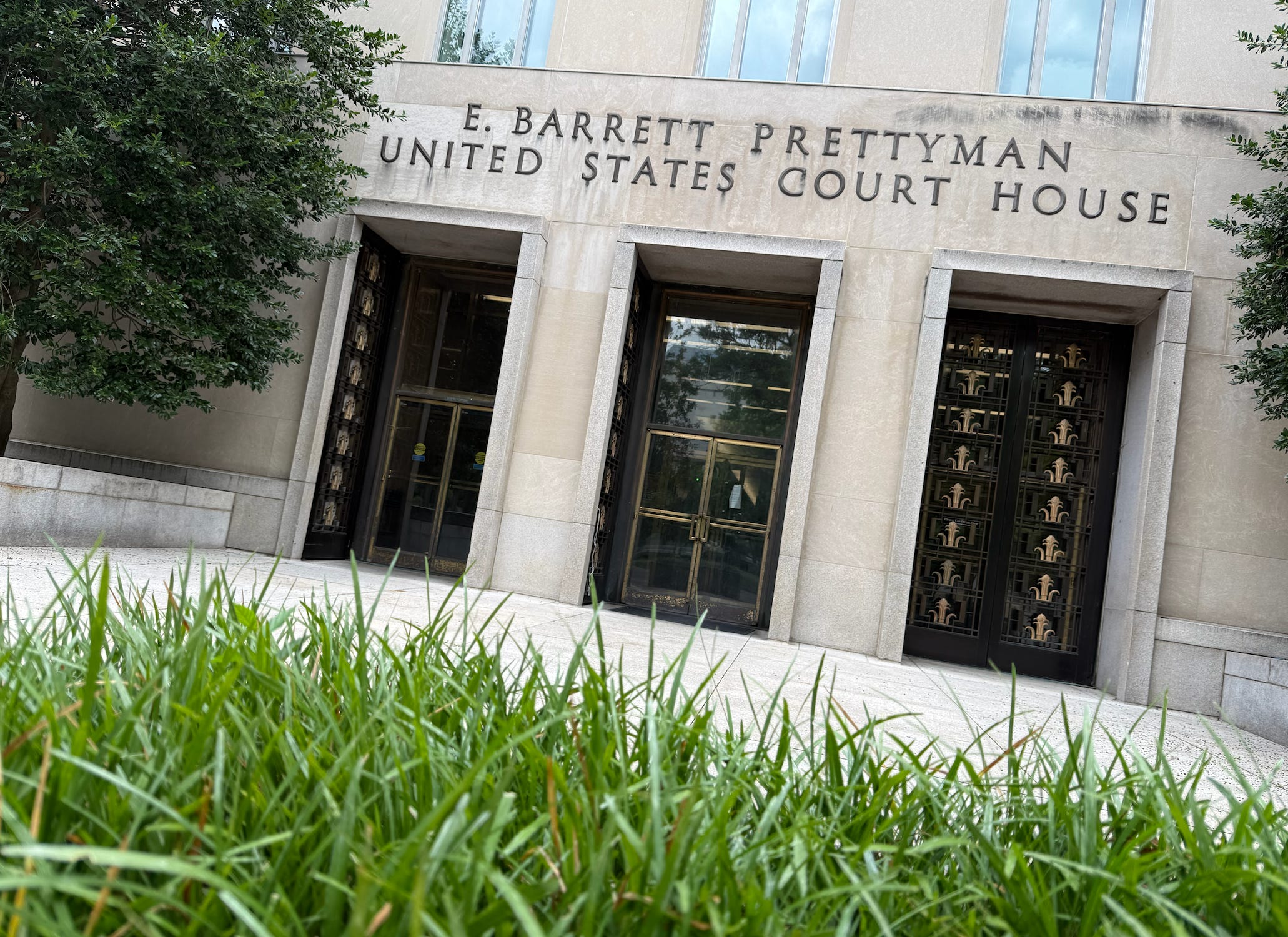
After a hearing that lasted about an hour in his second-floor courtroom at the E. Barrett Prettyman U.S. Courthouse on Pennsylvania Avenue in between the Capitol and White House, Boasberg said he would issue a decision on Friday.
While sympathetic to WPATH’s concerns — he had already ruled for the group once in an opinion calling the FTC’s efforts likely retaliatory — Boasberg also expressed skepticism as to whether WPATH needing to litigate the questions in two different courts constitutes the “irreparable harm” needed for such emergency relief.
The questions before Boasberg, an Obama appointee, addressing two overlapping lawsuits — WPATH v. FTC, in front of him, and FTC v. WPATH, in Texas — involve important issues of federal agency authority, as Jonathan Cohen argued for the FTC, and the power of someone being targeted by an agency to challenge those efforts when they are improper, as Caleb Hayes-Deats argued for WPATH.
As cases and specifics multiply across the country, however, the bigger picture is whether the federal government can go after a discrete minority for unequal treatment repeatedly and on multiple fronts, forcing the targeted group — here, trans kids and those supporting them — to win in every challenge, while the federal government will just keep using its resources and authorities to try another angle.
Here, all of those angles are aimed at making it impossible for those medical providers and associated organizations supporting trans kids — and, potentially, all trans people — to keep doing so.
Thursday’s hearing was before Boasberg because, after receiving a Civil Investigative Demand from the FTC in January, WPATH brought a lawsuit challenging that effort in D.C.
In early May, Boasberg issued a preliminary injunction blocking the FTC from “implementing or enforcing its previously issued Civil Investigative Demand” as to WPATH or, in a companion case, the Endocrine Society. In the pair of opinions, Boasberg concluded, as explained in the Endocrine Society opinion:
The Court believes that Plaintiff has established a likelihood that the CID was issued in retaliation for its First Amendment activity and that the FTC’s purported reason for its investigation bears little relationship to the extensive demand it issued.
Specifically as to WPATH, Boasberg wrote that “WPATH has presented circumstantial evidence sufficient to establish that retaliation for its protected speech motivated the FTC’s issuance of a CID.”
Following those May 7 injunctions, the FTC did not appeal. Instead, at least as to WPATH, on June 16 a WPATH member was served with a grand jury subpoena from the Northern District of Texas. The next day, the FTC, joined by four states, filed a civil lawsuit against WPATH. The case ended up before U.S. District Judge Reed O’Connor, a far-right George W. Bush appointee. That same day, the FTC withdrew its civil investigative demand as to WPATH. Days later, on June 22, the agency informed Boasberg.
On June 30, WPATH asked Boasberg to block the FTC’s Texas-based effort, arguing that “the Texas litigation raises the same issues as this case, involves the same parties, and implicates the same First Amendment rights that WPATH’s complaint seeks to protect,“ as well as “to ‘prevent the frustration’ of the preliminary injunction the Court has already issued“ in the D.C. case.
Although the parties initially discussed a plan for proceeding on that temporary restraining order motion and submitted a jointly signed proposed briefing schedule to Boasberg, the FTC then went to O’Connor, asking him to issue his own TRO blocking WPATH from continuing its challenge to the Texas case before Boasberg. WPATH then filed a second TRO request with Boasberg, noting the FTC’s Texas action.
Ultimately, and as covered previously at Law Dork, Boasberg and O’Connor acted in “consultation” with one another, concluding on July 3 that Boasberg would first consider the June 30 TRO request before O’Connor took further action.
At Thursday’s hearing, Boasberg made it clear that he and, presumably, O’Connor did not appreciate being put in this position, with Boasberg noting that the parties’ actions “left it to [him] and O’Connor” to figure out how to handle the piling of TRO requests.
Ultimately, Boasberg went first, with the FTC filing its opposition to WPATH’s June 30 TRO request on July 6, arguing that “[t]here is no colorable argument that the Enforcement Action [in Texas] is the ‘same’ as the CID Action“ challenged before Boasberg.
At Thursday’s hearing, however, Hayes-Deats countered that if WPATH were to succeed in its case before Boasberg, there would be “nothing left to decide in Fort Worth” because one of their requests in the case is for a ruling that the FTC does not have investigative authority over WPATH.
As such, he explained, the cases are sufficiently duplicative that Boasberg should block the Texas action.
In addition to the irreparable harm question, one of the areas where Cohen got the most traction from Boasberg was with concerns about the implications of a decision here for other agency investigations — even outside of the FTC.
As Boasberg asked Hayes-Deats, if this is allowed here and works for WPATH, would anyone being investigated “go to a favorable forum“ to try and cement in jurisdiction there.
Although Hayes-Deats attempted to note the FTC’s headquarters being in D.C. as a logical reason WPATH brought their lawsuit in D.C., Boasberg countered that it appeared that the decision was “somewhere on the spectrum between gamesmanship, tactics, and strategy.”
When, in rebuttal, Hayes-Deats expressed his concern about the FTC’s “blatant forum shopping” in going to Texas, Boasberg made clear, “I’m not missing that point,” either.
Law Dork will have more on Friday when there is a decision.
*sigh
Thank you for this in depth coverage!!!