

Two judges on the Fifth Circuit gave Trump exactly what he wants to enact mass detentions
On Friday night, Judges Edith Jones and Kyle Duncan split with more than 150 judges who have ruled against the Trump admin's unilateral, harsh interpretation of a 1996 law.

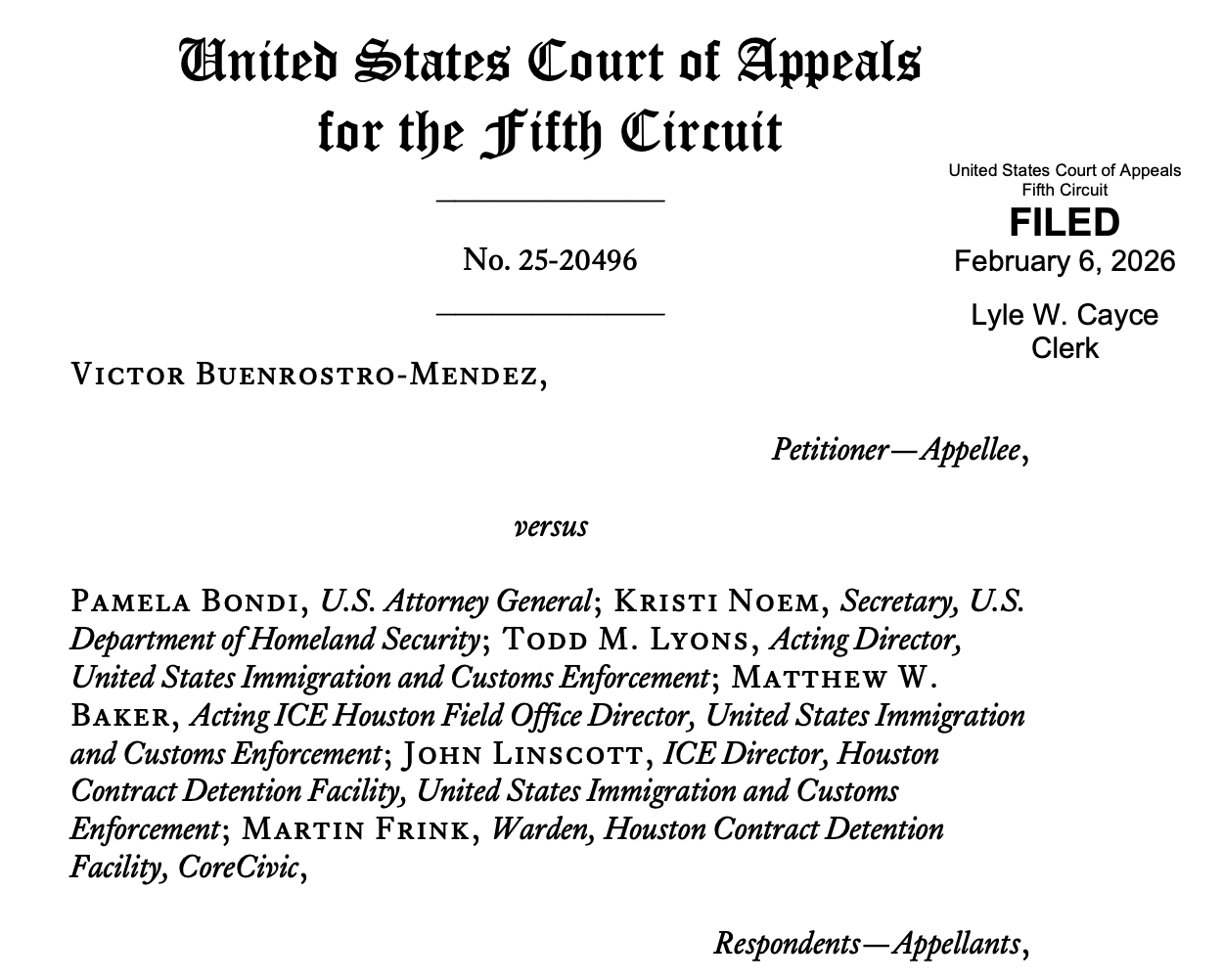
The U.S. Court of Appeals for the Fifth Circuit released a hastily decided ruling on Friday night, obliterating a key understanding of federal immigration law just three days after arguments in the case and giving the Trump administration a powerful tool — for now — to enact mass detentions as part of its mass-deportation program.
As covered at Law Dork on February 4, the Trump administration issued an internal policy change in 2025 that represented a unilateral shift in how people already in the United States but still without legal status would be treated when the government is seeking to deport them.
Prior to now, the understanding of the Illegal Immigration Reform and Immigrant Responsibility Act of 1996 (IIRIRA) has been that people present in the country who were never legally admitted here are subject to a section of law that allows release and requires bond hearings (absent exceptions in the law) if the government seeks to deport them — and not a different section of law that requires mandatory detention. That second section has been applied only to “arriving aliens,” which just so happens to be the language used in that title of the U.S. Code.
Not so, said the Trump administration, which argues that everyone who was never legally admitted to the country is subject to the mandatory detention provision. The bond-hearing section, they argue, essentially only applies to people who overstay their visas.
Judge Edith Jones, a Reagan appointee, was joined by Judge Kyle Duncan, a Trump appointee, in holding on Friday night that the second Trump administration singularly and correctly decided how the pair of provisions fit together.
Arguments in the case had only been held on February 3 — an extremely quick turn-around in such an important case.
“[W]e conclude that the government’s position is correct,“ the 76-year-old Jones wrote, explaining, “In contrast to past administrations, the current Administration has chosen to exercise a greater portion of its authority by treating applicants for admission under the provision designed to apply to them.“
Jones and Duncan — two of the four most extreme-right judges on the far-right court — ignored or pushed aside everything that everyone — presidents and past administrations, Congress, and the courts — had done since the law’s 1996 passage to conclude that the Trump administration got it right.
As Judge Dana Douglas, a Biden appointee, wrote in dissent, the majority’s decision is not only wrong, but would “upend this country’s historic immigration practices” — and virtually everyone to consider the question has agreed with Douglas.
As Law Dork covered, district court judges across the board have rejected the Trump administration’s interpretation — more than “160 different judges sitting in about fifty different courts spread across the United States,“ per a count from U.S. District Judge Lewis Kaplan in a November 2025 decision that has been cited across the country in the months since. Only in a dozen of 362 cases identified did the district court judges side with the Trump administration, Kaplan, a Clinton appointee found.
Summing up the legal analysis — the statutory interpretation at issue here — Kaplan found that the Trump administration’s argument failed as to “the ordinary meaning of the statutory text,“ that “[t]he structure of the statute … undercuts or contradicts their position,” that the “statutory history reflects an unbroken chain of granting discretion to immigration authorities to release noncitizens pending final removal decisions,” and that court precedent was in agreement with the above.
A Law Dork review of Kaplan’s list included district judges who sit in the Fifth Circuit appointed by Reagan, George H.W. Bush, Clinton, Obama, Trump, and Biden who all ruled against the Trump administration on this question. Only two judges — both Trump appointees in Louisiana — agreed with the Trump administration’s position.
Beyond that, Douglas explained, “[I]t is simply not plausible that the Congress that enacted IIRIRA intended to give the government the authority and mandate to detain all noncitizens unlawfully present in the United States without bond.” This interpretation “would have required the detention of millions of people” when the law was passed in 1996, she noted, “whereas Congress specifically gave the Attorney General authority to defer” another provision’s mandatory detention requirement because it would have affected “an estimated 45,000 people in total” because “of a recognition that this mandate alone would strain the agency’s limited detention capacity.”
In short, Congress thought a rule requiring the detention of 45,000 people was too much for the agency to handle initially — but now the Trump administration, Jones, and Duncan say that there was also a secret and, until now, ignored requirement that millions of people were to be mandatorily detained.
But, Jones and Duncan were the majority on Friday night’s panel.
The Trump administration’s mandatory detention policy is, for now, the law in Louisiana, Mississippi, and Texas.
More than that, though, since habeas corpus actions need to be filed in the jurisdiction where a person is located, and, as Aaron Reichlin-Melnick wrote on Friday night, this decision “will fuel ICE’s push to transfer people to Texas immediately.“ The same, I would note, would also apply to the Louisiana detention centers often used by the administration over the past year.
All that said, the decision might not stand. It is wrong. And although both the full Fifth Circuit’s 17 judges and the current U.S. Supreme Court are not where one would choose to bring these arguments, it is a bad enough decision — with such dramatic consequences — that there is a possibility that the ruling could be reversed by the full Fifth Circuit sitting en banc or by the Supreme Court.
The ruling is nonsensical and wrong, but it is also particularly horrifying in this moment. The consequences are all the more alarming, building, as it would, on the Supreme Court’s shadow docket order that unleashed Kavanaugh stops, ultimately, across the nation.
Douglas, although not directly addressing that case — Noem v. Vasquez Perdomo — did address her colleagues (and, in turn, the rest of us) regarding the consequences the could — and undoubtedly will, in light of Vasquez Perdomo, result if Friday night’s Fifth Circuit decision stands.
She wrote:
The majority seems to be unable to imagine what it might mean to be detained within the United States without the appropriate proof of admissibility, and, without a bond hearing, to require the services of a federal habeas corpus lawyer to show that one is entitled to release and deserves to see the outside of a detention center again.
This, of course, is the sort of world that judges in Minnesota and elsewhere have been telling us is happening — and that will only, and exponentially, get worse if the Trump administration is allowed to act as it has unilaterally decided it can.
Further, if they are allowed to do this, the Trump administration has made clear that it absolutely will try to implement it on a massive scale — upending families, communities, America — to lock up as many people as they can as quickly as they can before deporting as many of them as they can.
As NBC News reported on February 5, the Department of Homeland Security is purchasing “mega warehouses” across the country. The report, from Laura Strickler and Julia Ainsley, detailed:
The proposed centers are so large that some could house as many as 8,000 detainees at once, according to a DHS spreadsheet of more than 20 potential locations that was verified by NBC News. The largest federal prison in the U.S., for example, has roughly 4,000 inmates.
One of the three warehouses identified in the report as already having been purchased is in San Antonio, Texas — within the Fifth Circuit. It is “nearly 640,000 square feet,” and a local NBC report from Jaie Avila stated that the warehouse “will be turned into a 1,500 bed ICE detention center.“
Pulling these stories together, Douglas is not just warning her colleagues of the possible consequences of the ruling with a parade of horribles — worst-case scenarios that could happen far down the line.
Rather, Douglas told them — and us — what is already happening and what the Trump administration will implement on a massive scale if Friday’s ruling stands.
“Mega warehouses” — indoor concentration camps.
I’m without words for the steam expanding off the top of my head.