

Fifth Circuit to consider whether the federal ban on firearm possession violates the Commerce Clause
The order came a month after Justice Thomas asked for just such a case. Also: A Hawaii Supreme Court justice speaks out. And, for paid subscribers: Closing my tabs.

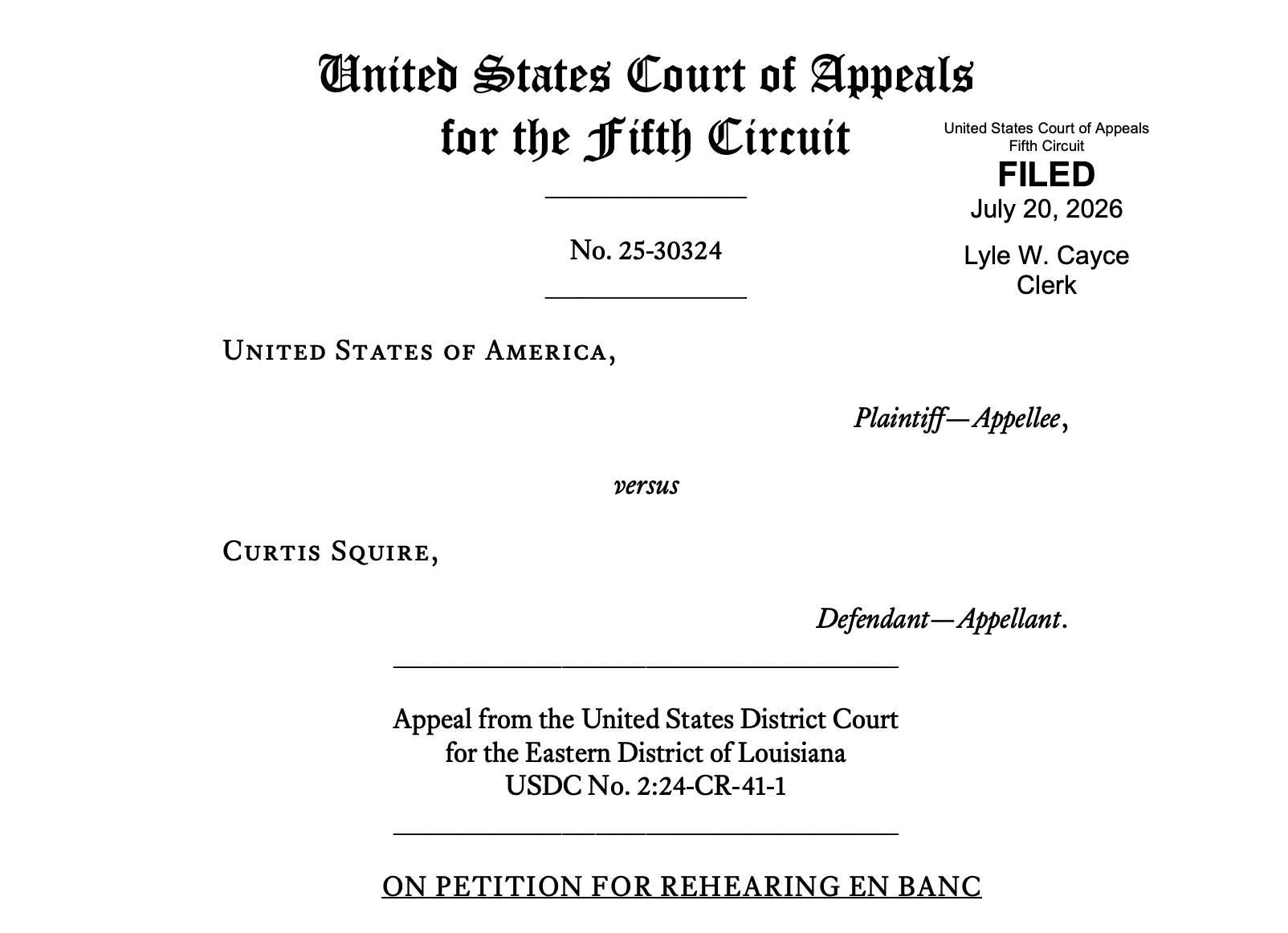
The U.S. Court of Appeals for the Fifth Circuit on Monday agreed to have the full court review the constitutionality of the federal ban on firearm possession by a person previously convicted of a felony.
It will not, however, be a Second Amendment argument. Instead, the court will be considering whether the ban violates the Commerce Clause.
If you’re confused, don’t worry. Judge Stephen Higginson has you covered.
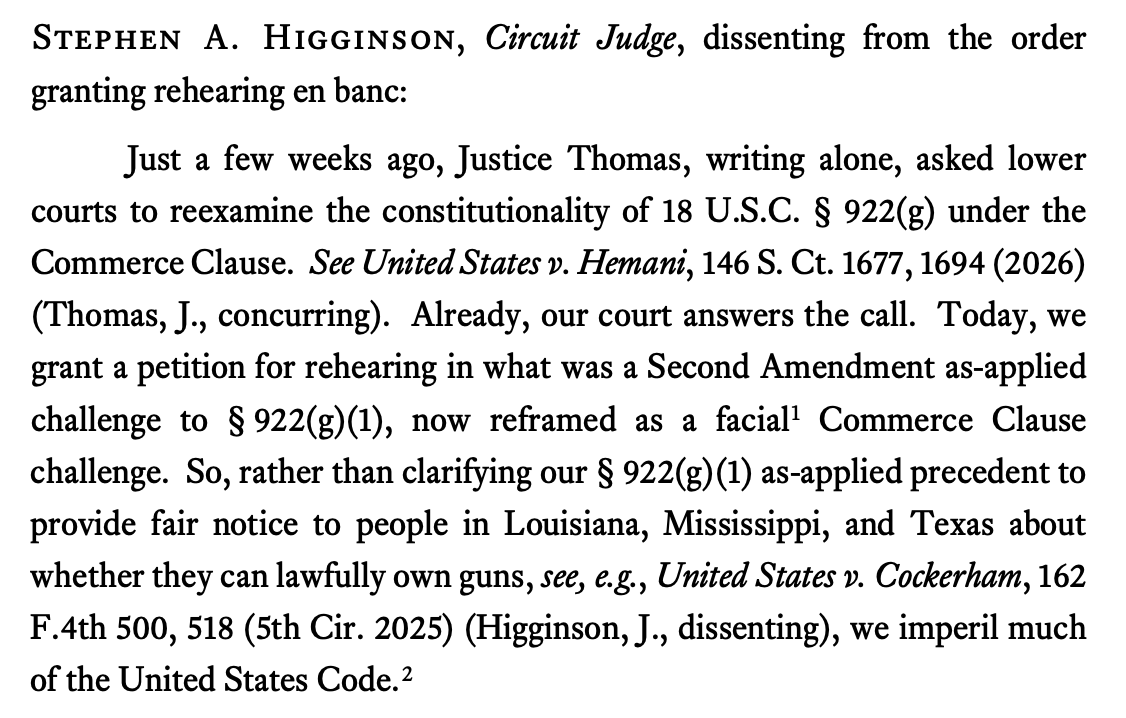
After a panel upheld the law against a Second Amendment challenge in early June, the defendant, Curtis Squire, on June 16 asked for the full court to rehear the matter and consider a Commerce Clause argument that the panel had noted was “foreclosed” by circuit precedent.
Two days later, the Supreme Court handed down its decision about a different part of the law — 18 U. S. C. §922(g)(3) — that had barred occasional marijuana users from possessing firearms. In holding that that particular use of the law is unconstitutional under the Second Amendment, as I wrote at the time, Justice Clarence “Thomas, unsurprisingly, would go further. He wants a Commerce Clause case challenging all of §922(g).“
At the end of June, the federal prosecutor’s office in New Orleans opposed the request for en banc review, noting, “The panel correctly held that Squire’s Commerce Clause challenge was foreclosed. Squire fails to show the panel’s decision conflicts with a decision of this Court, the Supreme Court, or any other court of appeals.“
On Monday, a majority of the Fifth Circuit announced they were going to consider the matter anyway. (Thanks to Gabriel Malor for noting the order.)
As Higginson, an Obama appointee, made clear, this is a wild escalation of how quickly courts are seeking to move the law rapidly to the right. As I put it on Bluesky, they're apparently not even waiting for a new case to take up Thomas's reactionary requests any longer.
Centering state supreme courts
On July 17, Slate’s Mark Joseph Stern highlighted a July 15 Hawaii Supreme Court opinion that is getting some attention for its treatment of the U.S. Supreme Court.
The opinion from Justice Todd Eddins is an important decision about how courts — specifically in the case, Hawaii’s Constitution — should treat challenges to scientific evidence that had been relied upon at a trial but was later discredited. The court held that it should be treated as false evidence, not “new” evidence. The ruling makes overturning a conviction secured using that evidence easier.
But, and as Stern detailed, Eddins took a disagreement with the concurring justices to raise “a much broader critique“ about its suggested reliance on the U.S. Supreme Court.
As Stern explained:
Eddins accused the concurrence of trying to graft the U.S. Supreme Court’s interpretation of federal due process onto the Hawaiʻi Constitution, then widened the lens to explain why Hawaiʻi should reject SCOTUS’s conception of more than just due process. “What this court has done to constitutional rights, democratic institutions, and the rule of law,” Eddins wrote, “explains why Hawaiʻi’s Constitution takes no instruction from it.”
Eddins continued, and I strongly suggest that anyone interested check it out at pages 70-80 of the opinion. For our purposes, I want to pull out one quote from Eddins that explains why he was doing this:

Reading this, I was struck by — pared away from the specificity of the moment — how much this passage reminded me of the work of another jurist: Judge Jeff Sutton.
The judge on the U.S. Court of Appeals for the Sixth Circuit, who is taking senior status on October 1, literally wrote the book on “State Constitutional Law” (and taught me about it while I was in law school).
As the summary of the casebook notes, “A central theme of the book, explored in the context of a variety of constitutional guarantees, is that state constitutions provide a bountiful source of rights independent of the federal constitution ….“
Although Sutton and Eddins undoubtedly would disagree on how those rights are interpreted, they both, surely, would agree on the importance of that judgment being an independent one.
After reviewing the actions of the 6-3 U.S. Supreme Court, Eddins wrote, “That’s not all life tenure and zero accountability have produced lately. But it’s enough,” concluding, “Article I, section 5 [of the Hawaii Constitution] needs no part of this. The Hawaiʻi Constitution was built to stand on its own. And so it does.“
Closing my tabs
For those who don’t know what this is, it’s my effort to give a little thank you to paid subscribers. “Closing my tabs” is, literally, me looking through the stories and cases open — the tabs open — on my computer and sharing with you all some of those I was unable to cover during the week but that I nonetheless want to let you know that I have on my radar. Oftentimes, they are issues that will eventually find their way back into the newsletter as a case discussed moves forward or something new happens that provides me with a reason to cover the story more in depth.
This Monday, these are the tabs I am closing:
