

DOJ is [not?] dropping its appeals of losses in the law firm order cases. What is going on?
Update: DOJ reverses course, seeking to keep the appeals going. And: SCOTUS heard arguments over a federal law banning firearm possession by users of illegal drugs.

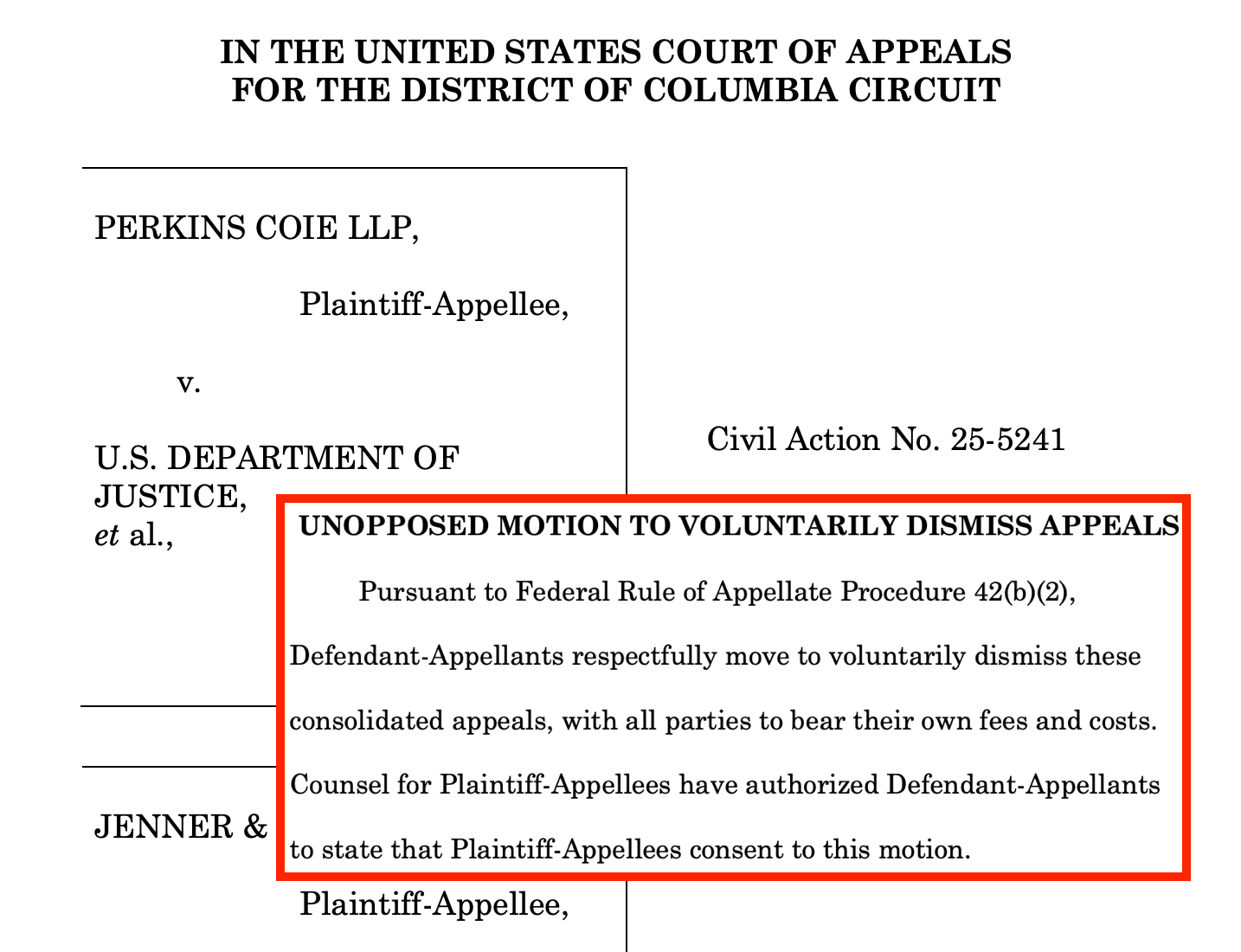
Update, 1:25 p.m. March 3: In a move that melds the unprofessionalism of the Justice Department under Attorney General Pam Bondi with the rule-by-shifting-Truth-social-decrees attitude of President Donald Trump, the two DOJ lawyers on the law firm executive order cases filed a motion on Tuesday to withdraw their Monday motion to dismiss the law firm order case appeals.
Yes, now DOJ wants to continue the appeals.
The motion provided no reasoning for the reversal, with Associate Attorney General Stanley Woodward and Deputy Associate Attorney General Abhishek Kambli simply stating that “it is the prerogative of Defendant-Appellants to pursue this appeal.“
Per the motion, the lawyers for the law firms “oppose the government’s unexplained request to withdraw yesterday’s voluntary dismissal, to which all parties had agreed.“
They also noted that, regardless, this should not provide DOJ with yet another excuse for delay in the case, specifically referencing DOJ’s forthcoming Friday deadline for filing its combined brief in the appeals.
[Note: This initial report was updated after the Justice Department filed its motion to dismiss the law firm executive order case appeals, with the final update at 9:30 p.m.]
The Trump administration is ending its defense of President Donald Trump’s 2025 executive orders attacking individual law firms in four cases pending at the U.S. Court of Appeals for the D.C. Circuit. The Justice Department filed a motion to dismiss all four appeals on Monday night.
The Wall Street Journal had first reported the plans on Monday afternoon.
The Trump administration had lost in all four cases — challenges to executive orders targeting Perkins Coie, Jenner & Block, WilmerHale, and Susman Godfrey — at the district court level. Although it appealed the losses, the Justice Department took none of the steps to move the case forward quickly — like seeking stays pending appeal — that it has taken in countless other challenges. More than that, and as covered at Law Dork, DOJ has actually delayed the merits appeals for as long as possible.
The Monday night filing at the D.C. Circuit came just four days before DOJ’s combined opening brief in all four appeals was due at the D.C. Circuit.
It is a shocking development that would appear to suggest that the Justice Department convinced the White House that they were likely to lose the cases on appeal and that the district court losses would be better than a precedent-setting decision from the D.C. Circuit.
It is a stark reminder of the firms, beginning with Paul Weiss, who capitulated to Trump and the Trump administration’s threats. Skadden Arps followed, with others — as tracked by Demand Justice here — following those two BigLaw firms. Their agreements were appalling to start, indefensible once the wins started piling up from those who did challenge Trump, and outright embarrassing if the Trump administration drops these appeals as the WSJ has reported is expected.
There is a caveat, though. This reported move also comes in the context of an extensive, though administrative and confusing, effort to push another case — Mark Zaid’s challenge to the Trump administration’s revocation of his security clearance — ahead of the law firm cases, despite the preliminary injunction in Zaid’s case (also in his favor) having come months after the appeals of the final judgments in the law firm cases.
Although DOJ didn’t give a reason for the action, it appeared most likely that lawyers had decided Zaid’s individualized revocation case presented a better chance of success for them than the challenges to the law firm orders, which contained firm-wide security clearance actions along with other firm-wide restrictions on contracts and government access.
On February 6, the D.C. Circuit rejected DOJ’s effort to move the appeal of Zaid’s case ahead of law firm cases — setting all five appeals for argument before the same panel of judges on the same day.
As such, if DOJ proceeds with the appeal in Zaid’s case, it is possible that DOJ decided it was better to give up the law firm case appeals and accept those losses with the hope that the government can eventually secure a win in Zaid’s case.
If DOJ drops the Zaid appeal as well, which would appear less likely and had not happened as of 9:30 p.m. Monday, that would be a sign that DOJ determined a D.C. Circuit ruling would likely go against the Trump administration in all of these cases and that the potential for such a precedent was too stark of a danger to proceed.
In a statement issued on Monday afternoon, Zaid’s lawyer, Abbe Lowell, said, “By abandoning the D.C. Circuit appeals, the Department of Justice is effectively acknowledging that President Trump’s executive orders targeting entire law firms were illegal. Like those orders, Trump’s attempt to punish attorney Mark Zaid, alongside other senior political officials as a group, merely because he represents whistleblowers who have exposed other wrongdoing by the President will fare no better. A federal judge has already concluded as much, and we are confident a court of appeals will do the same. No President is permitted to broadly target or punish groups without appropriate due process, even under the guise of national security.“
Regardless of whether DOJ abandons the Zaid appeal as well, as to the challenges to the law firm executive orders, a win is a win, and DOJ giving up these appeals is a big win for those who defended the rule of law — both the law firms who challenged Trump’s efforts and the law firms and lawyers who stood up to represent them — and for the rule of law itself.
Thomas’s Second Amendment muddle, continued
Nearly four years after Justice Clarence Thomas laid out a restrictive “historical tradition” test for judging the constitutionality of gun restrictions under the Second Amendment, the continued difficulties of applying that test to the nation as it exists today was front and center in arguments over a federal law that bans the possession of firearms for anyone who is an “unlawful user of … any controlled substance.“
The two hours of oral arguments on Monday operated on three levels — and followed the 2022 decision in New York State Rifle and Pistol Association v. Bruen, the 2024 decision by Chief Justice John Roberts in United States v. Rahimi scaling back the extremism of the Bruen decision in a case upholding the federal ban on firearm possession by a person with a domestic violence order out against them, and the arguments from earlier this term in Wolford v. Lopez over Hawaii’s law barring guns on private property open to the public unless the owner gives permission.
On Monday, then, the justices were primarily considering a dispute over the federal government’s effort to charge Ali Danial Hemani under 18 U.S.C. 922(g)(3) as such an “unlawful user” of marijuana based on a record of his use of marijuana a few times a week.
Underlying that, though, was a bigger dispute about how a challenges to gun regulations should be considered under Bruen, in light of Rahimi.
And, finally, there was the continued large-scale dispute over whether Bruen is right.
At the end of the two hours of arguments, it appeared likely that a majority of the court will hold that the federal government’s effort to charge Hemani in this way is unconstitutional. As with Rahimi, however, it is likely that whatever judgment the majority agrees upon could split into pieces when it comes to providing reasoning — to understanding why varying justices believe the prosecution doesn’t work.
Additionally, a second portion of the law, banning firearm possession by a person “addicted to any controlled substance” would not be affected, as Erin Murphy, Hemani’s lawyer, noted they are not challenging the ability of the government to have that restriction — although, even there, she noted some definitional disputes they could raise if such a challenge were before the court.
In short, Thomas, himself acting to propel Justice Antonin Scalia’s 2008 decision in District of Columbia v. Heller even further to the right, has made a muddle of Second Amendment case law — and clarity is unlikely to come from Hemani’s case.
Digging into the mud
As to Bruen itself, both Justices Sonia Sotomayor and Elena Kagan made clear in Rahimi that they continue to believe Bruen’s test — requiring a showing that a challenged regulation “is consistent with the Nation’s historical tradition of firearm regulation” — is wrong.
On Monday, Justice Ketanji Brown Jackson challenged Principal Deputy Solicitor General Sarah Harris repeatedly about the workability — and, ultimately, correctness — of Bruen.
“I guess maybe I just don’t understand how the tests work anymore,” Jackson told Harris, driving into a discussion of how Bruen, or Bruen as limited by Rahimi, differ from the way gun regulations were reviewed earlier.
“I guess the benefit of the pre-Bruen kind of means-end scrutiny is that you got to the bottom of whether what Congress was actually doing here was legitimate and whether the means that they had chosen, the disarmament of this person, was … sufficiently tailored to that aim. And what’s worrying me is that the current Bruen test modified by Rahimi or whatnot is not allowing us to assess that, and that’s really the problem in this situation.”
Then, more pointedly and noting Harris’s arguments against the constitutionality of the law in the Hawaii gun law case, Jackson said, “I guess I’m concerned that Bruen and Rahimi are going to be allowing for arbitrary identifications of analogues and producing inconsistent results.”
To that end, when it comes to how to apply Bruen-as-modified-by-Rahimi, Justice Neil Gorsuch picked up on a line of questioning from Sotomayor, looked at the Justice Department’s claimed historical tradition — “habitual drunkard statutes” — and asked Harris about how courts do that work.
“[O]ne can ask whether the habitual drunkard statutes are sufficiently — how and why— sufficiently analogous,” he noted, echoing Sotomayor’s questions. “One could also ask, though, more basically whether this defendant would qualify as a habitual user.”
Addressing Harris, Barrett noted, “I think this is what Rahimi says, that legislatures can regulate to keep guns out of the hands of dangerous people …”
As to the statute at issue, however, she continued, “… but when I look at this statute and when I look at what the qualifications are for being listed on one of these schedules, they’re all about public safety, you know, they’re about reducing addiction.”



The statute itself, of course, is the bottom line here, and it is — on top of the muddled Second Amendment law — itself a bit jumbled, taking language and determinations under the Controlled Substances Act to create federal crimes under another act.
First, the government’s interpretation of “user” is “habitual user,” which led to significant questions about both the overlap of the two categories — “unlawful user of” and “addicted to” — of people covered by the law and what “habitual” meant.
As Sotomayor put it, the historic use of “habitual” in the “habitual drunkard” laws, “centered around not merely taking the drug but the potential effect it had on you because you couldn’t control it and would continue to use it.“
Additionally, while the Justice Department’s initial argument was that all scheduled drugs could justify a prosecution under this law, Harris explained that its “backup” position was that, perhaps, only Schedule 1 and 2 drugs should justify prosecution because their classification justifies a presumption of dangerousness.
A key problem for the Justice Department throughout the morning appeared to be the fact that all three Trump appointees raised questions about fairness.
Gorsuch asked about why DOJ was bringing this case — involving marijuana — in light of that backup position.
Barrett noted how certain drugs are legal when used as prescribed but not when used unprescribed, and asked how could that show the dangerousness under Rahimi.
Justice Brett Kavanaugh noted that most of the state laws focus restricting addicts from possessing firearms, not users, and though Harris pushed back on that a little, Kavanaugh was still pressing the point when Murphy was up to argue against the law being used against her client as an unlawful user, not an addict.
Only Justice Sam Alito, in his role as a former prosecutor, appeared to aggressively defend the Justice Department’s position on Monday, although Chief Justice John Roberts did pose a few questions about judicial deference to Congress — which Jackson retorted isn’t allowed under Bruen — and Kagan asked a lot of questions about Ayahuasca. While Kagan let us all know, “I don’t know a lot about this drug,” she used it throughout arguments to probe at what and how the parties believed the government could go about barring possession of firearms in a Bruen-Rahimi world.
A decision — or several opinions and a judgment — is expected by late June (or early July).
Law Dork in the media
I joined Leah Litman on this week’s episode of Strict Scrutiny to talk about the U.S. Supreme Court, lower courts, public access to courts, independent media, and more.
It was, as always, a delight to spend time with Leah.
Check it out!
This court has egregiously ruled against precedent in several major cases - often in ways I completely disagree with.
But Bruen (and particularly Bruen + Rahimi) takes the cake in terms of absolutely stupid decisions. Suddenly judges are expected to do the work of American History grad students and, as noted in this excellent writeup, without the benefit of either Congress's words or (assumed) intents - a strange leg to stand on for the originalist/textualist wing of the court.
In the words of the late justice Scalia (words that everyone assume pointed at justice Thomas) "I'm an originalist, but I'm not a nut"
Bruen compounds bad “history” with bad theory and it would be better to simply bury it as wrongly decided as well as unworkable.