

Judge blocks Noem's second attempt to keep members of Congress out of immigration facilities
U.S. District Judge Jia Cobb issued a temporary restraining order on Monday morning. Also: For paid subscribers, closing my tabs.

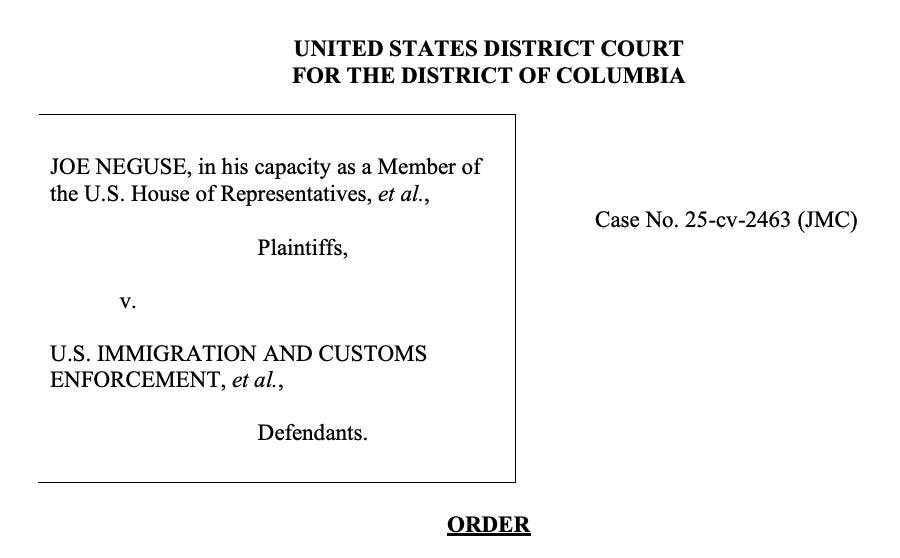
As the Trump administration continues its extremist immigration enforcement efforts and public protests continue, several members of Congress have been fighting to get into immigration detention facilities — as part of their oversight role and as provided in federal appropriations laws.
On Monday morning, U.S. District Judge Jia Cobb, a Biden appointee in D.C., issued a temporary restraining order aimed at allowing those on-rquest oversight visits to occur without delay.
This was Cobb’s second order issued to that end.
In December, Cobb issued her initial order and opinion blocking U.S. Immigration and Customs Enforcement policies requiring seven-day notice for members of Congress to access facilities and asserting that ICE field offices were not subject to the appropriations oversight visitation requirement.
The requirement — known as Section 527 for its placement in federal appropriations — is simple and clear:
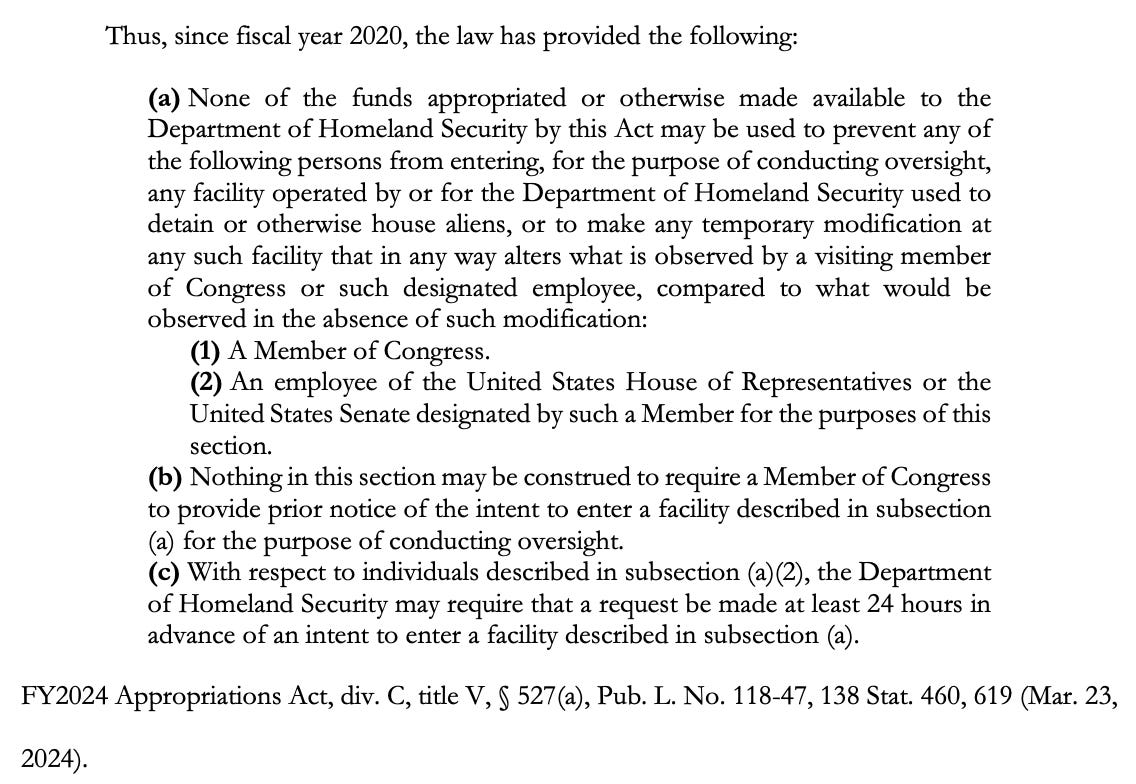
Cobb, essentially, found the Section 527 means what it says in her December 17 opinion, writing, in part, “Any indication that a seven-day advance notice policy is permissible under the definition of ‘prevent’ as used in Section 527(a) is dispelled by Section 527(b), which states that ‘[n]othing in this section may be construed to require a Member of Congress to provide prior notice of the intent to enter’ a covered facility.“
Ultimately, Cobb ruled that “[t]he challenged Oversight Visit Policies are STAYED pending conclusion of these review proceedings.”
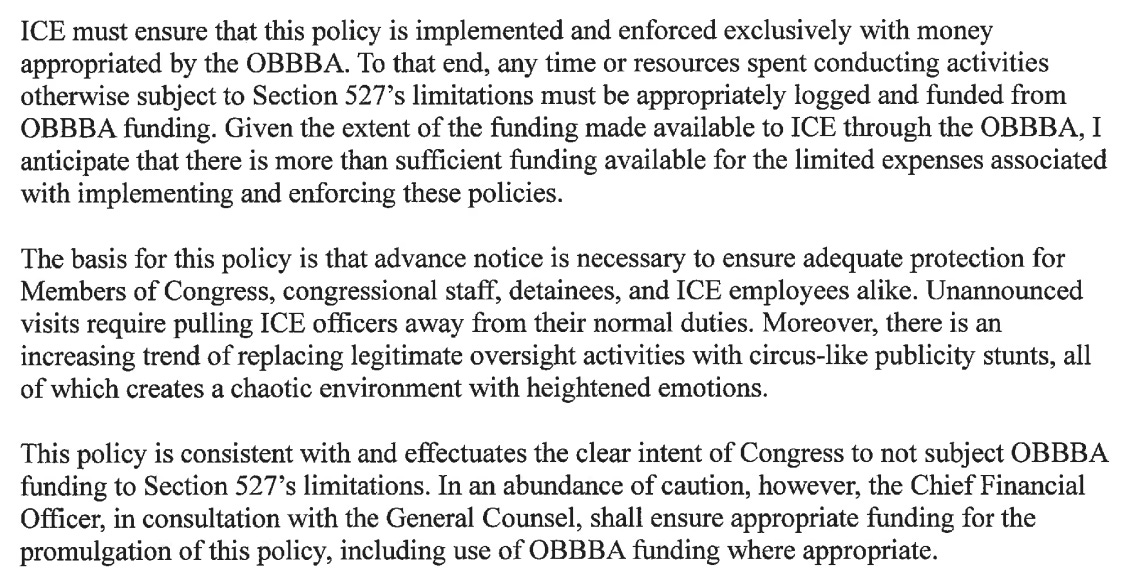
After the ICE killing of Rennee Good three weeks later on January 7, however, Homeland Security Secretary Kristi Noem issued a new policy on January 8, purporting to get around Cobb’s order with a new seven-day notice policy and a claim that all congressional oversight visits are to be funded through the One Big Beautiful Bill Act (OBBBA), which did not include a Section 527 requirement. From the policy memorandum:
The plaintiff members of Congress, represented by Democracy Forward and American Oversight, went back to court immediately, arguing that the action violated the December 17 order.
After a hearing and follow-up briefing, Cobb denied the plaintiffs’ request on January 19, deciding that Noem’s January 8 policy constituted a new policy that raised new legal questions from those raised by the 2025 policies and addressed in her December ruling. At the same time, however, she all but urged the plaintiffs to bring a challenge to the new policy, concluding her decision by stating, “If Plaintiffs wish to challenge the legality of a new agency action, Plaintiffs may seek leave to amend their complaint or file a supplemental pleading … which could also be accompanied by a request for a temporary restraining order or other preliminary relief.“
A week later, the members of Congress did so, with a new request for a temporary restraining order. DOJ opposed the request, leading to Monday’s decision.
“Plaintiffs have made a strong showing that the January 8, 2026, notice requirement was also promulgated, implemented, and is presently being enforced with the use of Section 527 funds,” Cobb wrote.
To that end, Cobb went through the arguments advanced by the plaintiff members of Congress and defendants at DHS and ICE:
Plaintiffs have presented evidence in the form of testimony by a former DHS and ICE legal and budgeting official stating that it would be logistically difficult, if not impossible, for DHS to identify and segregate the relevant expenditures to ensure that only funds from the OBBBA were used to first promulgate and enforce the January 8 policy or will be used to enforce it going forward. …
Defendants have not seriously attempted to argue that DHS and ICE ensured that only OBBBA-funded resources were used before promulgating and first implementing the January 8 policy. … Defendants’ argument on this point appears to be that any funds or resources used to promulgate the policy can be tracked on the back end and subsequently “assigned to the OBBBA” through the reconciliation of accounts, and thus will not qualify as a use of funds under federal appropriations principles.
At this stage, Cobb sided with the members of Congress:
[I]n addition to Plaintiffs’ arguments about the practical infeasibility of such tracking, Plaintiffs raise other reasons why such purported back-end accounting is not likely possible as a mechanism for DHS and ICE to avoid using Section 527-restricted funds for the January 8 policy. Without addressing all of Plaintiffs’ theories at this early juncture, the Court notes that it finds compelling Plaintiffs’ argument—one not presently disputed by Defendants—that at least some of these resources that either have been or will be used to promulgate and enforce the notice policy have already been funded and paid for with Section 527-restricted annual appropriations funds, including pursuant to contracts or agreements that predate the OBBBA.
The bottom line of Cobb’s decision: There is virtually no way that Noem put forward or is implementing this policy without using funds that are subject to the Section 527 oversight visitation requirement.
As such, Cobb blocked Noem’s January 8 policy — allowing no-notice visitations.
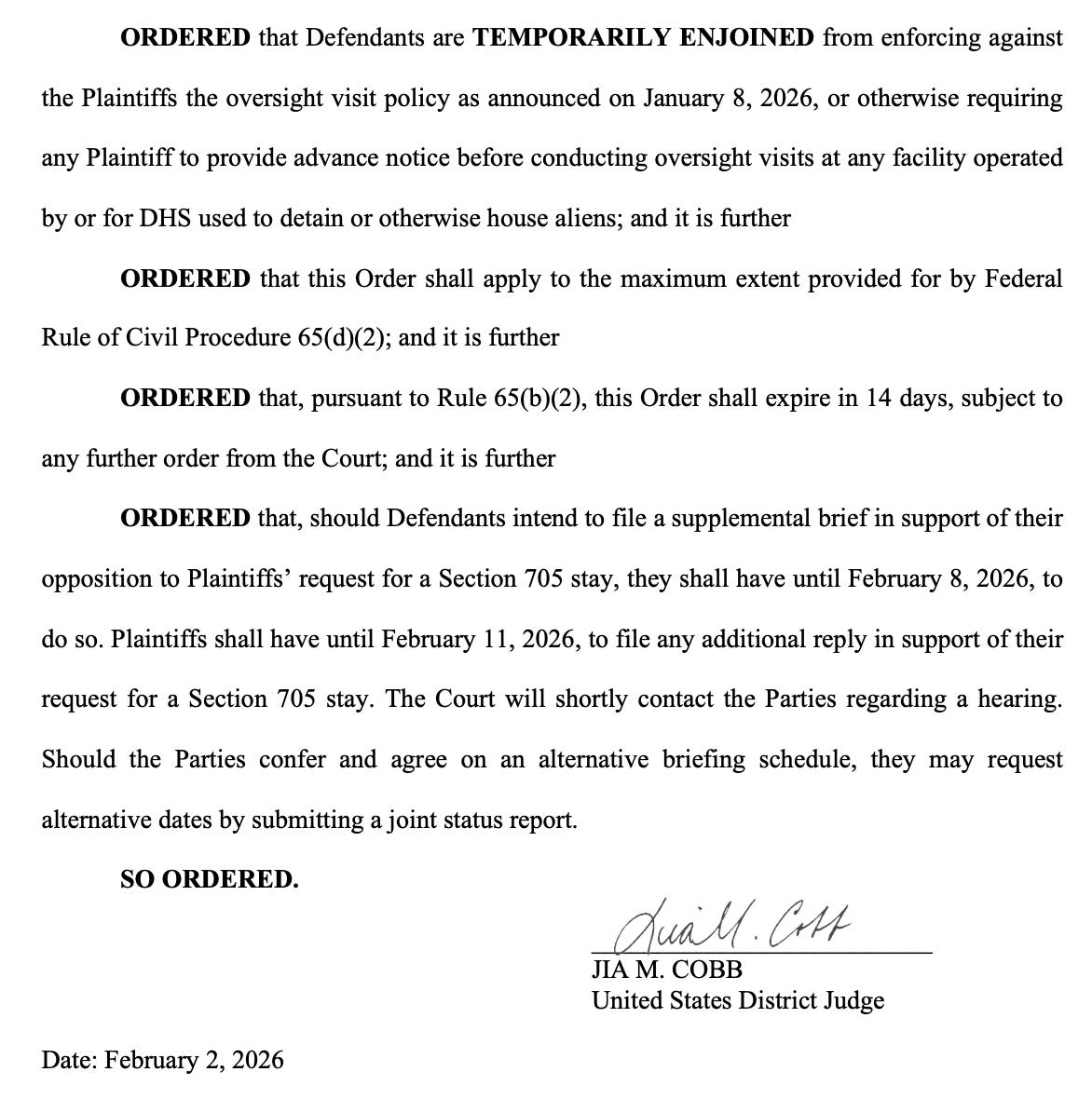
As the temporary restraining order is only in place for 14 days, Cobb set a quick briefing schedule on the Administrative Procedure Act case version of a preliminary injunction request — plaintiffs’ request for a Section 705 stay — which would block the implementation of the policy during the remainder of the litigation.
Closing my tabs
For those who don’t know what this is, it’s my effort to give a little thank you to paid subscribers. “Closing my tabs” is, literally, me looking through the stories and cases open — the tabs open — on my computer and sharing with you all some of those I was unable to cover during the week but that I nonetheless want to let you know that I have on my radar. Oftentimes, they are issues that will eventually find their way back into the newsletter as a case discussed moves forward or something new happens that provides me with a reason to cover the story more in depth.
This Monday, these are the tabs I am closing:
