

The birthright citizenship arguments will show what Trump has done to the United States
Trump's executive order to end birthright citizenship is at the Supreme Court on Wednesday. The case will test his anti-immigrant authoritarian project — and the court.

Donald Trump has been back in office for 433 days. Altogether, then, he has spent nearly 1,900 days as president of the United States — with many infamous moments already in the rear-view mirror. This week, however, could be the greatest sign of how successful he has been in his dual and aligned efforts to amass power for himself and, by ignoring and eviscerating norms, diminish the power of other institutions.
On Wednesday, the U.S. Supreme Court will be hearing oral arguments over the legality and constitutionality of Trump’s January 20, 2025 executive order seeking to end birthright citizenship in the United States.
Trump appointed three of the nine justices on the court, and, in a pair of rulings in 2024, the court made Trump’s second term possible — first by preventing states from enforcing the Insurrection Clause of the Fourteenth Amendment, keeping Trump on the ballot, and second by dramatically expanding the scope of presidential criminal immunity, delaying Trump’s criminal trials beyond his re-election.
Now, days after millions of people came out across the nation in protest of this man and his presidency, the Trump administration will be asking the justices to uphold Trump’s executive order as “compl[ying] on its face with“ the Fourteenth Amendment’s Citizenship Clause, as well as federal law implementing the same.
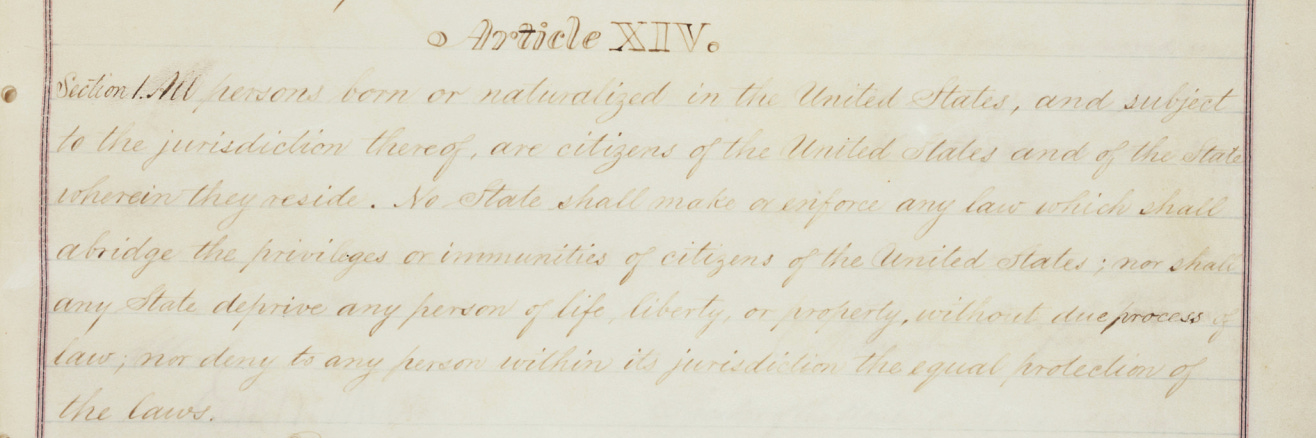
“All persons born or naturalized in the United States, and subject to the jurisdiction thereof, are citizens of the United States,” the amendment states.
No court has sided with the Trump administration on that question thus far. No district court, no appeals court, no judicial body. In Trump’s first year back, the conservative justices blocked “universal injunctions” in cases about the birthright citizenship executive order, but the opinion from Justice Amy Coney Barrett made clear the decision was only about the universal injunction remedy — not the merits of Trump’s order. When cases went back down, and a new case was filed, courts again found paths to keep the order broadly blocked — through multi-state litigation or class-action litigation.
That should not change when the Supreme Court rules — likely this June — but we will get a picture of where things stand when the justices take the bench to consider Trump v. Barbara, the new case filed after the universal injunction decision, on Wednesday.
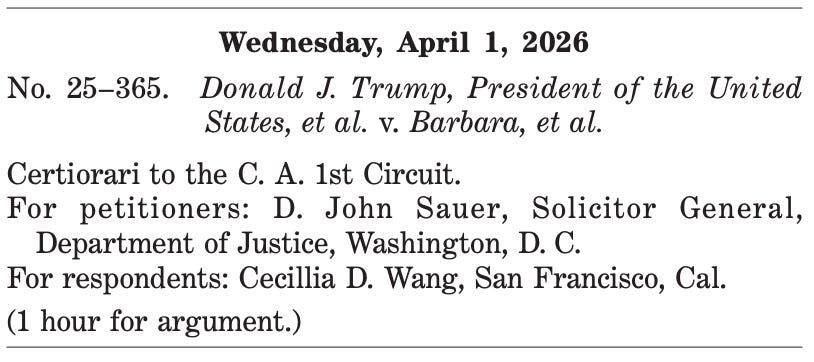
In addition to arguing that Trump’s executive order doesn’t conflict with the Fourteenth Amendment and Immigration and Nationality Act (INA), Solicitor General John Sauer — who previously served as Trump’s personal lawyer, having argued the immunity case at the Supreme Court — will be arguing against history.
Saturday was the 128th anniversary of the Supreme Court’s decision in United States v. Wong Kim Ark, where — at the time of the racist, xenophobic Chinese Exclusion Act — the Supreme Court nonetheless held that the Fourteenth Amendment prevented the governmental effort to bar Kim Wong Ark from returning to the country. That was so because he was a U.S. citizen because he was born in the U.S. — notwithstanding his parents having been citizens of China.
In a lengthy opinion by then-justice Horace Gray, he concluded for the 6-2 court:
The Amendment, in clear words and in manifest intent, includes the children born, within the territory of the United States, of all other persons, of whatever race or color, domiciled within the United States. Every citizen or subject of another country, while domiciled here, is within the allegiance and the protection, and consequently subject to the jurisdiction, of the United States. His allegiance to the United States is direct and immediate, and, although but local and temporary, continuing only so long as he remains within our territory, is yet, in the words of Lord Coke in Calvin’s Case, 7 Rep. 6a, “strong enough to make a natural subject, for if he hath issue here, that issue is a natural-born subject” ….
The opinion has stood for 128 years — based as it was on a long history that preceded it — and has threaded itself into and throughout American law and the fundamental understanding of what it means to be an American.
As Jamelle Bouie noted on Bluesky, “really can't be said enough that this case was decided by the same court that decided plessy v. ferguson. if they could have found a plausible rationale to limit birthright citizenship they would have done it. but there is none! the text is as clear as constitutional language can be.“
Stephen Miller wants to change all of that, and Sauer will be his mouthpiece on Wednesday. Quoting from Elk v. Wilkins, a case applying the Fourteenth Amendment to Native Americans — which raised specific and distinct questions — the Justice Department argued in its brief that, “This Court has long read the Clause to mean that a person becomes a citizen by birth only if he is ‘completely subject’ to the United States’ ‘political jurisdiction’— i.e., only if he owes ‘direct and immediate allegiance’ to the United States and may claim its protection.“
The Justice Department from there on out, by and large, just added “completely“ to the Fourteenth Amendment in its framing of how the justices should consider the case.
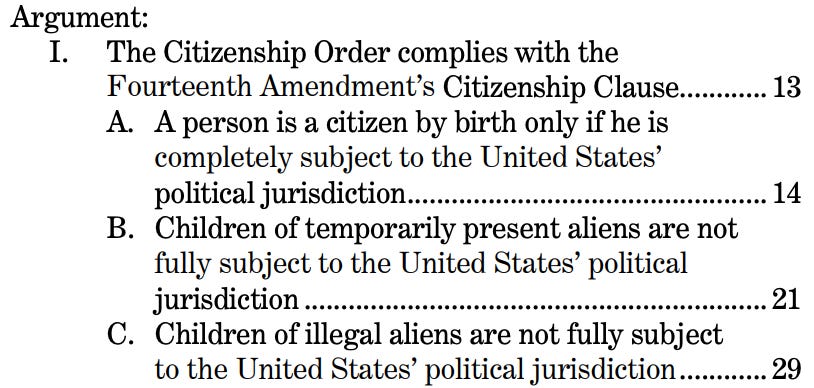
The Justice Department went on to simply insist that Wong Kim Ark didn’t suggest, let alone decide, otherwise.
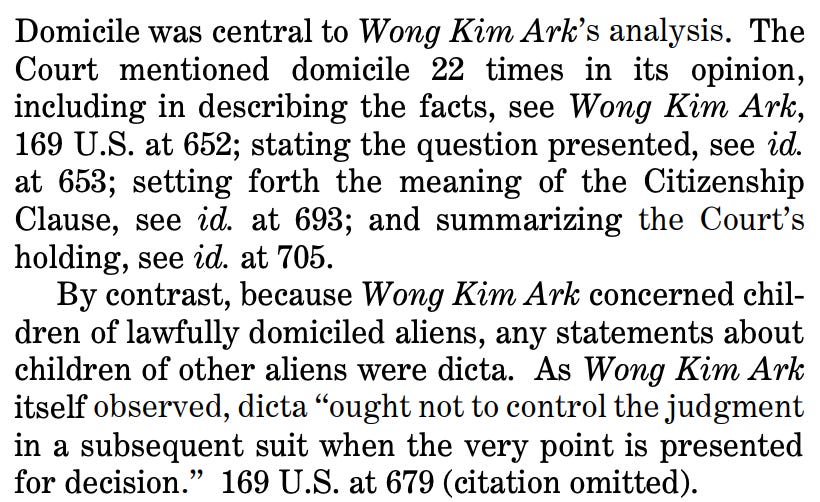
Among the many problems with the Justice Department’s arguments, the Barbara plaintiffs’ brief noted in one section of its argument: “Most Parents of the Children Targeted by the Order Are Domiciled Here.“
To be represented in court by ACLU National Legal Director Cecillia Wang on Wednesday, the plaintiffs argued that the plain text, history, and Supreme Court precedents in both Wong Kim Ark and Elk v. Wilkins show why the Trump administration’s argument doesn’t work.


Among those siding with them are Fred T. Korematsu Center for Law and Equality; Cato Institute; “Race Law Scholars,” including Sherrilyn Ifill; “Originalist Scholars,” including Evan Bernick; the American Bar Association; and the U.S. Conference of Catholic Bishops.
Ultimately, this should not be a close case. As American Immigration Council’s Aaron Reichlin-Melnick told Law Dork on March 27, “My hope is that what we hear is that it’s going to be at minimum 7-2, and that we don’t lose any further justices than that.“ Although his view is one I share, it does reflect the alarming reality that Justices Clarence Thomas and Sam Alito are more willing to align with Trump — and Miller — in their ideological project than anyone else on the court, even more so than the three Trump appointees.
Whether they do so here — and whether they have any other support — will be front and center on Wednesday. Coming out of Wednesday, Trump — and the rest of us — will have a better idea of what people remain able and willing to stand up against Trump’s anti-immigrant authoritarian project and whether those people include a strong majority of the Supreme Court.
And, though I believe the court will not side with Trump, any possibility that the justices are even considering doing so will be an extremely alarming sign for the United States and its future, as well as the stability of the world in which we exist.
This decision, when it comes, will almost certainly be a pivotal moment, if not the pivotal moment, for the Supreme Court in this era — and in the first 2,000 days of the presidency of Donald Trump.
Closing my tabs
For those who don’t know what this is, it’s my effort to give a little thank you to paid subscribers. “Closing my tabs” is, literally, me looking through the stories and cases open — the tabs open — on my computer and sharing with you all some of those I was unable to cover during the week but that I nonetheless want to let you know that I have on my radar. Oftentimes, they are issues that will eventually find their way back into the newsletter as a case discussed moves forward or something new happens that provides me with a reason to cover the story more in depth.
This Sunday, these are the tabs I am closing:
