

Before marriage, there was the nearly 20-year fight over sodomy laws
In 2003, the Supreme Court overturned its 1986 decision upholding sodomy laws. Both cases have a lot to teach us in and about this moment.

On Friday, much U.S. Supreme Court-related attention — including from me — was on the 11th anniversary of the court’s decision in Obergefell v. Hodges. (In addition to Justice Sam Alito’s ridiculous claim that a “misunderstanding” led to his Thursday “rebuttal” to Justice Sonia Sotomayor.)
While Obergefell was the obvious moment — the rainbow White House photos will forever be a constant emblem that D.C. folks can pull out to show “I was here when” — my brain shifted back a dozen years earlier to then-Justice Anthony Kennedy’s first June 26 Supreme Court “gay rights” case opinion.
The decision, its reasoning, and the case that it overturned have a lot to teach us in and about this moment.
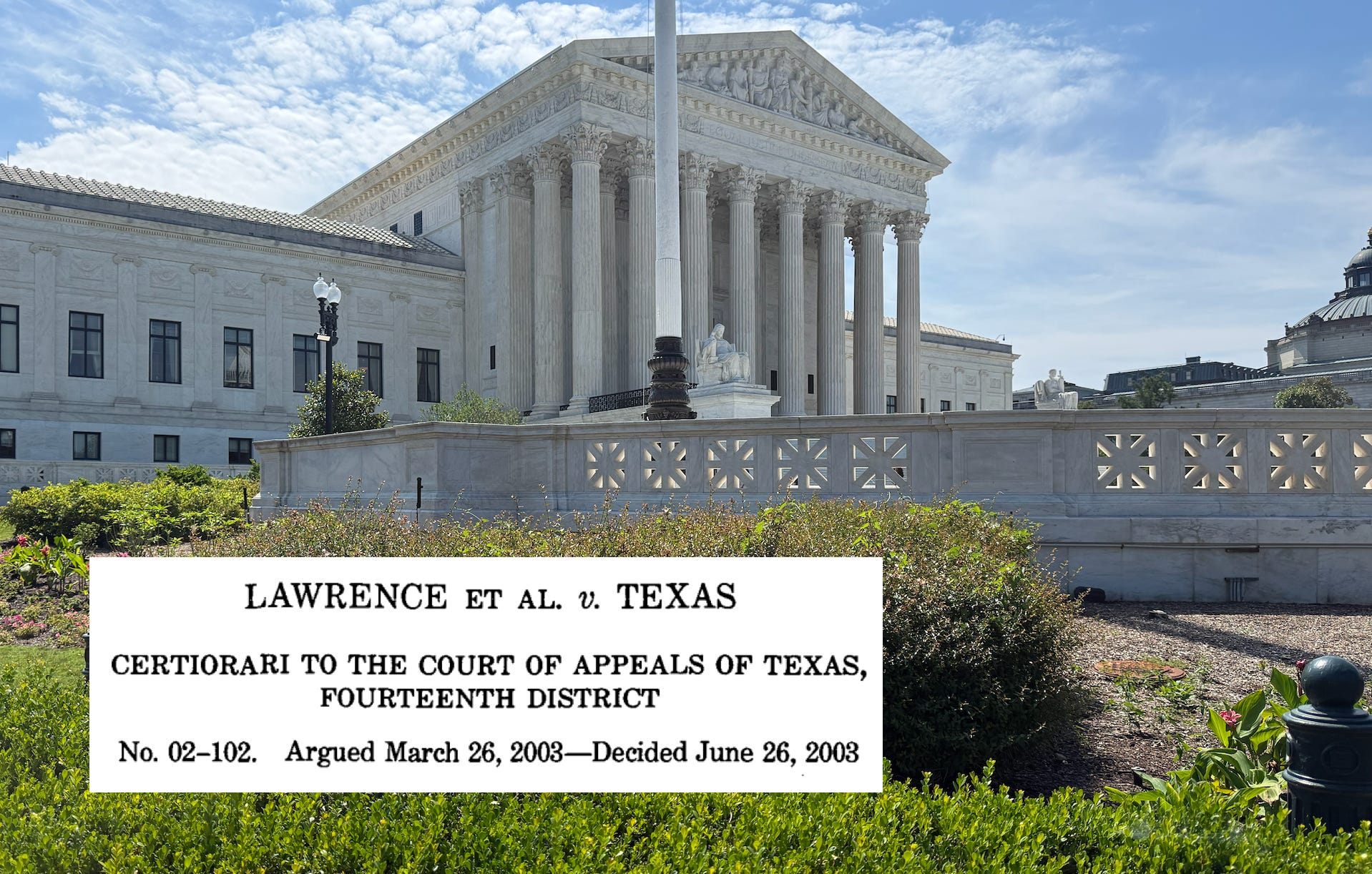
In 2003, the Supreme Court, in Lawrence v. Texas, held that a state could not criminalize gay sex.
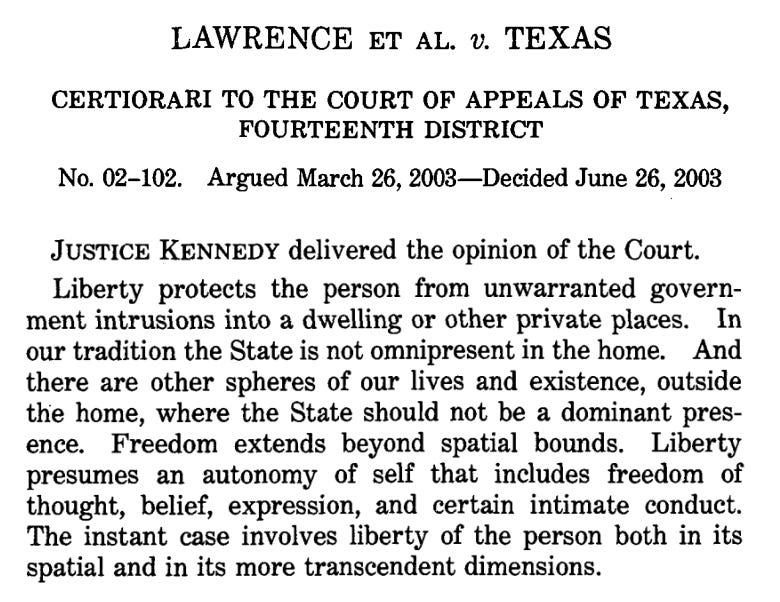
To do so, the court had to overturn the 1986 decision in Bowers v. Hardwick upholding Georgia’s sodomy law.
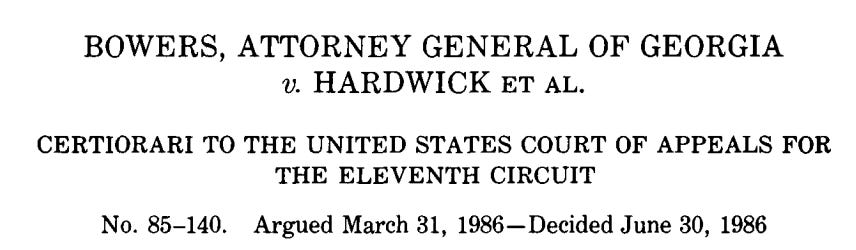
Forty years ago Tuesday, the Supreme Court issued Bowers. In announcing the court’s decision, then-Justice Byron White explained first what the court insisted the case was and was not about:
This case does not require a judgment on whether laws against sodomy between consenting adults in general, or between homosexuals in particular, are wise or desirable. It raises no question about the right or propriety of state legislative decisions to repeal their laws that criminalize homosexual sodomy, or of state-court decisions invalidating those laws on state constitutional grounds. The issue presented is whether the Federal Constitution confers a fundamental right upon homosexuals to engage in sodomy and hence invalidates the laws of the many States that still make such conduct illegal and have done so for a very long time. The case also calls for some judgment about the limits of the Court's role in carrying out its constitutional mandate.
But, what the decision was about was quickly made clear: Gay people — and what they do — is icky.
Noting the court’s history of privacy-related cases, which the U.S. Court of Appeals for the Eleventh Circuit had relied upon to strike down the Georgia law, White wrote bluntly, “[W]e think it evident that none of the rights announced in those cases bears any resemblance to the claimed constitutional right of homosexuals to engage in acts of sodomy that is asserted in this case. No connection between family, marriage, or procreation on the one hand and homosexual activity on the other has been demonstrated, either by the Court of Appeals or by respondent [Michael Hardwick].“
It was a short opinion, with White noting that Hardwick “would have us announce, as the Court of Appeals did, a fundamental right to engage in homosexual sodomy.”
His and the court’s response: “This we are quite unwilling to do.”
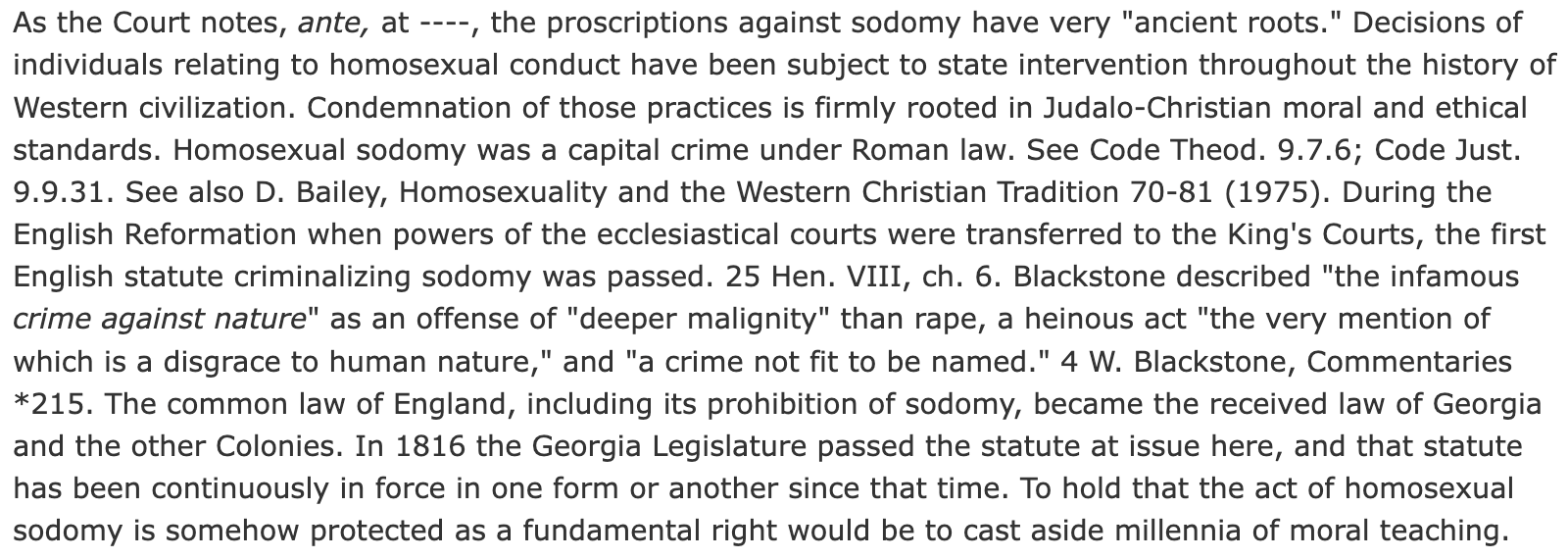
The Chief Justice of the United States at the time — Warren Burger — did not think that was enough, issuing a brief concurring opinion essentially to explain that the state could do whatever it wants to homosexuals because, history (and, again, because gay people — and what they do — is icky).
The coming years — in the midst of the height of the AIDS epidemic — involved expansive work from individuals and advocacy organizations to change the public’s view and work toward changing the law.
A dozen years after Bowers, John Geddes Lawrence and Tyron Garner were arrested, charged, and convicted in 1998 under a Texas law that remained constitutional following Bowers. In 2003, the challenge to that conviction — and law — reached the Supreme Court. Then-Justice Anthony Kennedy described the complaint and law as such:
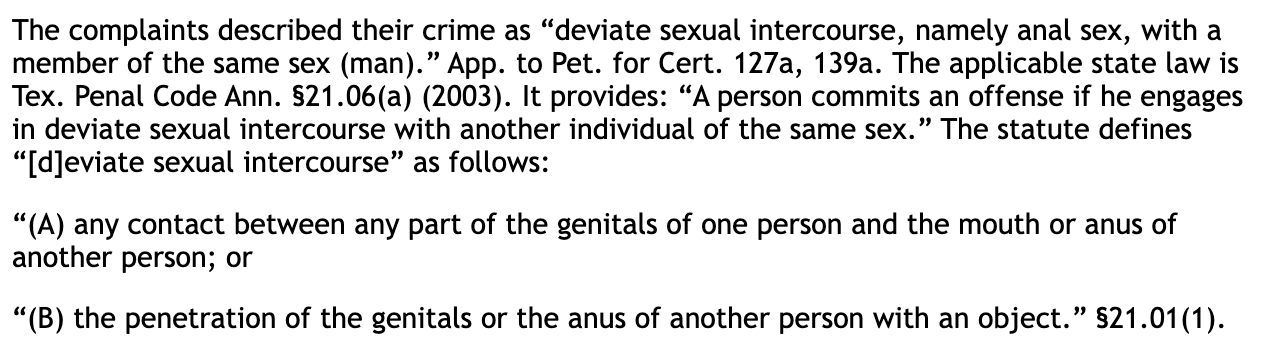
After analyzing the history, practice, and precedent, Kennedy drew the first of two conclusions: “Bowers was not correct when it was decided, and it is not correct today. It ought not to remain binding precedent. Bowers v. Hardwick should be and now is overruled.“ It took 17 years, but Bowers was gone.
Then, “The petitioners are entitled to respect for their private lives. The State cannot demean their existence or control their destiny by making their private sexual conduct a crime. Their right to liberty under the Due Process Clause gives them the full right to engage in their conduct without intervention of the government.“
Kennedy, often critiqued for his less-than-methodical resolution of these cases, then wrote one of his key paragraphs in his trio of June 26 “gay rights” decisions:
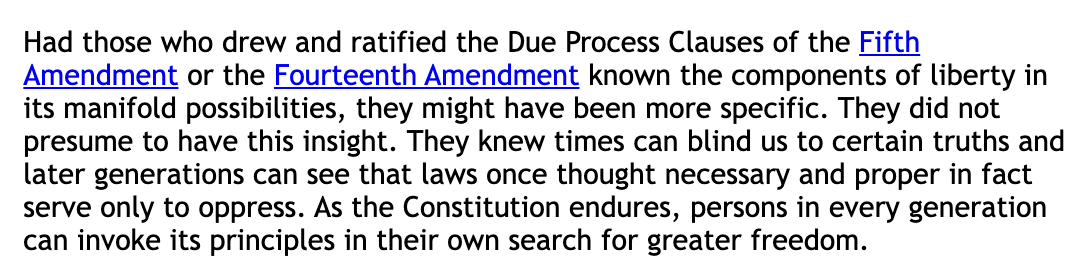
For all he got wrong — or failed to resolve — in his time on the court, I think this paragraph is one that will stand the test of time. This is the crystallization of the counterargument to originalism — specifically, to letting originalism work as an anchor aimed at holding the nation back.
In that era, then-Chief Justice William Rehnquist was left joining then-Justice Antonin Scalia’s dissent along with Justice Clarence Thomas, the latter two of whom joined the court after Bowers.
Fast-forward another 17 years, and a different era was beginning with the death of then-Justice Ruth Bader Ginsburg and confirmation of Justice Amy Coney Barrett in 2020.
Now, it was Chief Justice John Roberts at the court’s helm. Generally in the majority on the 6-3 right-wing and often reactionary court, Roberts wrote the court’s 2025 opinion upholding Tennessee’s ban on gender-affirming medical care for minors. If you’ve forgotten how Roberts did so in U.S. v. Skrmetti, here’s a refresher:
Roberts first held for the court that Tennessee’s law, S.B. 1, does not classify on the basis of sex. Instead, Roberts insisted, the law only classifies on the basis of age and what he called “medical use.”
“Under SB1, no minor may be administered puberty blockers or hormones to treat gender dysphoria, gender identity disorder, or gender incongruence; minors of any sex may be administered puberty blockers or hormones for other purposes,” Roberts wrote.
Such wordplay is disingenuous at best.
Roberts went on to hold for a five-justice majority that the law banning gender-affirming medical care for trans minors does not classify based on transgender status. Here’s what he wrote:
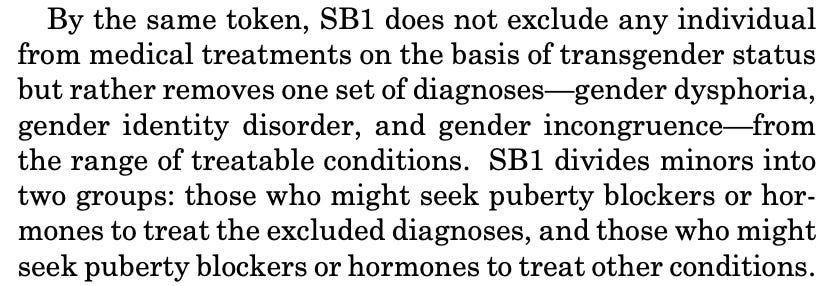
This constitutional-protections-by-wordplay was how Roberts wrote trans kids out of the Constitution.
If the current court — if Roberts’s facile, convenient thinking — were to have controlled in 2003, Texas’s law might have faced an easier time. Recall the law (above).
Here’s how Roberts’s Skrmetti opinion could have played when looking at Texas’s law:
Tex. Penal Code Ann. Section 21.06(a) does not criminalize any individual on the basis of homosexual status but rather removes one set of sexual activities—deviate sexual intercourse with another individual of the same sex—from the range of lawful sexual activity. Tex. Penal Code Ann. Section 21.06(a) divides people into two groups: those who might seek deviate sexual intercourse with another individual of the same sex, and those who might seek sexual intercourse that is either not deviate or not with another individual of the same sex.
Essentially, Roberts said the Tennessee law is not a status-based law because it’s just excluding somethings, not some people.
Roberts’s opinion in Skrmetti justified itself by noting that, while only trans people use the drugs at issue for cross-sex purposes, anyone — cis or trans — can use them for other, permitted purposes. With Texas’s law, a Roberts-minded jurist could do the same thing: While only gay or bi people might seek “deviate sexual intercourse with another individual of the same sex,” anyone is permitted non-deviate sexual intercourse.
Yes, go back and do the math. Anyone can kiss!
It would be a ridiculous argument, and that’s why such ill-suited “logic” wasn’t used by the court to uphold sodomy laws in 1986 and wasn’t a consideration when they were struck down in 2003.
In fact, it was then-Justice Sandra Day O’Connor — who had voted for Bowers and did not vote to overturn it in Lawrence — who quickly and succinctly dismissed that “logic,” such as it is, in concurring with the Lawrence decision. Explaining why the Texas law violated the Equal Protection Clause (an argument the majority called “a tenable argument“ but didn’t reach because the case was decided on Due Process grounds), O’Connor wrote:
The statute at issue here makes sodomy a crime only if a person “engages in deviate sexual intercourse with another individual of the same sex.” Tex. Penal Code Ann. §21.06(a) (2003). Sodomy between opposite-sex partners, however, is not a crime in Texas. That is, Texas treats the same conduct differently based solely on the participants. Those harmed by this law are people who have a same-sex sexual orientation and thus are more likely to engage in behavior prohibited by §21.06.
The Texas statute makes homosexuals unequal in the eyes of the law by making particular conduct—and only that conduct—subject to criminal sanction.
Those harmed by this law are people who have a same-sex sexual orientation.
Reading those words and then reflecting on Skrmetti as we await the court’s decision in Little v. Hecox and West Virginia v. B.P.J. over Idaho and West Virginia’s trans sports bans, respectively, is to see the emptiness in John Roberts’s Skrmetti opinion and in his vision of constitutional equality.
Those harmed by these laws are minors who are transgender.
The good news, and the reminder of Lawrence, is that a relatively short time later — longer than it should have been, but short in constitutional terms — the court was able to acknowledge that “laws once thought necessary and proper in fact serve only to oppress.”
As Kennedy told us all, “As the Constitution endures, persons in every generation can invoke its principles in their own search for greater freedom.”
No matter what happens in the coming days, that is what we will have to do as we move forward from these times.
Light in the darkness. We need these exercises. Thanks.
I think Kennedy was so right: in each generation We must find in the Constitution the means to continue to to expand human freedom