

Trump and Hegseth's anti-trans military policy is based on unconstitutional animus, D.C. Circuit rules
The court's split ruling would protect current trans service members from discharge but allow the Trump admin to keep new trans recruits from joining the military during litigation.

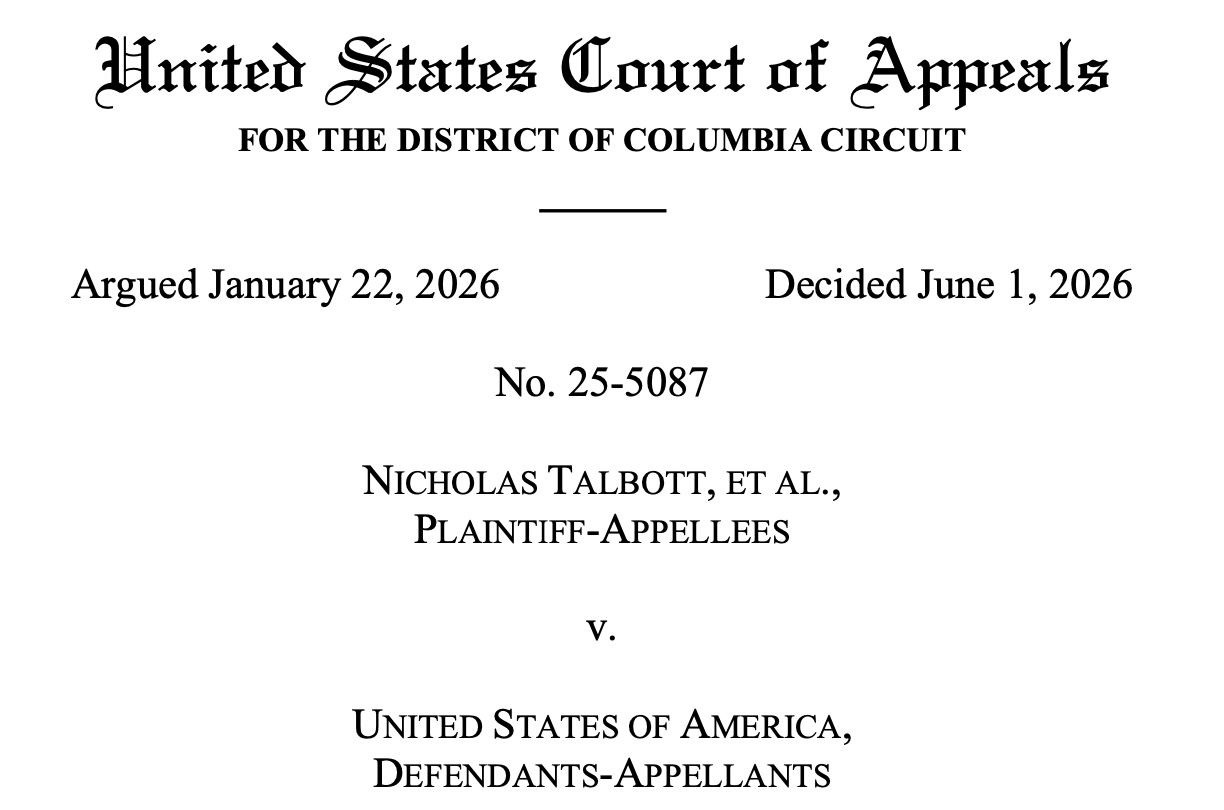
On Monday, the U.S. Court of Appeals for the D.C. Circuit held on a 2-1 vote that unconstitutional “animus-filled reasons” motivated the Trump administration’s policy barring transgender people from the military.
“Unless we are going to fall for the old Groucho Marx line—’who are you going to believe, me or your lying eyes?’—we have direct evidence in this case that animus motivated the classifications in the [Defense Secretary Pete] Hegseth Policy,” Wilkins, an Obama appointee, wrote in a portion of his opinion joined by Judge Judith Rogers.
On that key front, Judge Justin Walker dissented, writing that such decisions are, by and large, left to the executive and legislative branches.
The three judges split three ways on the remedy in this preliminary injunction appeal, with Rogers voting to uphold the injunction blocking the policy in whole and Walker voting to end the injunction in whole. Wilkins cast the decisive middle vote, protecting current trans service members from separation but ending the injunction’s protections for trans would-be service members during litigation.
“[W]e affirm the preliminary injunction as it pertains to the Hegseth Policy for current servicemembers, but we vacate the preliminary injunction with respect to the provisions of the Hegseth Policy applicable to those persons seeking to enlist in the military,“ Wilkins wrote.
Additionally, and in light of the Supreme Court’s Trump v. CASA decision from last term, the court further limited the so-called “universal” injunction entered by the district court to an injunction only covering the named service members who sued.
In addition to the disagreements from Walker, a Trump appointee, on the merits, he also argued that the U.S. Supreme Court’s unreasoned shadow docket decision blocking a similar injunction during appeals in a different challenge to the military policy should “inform“ the outcome here. The majority, however, noted that the lack of explanation from the Supreme Court in that case prevents any controlling reading of that order and that the stay there “could have been based on impropriety of the universal nature of the injunction.“
Monday’s decision did not go into effect immediately, and the preliminary injunction had earlier been stayed pending this appellate decision. As it often does, the court has ordered that the mandate — formally sending the case back to the district court — will not issue until after the time passes for either party to seek en banc review and the resolution of any en banc petition.
The ruling in depth
Explaining the animus that Wilkins and Rogers found to form the foundation of the policy, Wilkins went back to the opening days of President Donald Trump’s second administration.
“In sum, the Commander-in-Chief declared transgender people as categorically unfit for military service explicitly because of their gender identity,” he explained. “To add insult, the President labeled transgender persons as dishonorable, undisciplined, arrogant, selfish liars.“
Defense Secretary Pete Hegseth followed up accordingly. “The extirpation from the military of all persons with a ‘false gender identity’ was Secretary Hegseth’s explicit goal. Targeting persons with a history of gender dysphoria was merely the means of achieving that end.”
Reviewing the applicable precedents, Wilkins held that the proper test for analyzing a constitutional challenge to a military regulation looks like this:
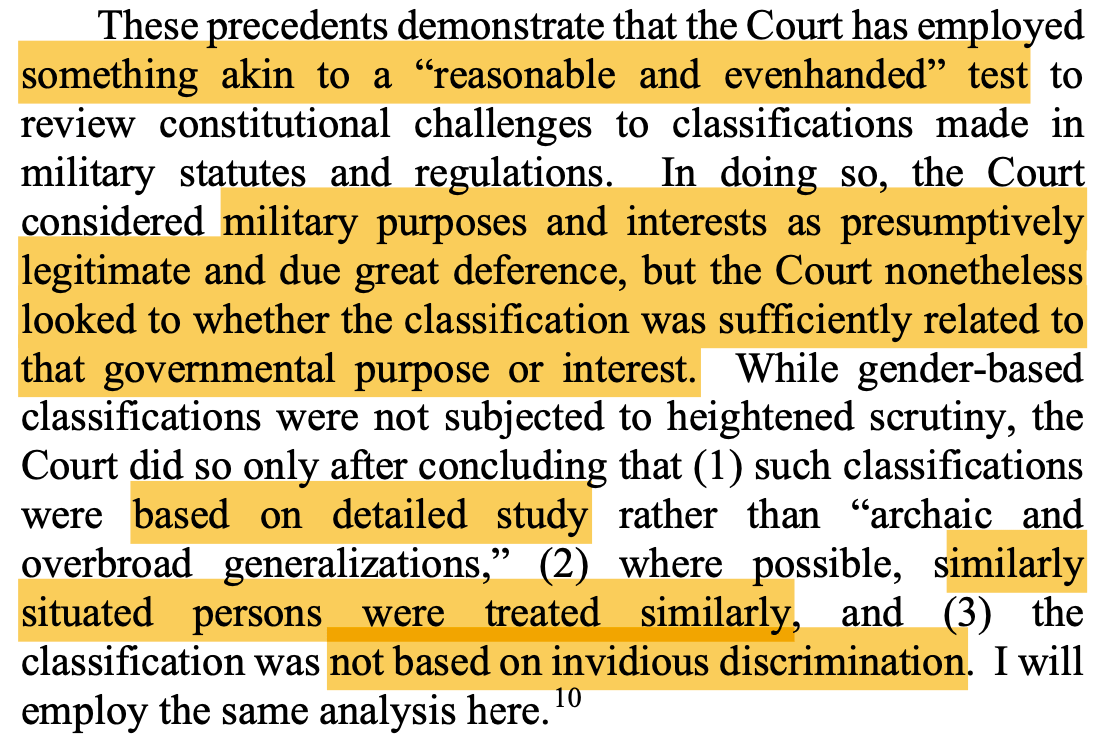
Even in light of U.S. v. Skrmetti — as to which he held the Hegseth policy had “many distinctions” from the Tennessee law at issue there — Wilkins held that, under this test, “the Hegseth Policy does not classify whether persons are eligible to serve in the military in a reasonable and evenhanded manner.“
Wilkins went on to explain how the Hegseth policy “contains classifications that are not sufficiently related to a legitimate government interest“; is “grounded, at least in part, on archaic and overbroad generalizations about sex“; and “does not treat, where possible, similarly situated persons in a similar fashion.”
In that discussion, Wilkins at one point stated that “the Hegseth Policy is a prototypical example of a sex-based classification created ‘reflexively and not for any considered reason,’ in direct contrast to the Congressional action that the Court upheld” in a challenge to male-only draft registration.
Also notable for a federal policy being defended by the Justice Department was the number of times Wilkins noted that the Trump administration simply provided no response to an points raised by the transgender plaintiffs — even, Wilkins wrote, waiving some arguments.
In discussing whether the policy treats similarly treated people similarly, Wilkins noted that “servicemembers with every other medical condition receive an individualized review of their circumstances to determine if they can continue to serve—except if they have gender dysphoria.“
He continued:
Plaintiff-Appellees pointed out this abnormal treatment of gender dysphoria in their brief, see Appellees’ Br. at 25, and Appellants made no response in reply.
Appellants have therefore conceded that persons with a history of gender dysphoria are not treated the same as similarly situated individuals.
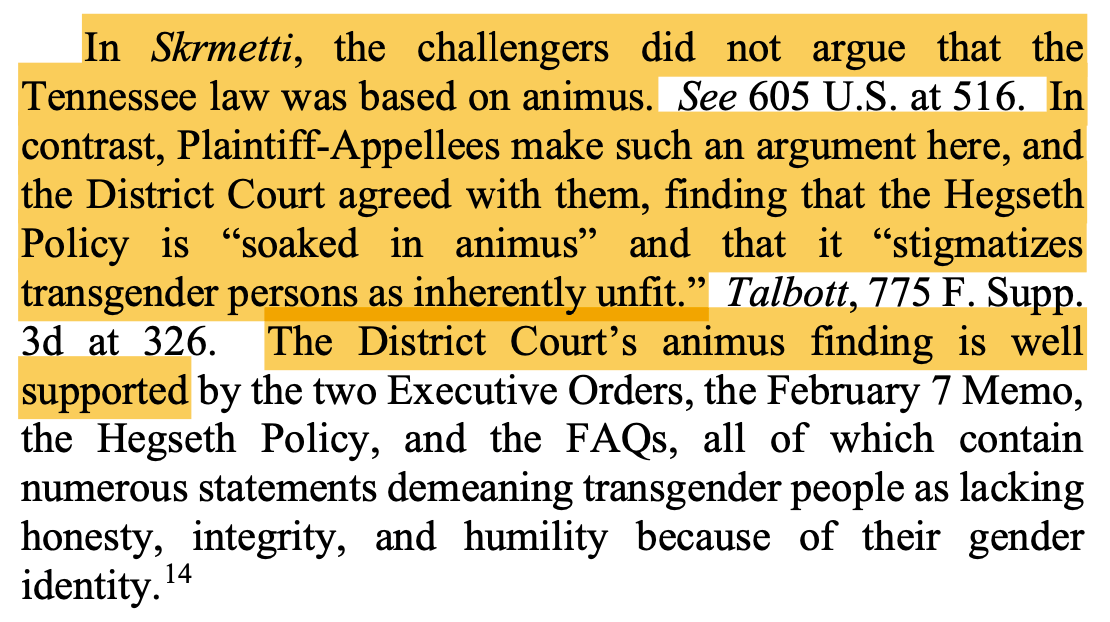
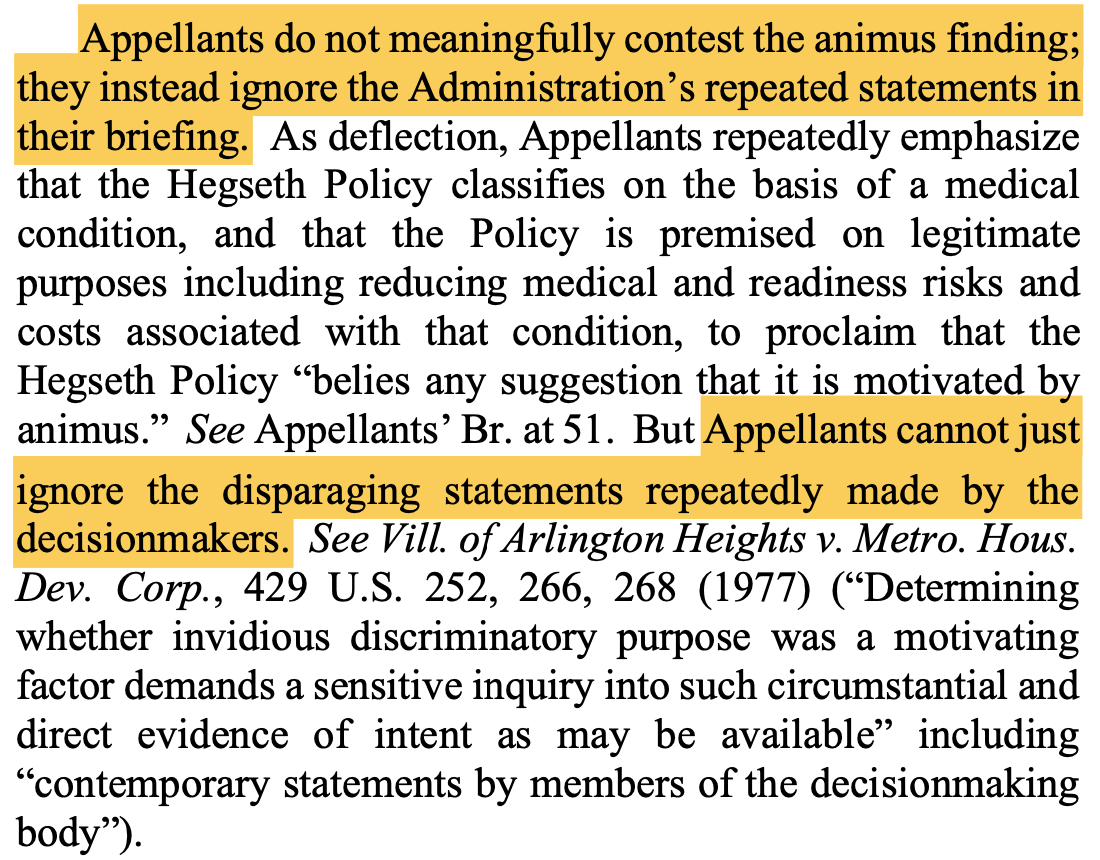
Finally, and most importantly, Wilkins, joined by Rogers, concluded that the policy “contains classifications that are based on invidious discrimination.“
This is key. Wilkins explained:
For Walker, a Trump appointee, this was almost all an improper inquiry by the courts into a “professional military judgment” carried out by the executive branch:
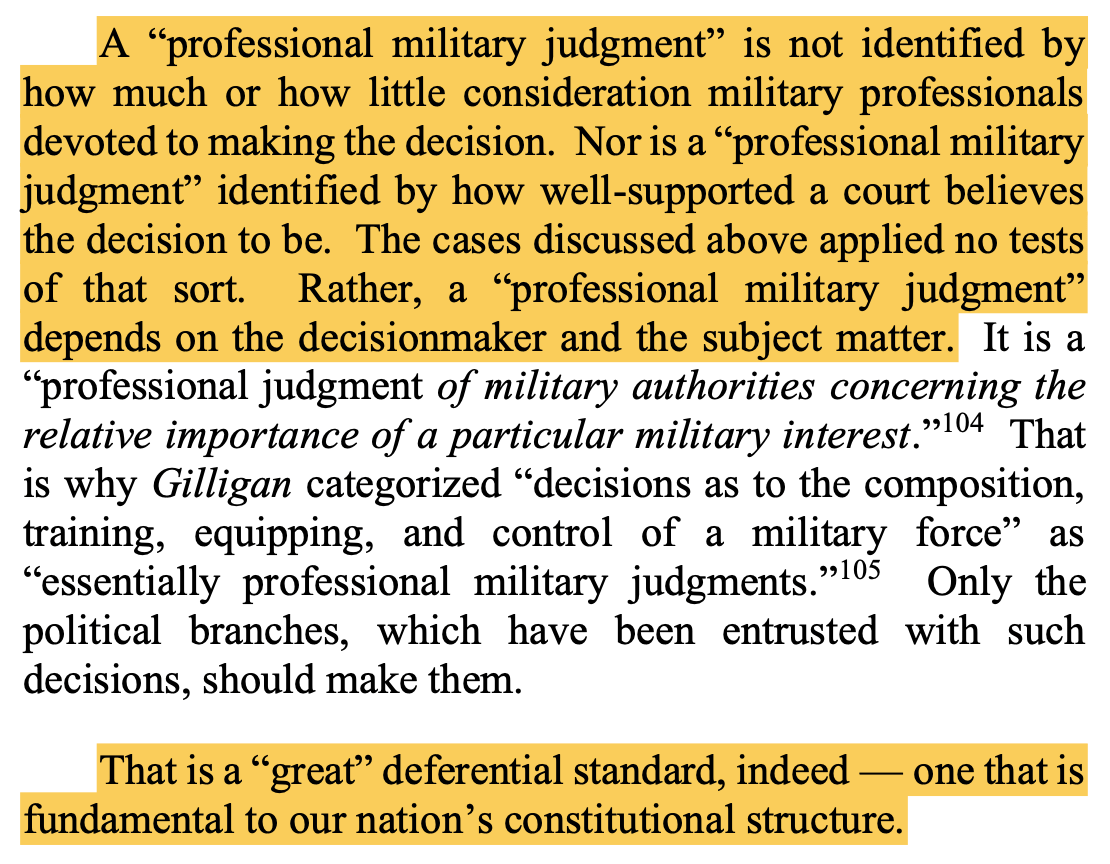
While Wilkins acknowledged that the courts give “great deference” to the military “concerning the relative importance of a particular military interest,“ he countered that the dissent was wrong about the implications of that deference, writing that it “does not mean … our role is transformed into that of a judicial rubber stamp.”
In this context, moreover, Wilkins wrote, in conclusion, that this is about the foundational nature of equal protection guarantees.
“If we are at the point where invidious reasons that were expressly given for a classification can be completely ignored and replaced with our imagined non-invidious reasons, then equal protection jurisprudence has truly become bankrupt.“
Three views on the interim remedy
Despite that, when it came to the other factors for granting a preliminary injunction, Wilkins split with Rogers, a Clinton appointee.
Wilkins wrote that “Plaintiff-Appellees who seek admission to the military have been deprived of constitutional freedoms,” but that “the harms and equities of their situations are not identical to those of persons already serving.“ Specifically, he wrote that those “seeking admission to the military can still obtain full relief later, following a final adjudication on the merits,” while “it is not clear how easily [those service members facing expulsion] can be reinstated and made whole.“ Additionally, he noted that there were different realities for the claimed national security harms because there was a “demonstrated” lack of harm from those currently serving but only “a predictive judgment“ as to those wishing to join the military, including as to “potential[] … increased risk” relating to health factors.
Those differences, he wrote, meant that “the District Court was obligated to consider separately the balance of equities and public interest for those who were already serving in the military as compared to those who are seeking to enlist.“
For her part, Rogers argued that Wilkins’s analysis misapplied the proper standard for reviewing the district court’s injunction. Under “the abuse of discretion standard,” she wrote, “Given the uncontested record evidence and the nature of this court’s review for abuse of discretion, the district court did not abuse its discretion in enjoining the Hegseth Policy on accession.“
Going further, she added, “No record evidence confirms the medical speculation offered by Judge Wilkins. So far, then, the government has not presented a basis for this court, upon review for abuse of discretion, to vacate the injunction on accession ….”
Although Wilkins and Walker, then, both were in agreement as to vacating the preliminary injunction regarding those seeking to join the military, Walker’s reasoning was wholly different given that he disagreed about the majority’s legal reasoning and its animus finding.
“The judiciary’s lack of institutional competence explains why judges should defer to the political branches in matters bearing on military-wide force composition, training, discipline, and readiness; constitutional structure explains why we must,” he wrote, later noting that “in every binding precedent identified by the plaintiffs regarding the constitutionality of internal military matters like military-wide preparedness, the military won.”
Walker’s parting thoughts
In his dissenting conclusion, Walker waxed poetic, including quoting Justice Robert Jackson about the limits of judicial oversight of the military.
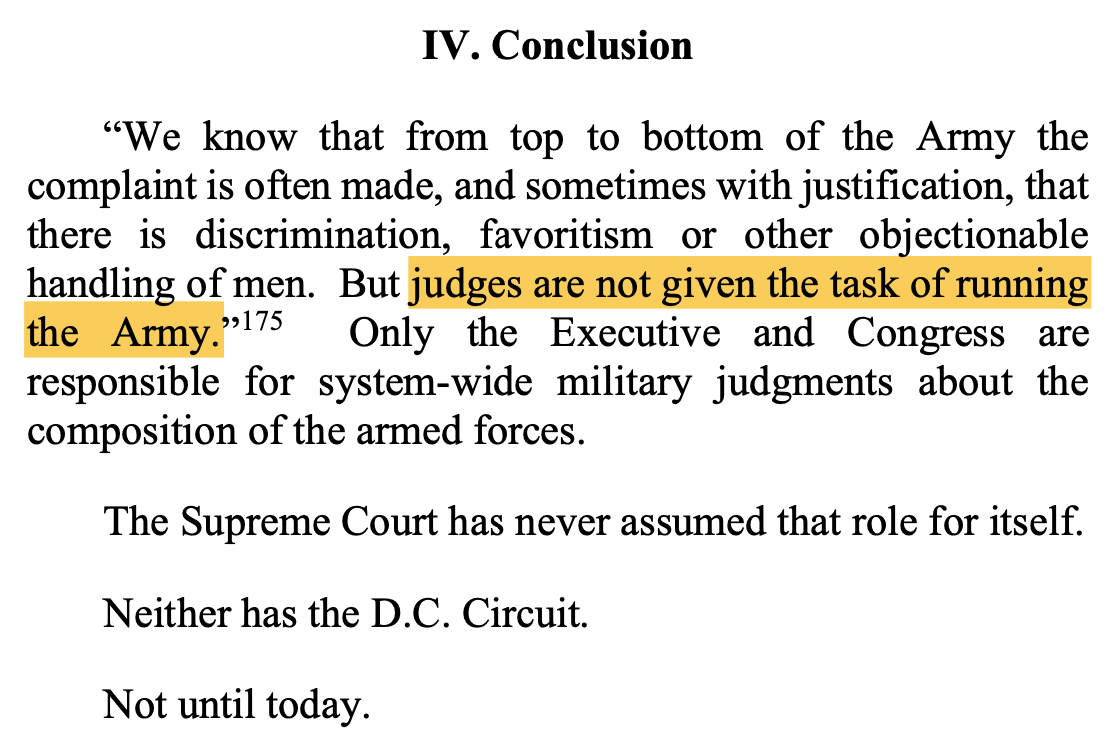
There’s just one problem. Literally one. The case Walker was quoting was not about a “system-wide military judgment[]” at all. It was, Jackson made explicitly clear, about one man’s claim — in the context of a habeas corpus petition — regarding the role to which he was being assigned within the military.
“Petitioner presents a novel case,“ Jackson wrote in opening the court’s 1953 decision in Orloff v. Willoughby about Orloff’s refusal to say whether he had ever been a member of the Communist Party, being assigned a noncommissioned military role because of that despite being a doctor called up under a special law for such conscription, and suing over being assigned that noncommissioned role.
In the paragraph immediately before the one quoted by Walker, Jackson wrote of the micromanaging that Orloff’s case would have been seeking: “[W]e are convinced that it is not within the power of this Court by habeas corpus to determine whether specific assignments to duty fall within the basic classification of petitioner.“
Of course, much has been decided since then to generalize that discussion in Orloff, but Walker’s disingenuous use of Jackson’s words — literally applying them to a very different context in which they were used — deserves note.
Later in the very paragraph from which Walker quoted, in fact, Jackson acknowledged that, while the judiciary has to be “scrupulous not to interfere with legitimate Army matters,“ it does have a role, noting that “the courts have found occasion to determine whether one has been lawfully inducted and is therefore within the jurisdiction of the Army and subject to its orders.“
Regardless of that, though, Walker was dissenting on that front on Monday.
Instead, Wilkins wrote for the court that it was not particularly difficult to conclude that what has happened here was not legitimate.
“It is neither conceivable nor reasonable to conclude that the President acted for reasons other than those he expressly gave in the Executive Order, nor is it conceivable or reasonable to conclude that the Secretary acted for reasons other than the ones he expressly gave when promulgating the Hegseth Policy,” Wilkins wrote in concluding that the plaintiffs are likely to succeed in their argument that “the Hegseth Policy violates the Equal Protection Clause.“
Thank you for your clear analysis
I’d be hopeful.. but this is going to end up at the corrupt Supreme Court and they will do anything the orange MF wants.