

The D.C. District Court strikes back
Three judges issued three rulings protecting constitutional rights in cases relating to Trump admin actions against federal inmates, Alien Enemies Act deportees, and Sen. Mark Kelly.

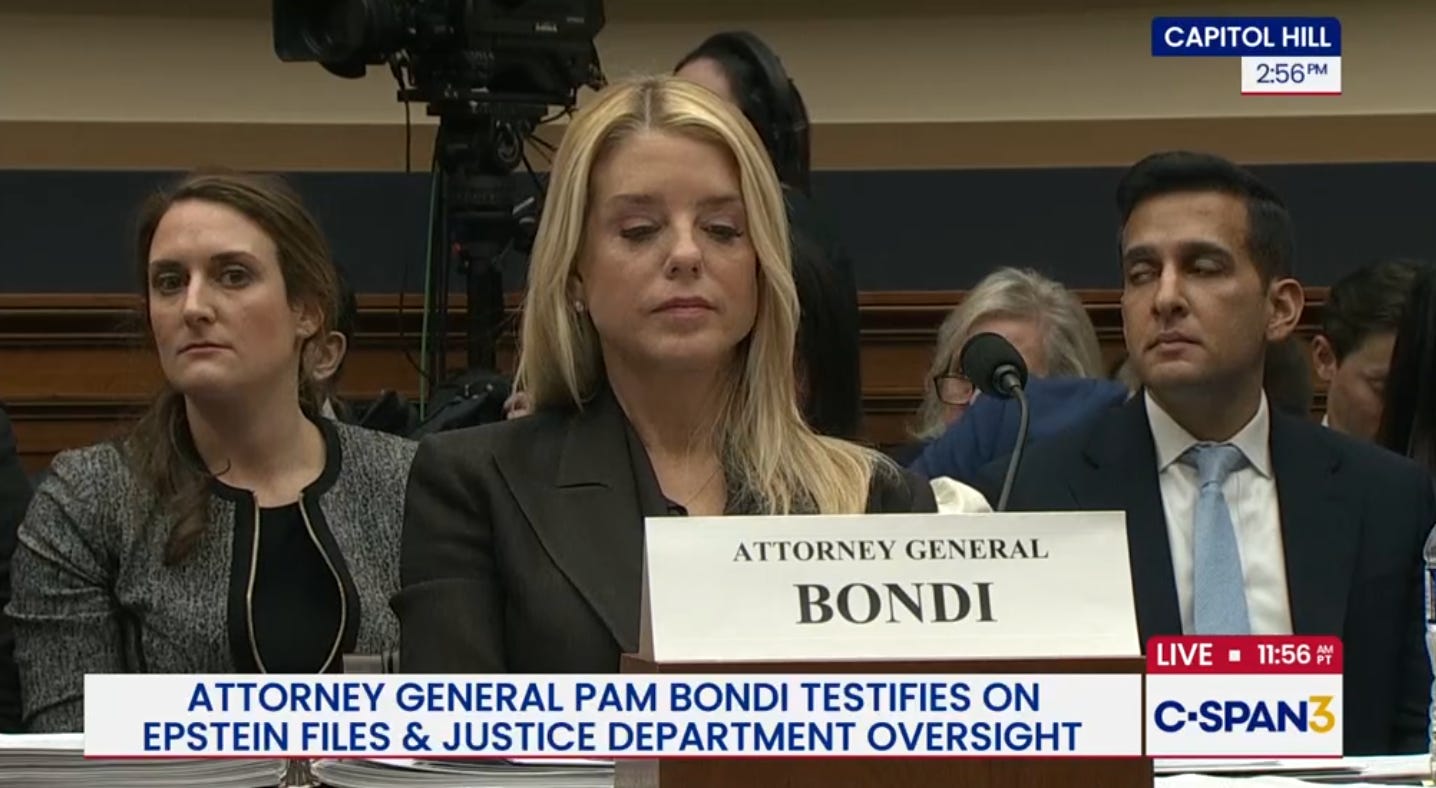
It was easy on Wednesday to get caught up the lawlessness of it all.
The Department of Justice is led by a person who, from day one, has stated that her only purpose for being attorney general is to advance President Donald Trump’s will. It was no surprise, then, that Attorney General Pam Bondi’s performance in a House hearing on Wednesday was embarrassing, yelling at members of the House like one of Trump’s adult children on a podcast.
But, underneath it all, the day ended with a good reminder that the powers of Trump and his sycophant subordinates have their limits. And a one-two response from judges on Thursday reinforced those limits in sharp terms.
The lawlessness is just the Trump administration’s presentation, not reality.
Within a 24-hour period, three judges of the D.C. District Court pushed back against the executive overreach in a way that would be unthinkable in another era. In three totally separate cases where the Trump administration has ignored people’s fundamental constitutional rights to advance its program of cruelty and retaliation, judges said, essentially, “Not on my watch,” in the midst of continuing offenses by the Trump administration against the Constitution and the nation’s laws.
Bondi’s appearance followed on the heels of DOJ filing redacted copies on Tuesday of the search warrants at issue in the alarming Georgia elections office raid.
Her appearance was followed by the White House’s purported firing of the prosecutor appointed by the Northern District of New York judges as authorized in federal law. When Bondi’s assistant, Deputy Attorney General Todd Blanche — Trump’s former personal criminal lawyer — got the law wrong on X, X’s community notes had to correct him.
There was more, and Talking Points Memo’s David Kurtz wrote all about it — including the news that broke of DOJ’s attempt and failure on Tuesday to indict members of Congress with military and/or national security backgrounds in relation to the video they issued in November reminding members of of the military and intelligence community of the oath they take and their responsibility to refuse illegal orders.
The grand jurors’ actions rejecting those indictments was just the start of the pushback.
Commuted death sentences
On Thursday night, U.S. District Judge Timothy Kelly, appointed to the D.C. District Court by Trump in his first term, issued a decision concluding that the Justice Department likely engaged in a “sham” process when seeking to carry out Trump’s retaliatory actions against those people whose death sentences then-president Joe Biden commuted to sentences of life without the possibility of parole.
After Biden’s commutations, Trump — as Kelly put it — “lashed out.” Once he became president a month later, he issued an executive order relating to the death penalty that Bondi followed up on when she was confirmed. Ultimately, the Bureau of Prisons was going to transfer those whose sentences were commuted to ADX Florence — which Kelly noted is “[t]he most restrictive prison in the federal system” and is “nicknamed ‘the Alcatraz of the Rockies’” — prompting the lawsuit and the inmates’ February request to stop the transfer. Kelly sided with the inmates.
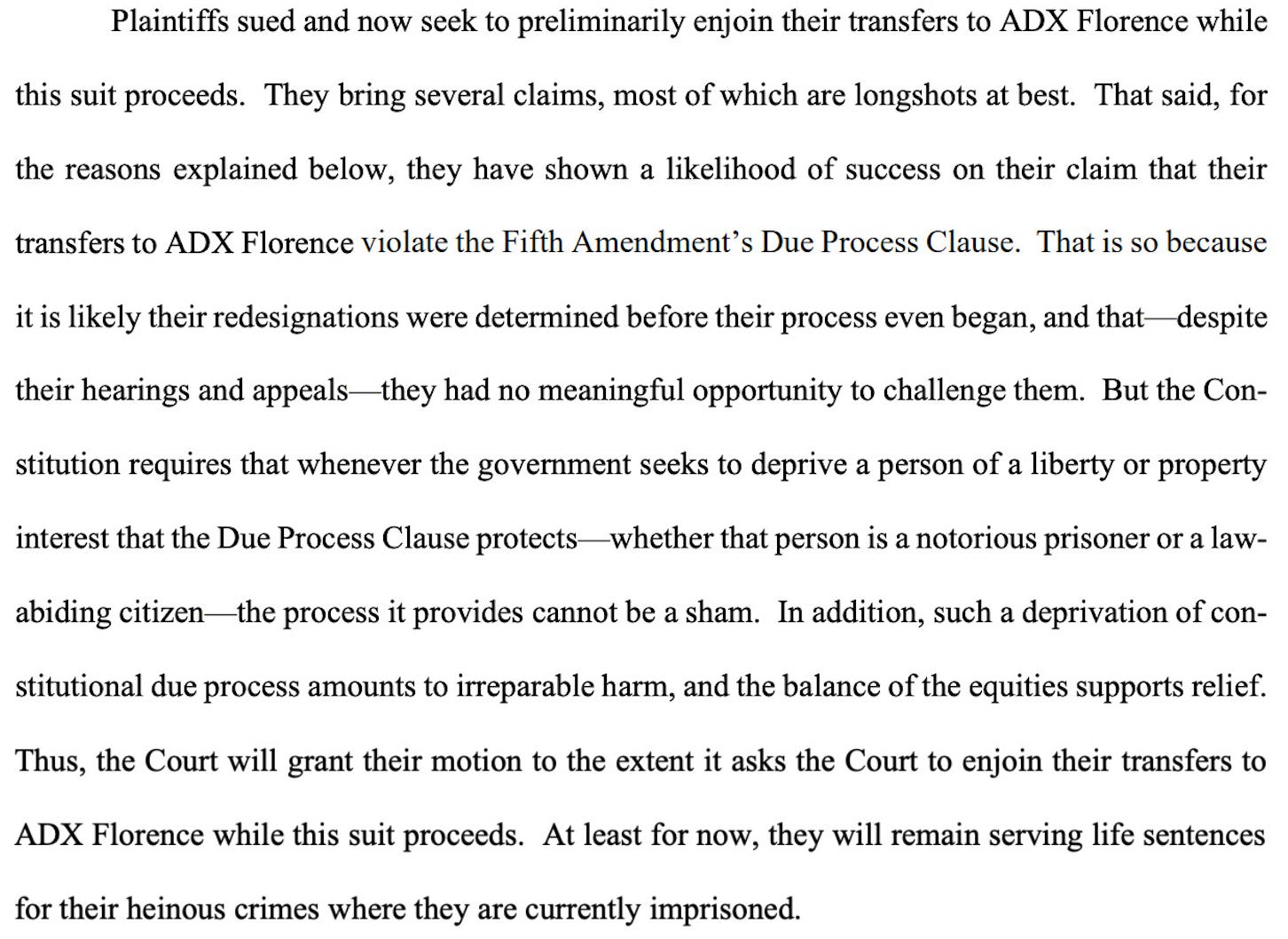
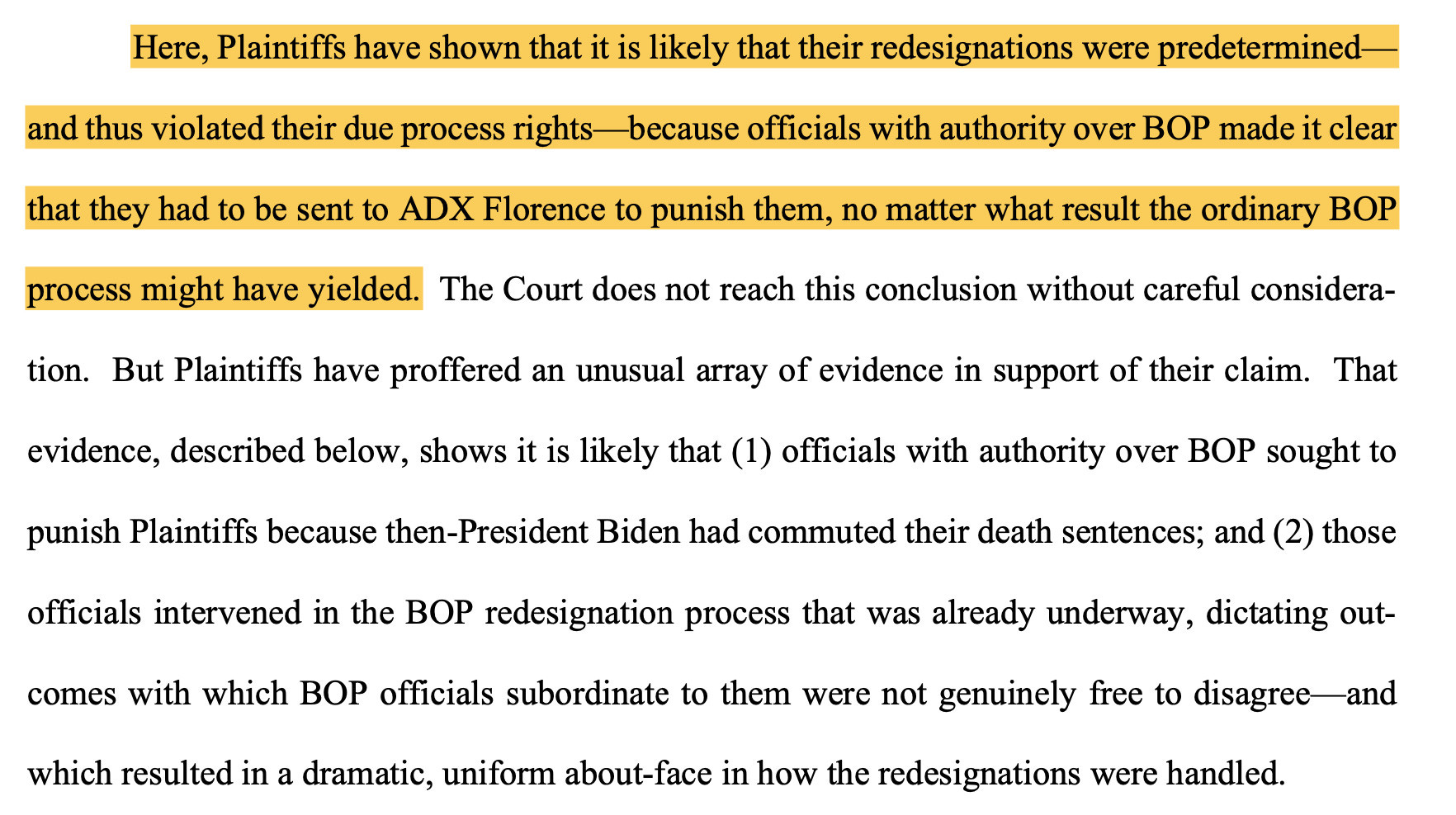
It was a strong opinion protecting the due process rights of convicted murderers — people whose pleas could be and often are ignored — and doing so by aggressively challenging the administration’s actions:
Among the more surprising moments in the opinion was the “credibility determination[]” the court made about the declaration submitted in the case by Shane Salem, the assistant director of BOP's Correctional Programs Division.
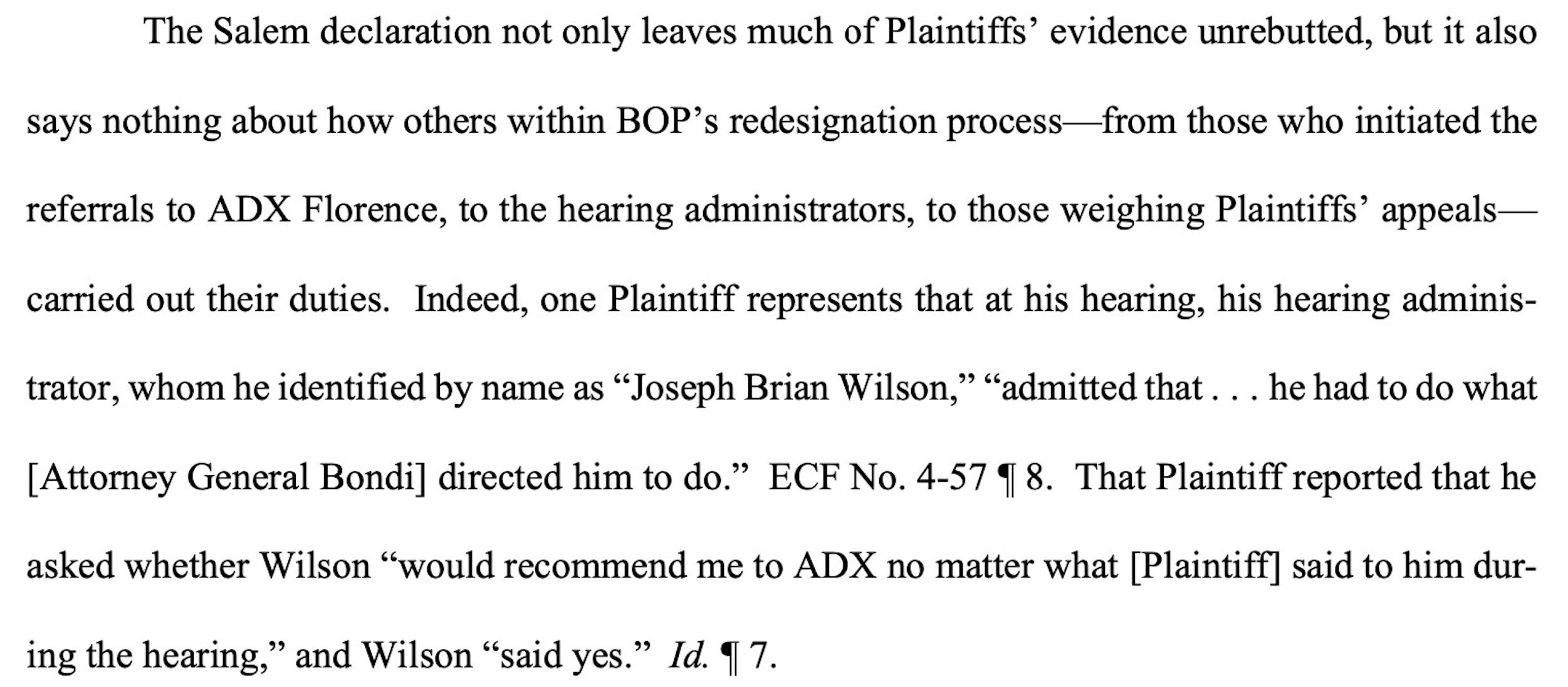
In short, Kelly wrote that “[t]he Court does not lightly cast aside“ Salem’s claims — before casting them aside.
The latest in the Alien Enemies Act challenges
On Thursday morning, the rulings against the Trump administration continued.
In the latest in the legal dispute over President Donald Trump’s March invocation of the Alien Enemies Act, Chief Judge James Boasberg, an Obama appointee, on Thursday morning ordered the administration to provide those it deported under the AEA — and initially sent to El Salvador’s CECOT prison — with the process they should have been given before the March 15 flights even took off, either in the U.S. or remotely.
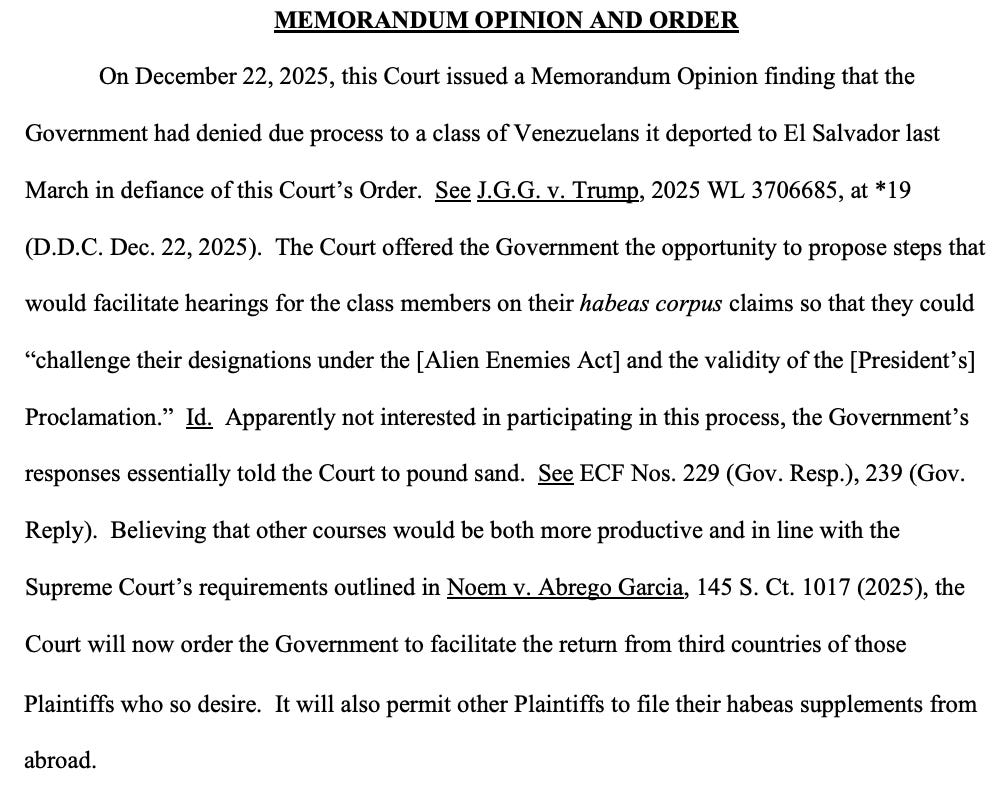
Noting the Justice Department’s intransigence, Boasberg wrote that “Defendants at every turn have objected to Plaintiffs’ legitimate proposals without offering a single option for remedying the injury that they inflicted upon the deportees or fulfilling their duty as articulated by the Supreme Court.“
Looking at the U.S. Supreme Court’s statements on the matter — both as to the AEA challenges and in Kilmar Abrego Garcia’s case — Boasberg summarized the rule as “it is up to the Government to remedy the wrong that it perpetrated here and to provide a means for doing so.“
As to the remedy here, Boasberg wrote that he was “mindful of the flagrancy of the Government’s violations of the deportees’ due-process rights” before ordering that people either be allowed to return to the U.S. at the government’s expense for further consideration of their habeas claims or be allowed to supplement their habeas claims from abroad, with future remote hearings possible.
As Boasberg noted at one point in his opinion, “It is worth emphasizing that this situation would never have arisen had the Government simply afforded Plaintiffs their constitutional rights before initially deporting them.”
A ruling for Senator Mark Kelly
Finally, a little past noon, a third ruling came down.
In it, U.S. District Judge Richard Leon — a George W. Bush appointee who was nominated to the federal bench on September 10, 2001 — blocked Defense Secretary Pete Hegseth’s attempt to punish Sen. Mark Kelly for the “illegal orders” video the he and other members of Congress issued this past fall.
Leon did not mince words in his opinion, either.
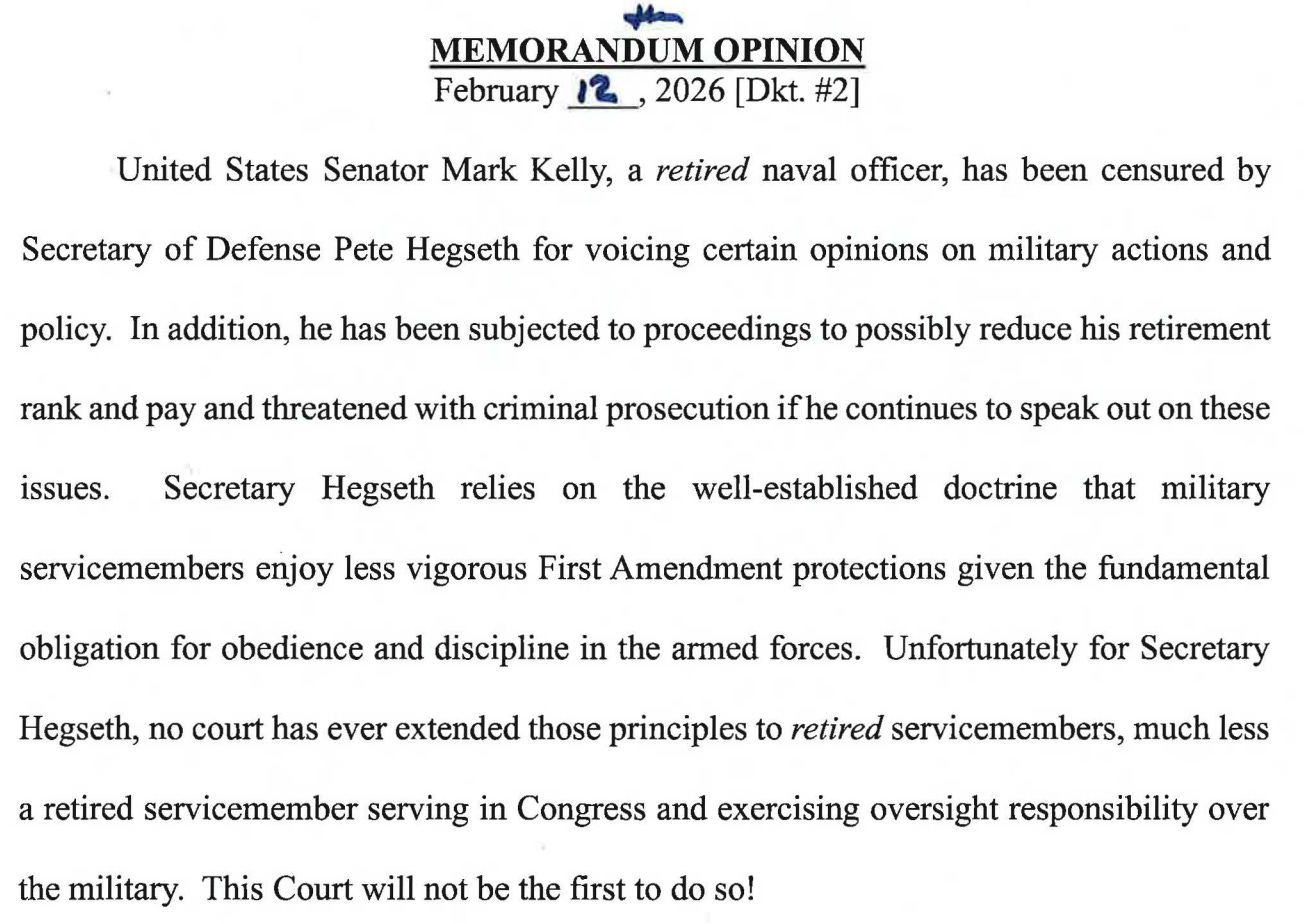
Against an argument that Sen. Kelly should have to proceed through the military appeals process before bringing his claim to court, Leon was characteristically blunt.
“I disagree,” he wrote. “This Court has all it needs to conclude that Defendants have trampled on Senator Kelly's First Amendment freedoms and threatened the constitutional liberties of millions of military retirees."
For example, in discussing ripeness, Leon noted, “Defendants argue that the case would benefit from a more developed factual record. How so? They do not say.“
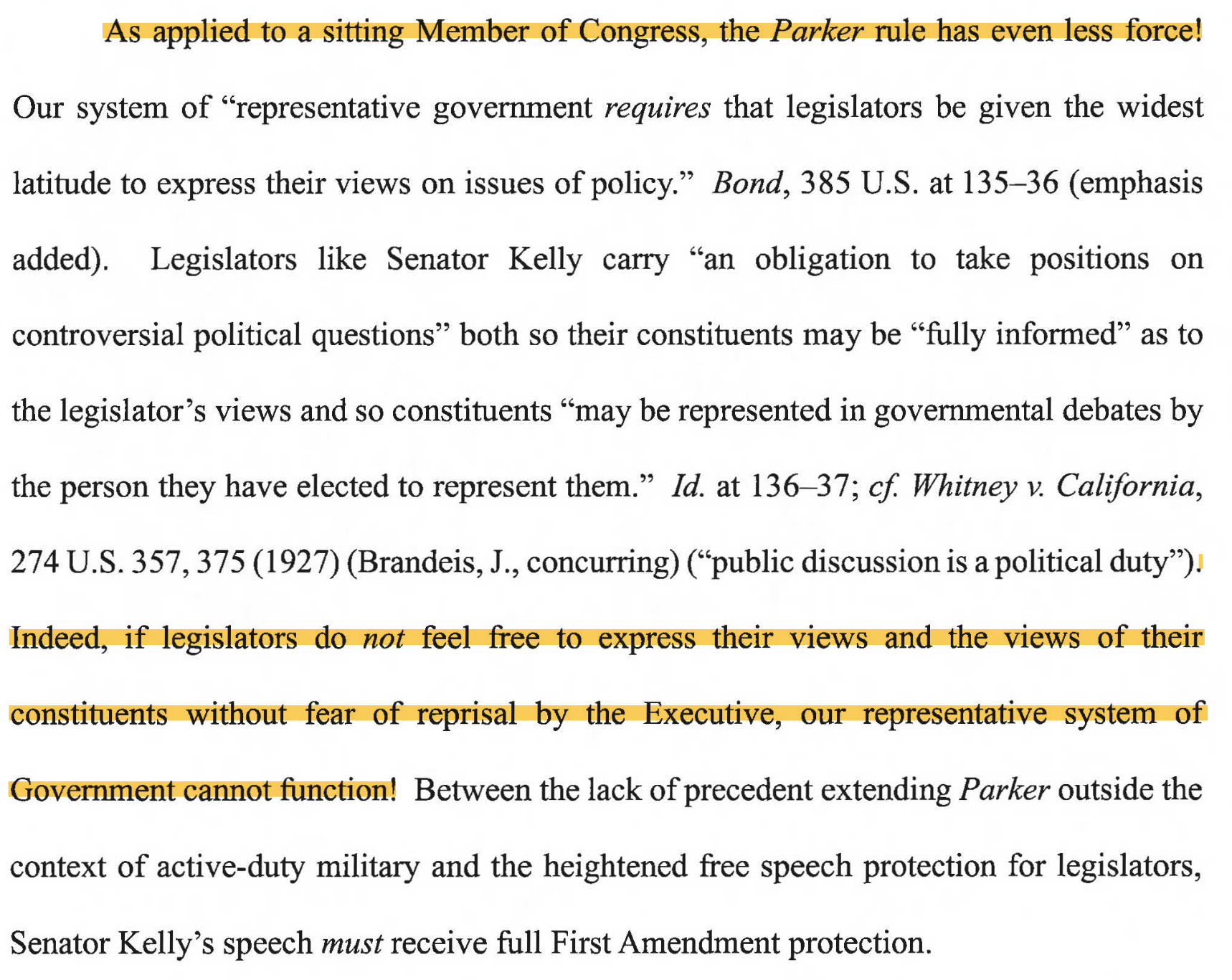
As to the merits, the Justice Department’s defense relied primarily on an expansion of Parker v. Levy, a 1974 case holding that there are more limited First Amendment protections for service members. Leon concluded that DOJ sought to stretch that case too far — on two counts.
“[T]he cases in this area uniformly involve active-duty servicemembers or speech on military bases,” he wrote. “While retired servicemembers have an ‘ongoing duty to obey military orders’ and may be recalled to active duty, … Defendants have not identified a single case extending Parker’s reasoning outside the context of active-duty soldiers.”
Applied to a lawmaker, Leon found, this extension of Parker was simply unworkable.
In short, no go for Hegseth.
Ever the optimist, in his conclusion, Leon expressed hope that “this injunction will in some small way help bring about a course correction in the Defense Department’s approach to these issues.“
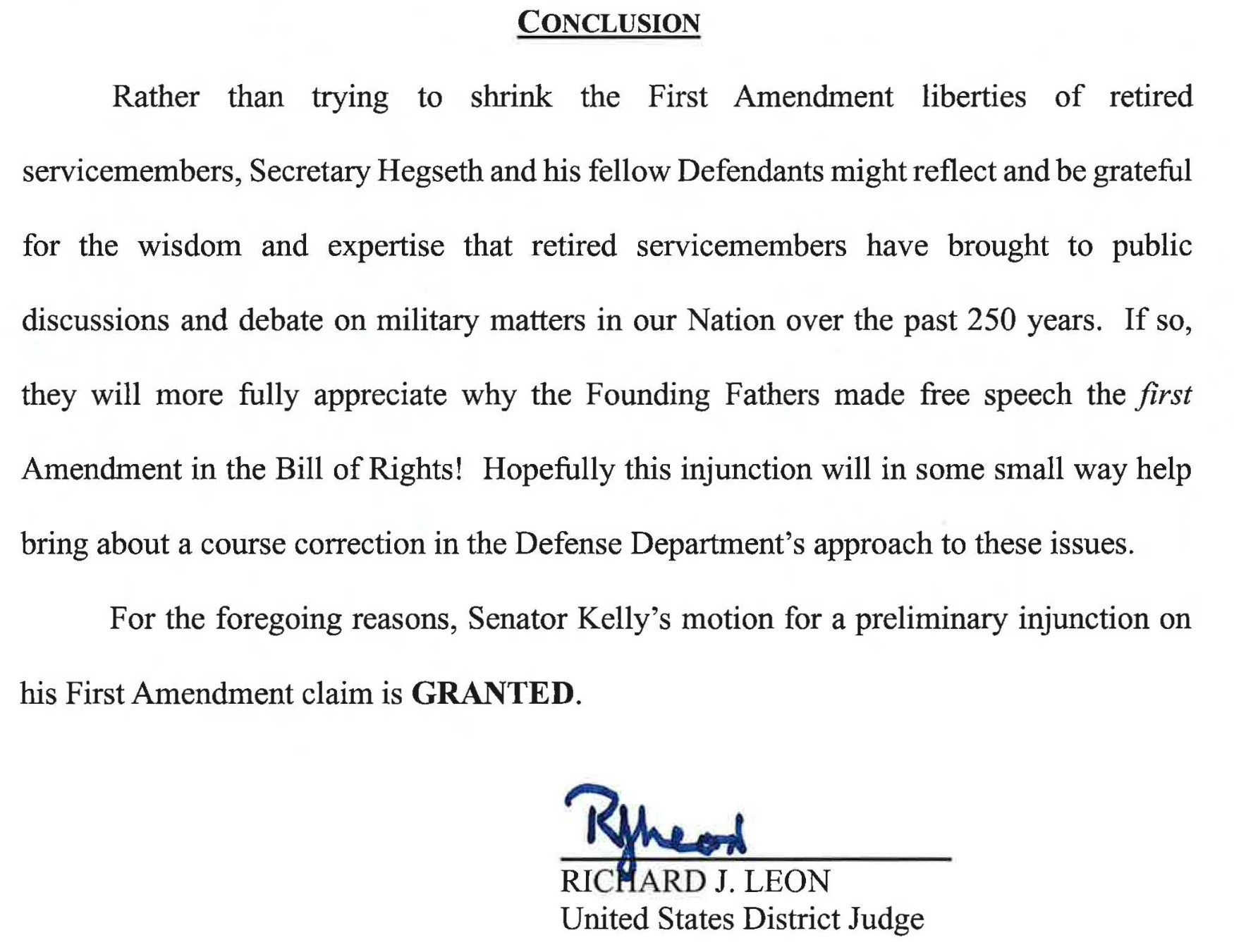
I wouldn’t hold my breath [a smart call, as Hegseth is ranting over at X that he will be appealing], but I do think this all sent a very important message.
The trio of judges — along with the grand jurors in D.C. — provided strong statements this week that lawless actions from the executive are not ultimately lawlessness if they are stopped by others who maintain respect for the law.
Almost lethal use of exclamation points!
Always appreciate …
🇺🇸Chris Geidner’s reporting