

The Supreme Court allowed Texas to kill a man the state earlier said it was not permitted to kill
Justice Jackson: "I cannot understand the Court’s rush to extinguish [life], much less in the circumstances of this case." And, for paid subscribers: Closing my tabs.

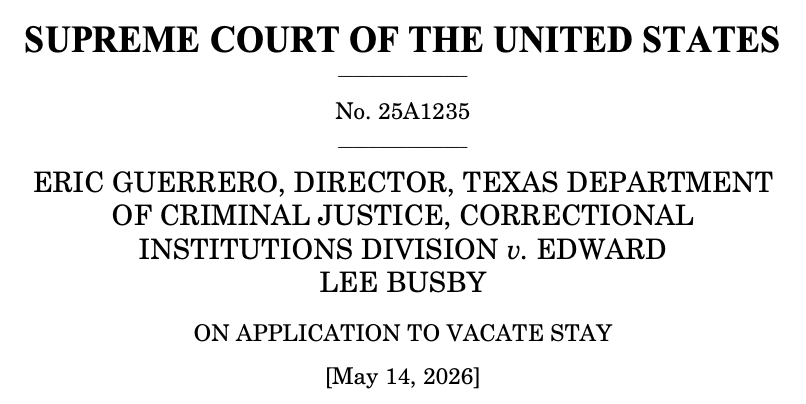
The U.S. Supreme Court on May 14 allowed Texas to kill a man who Texas officials had earlier stated in court papers was intellectually disabled and, as such, ineligible for to be executed.
Despite that, Edward Lee Busby was executed on May 14. At the Supreme Court, only Justices Sonia Sotomayor, Elena Kagan, and Ketanji Brown Jackson voiced opposition.
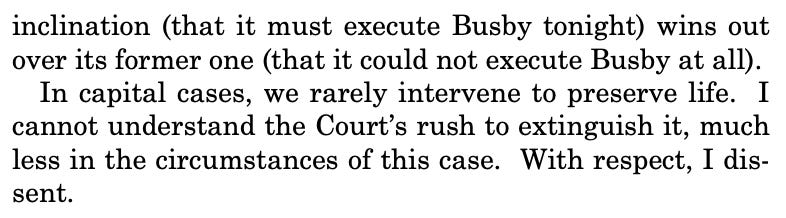
In dissent, Jackson, joined by Sotomayor, noted, “In capital cases, we rarely intervene to preserve life. I cannot understand the Court’s rush to extinguish it, much less in the circumstances of this case.“
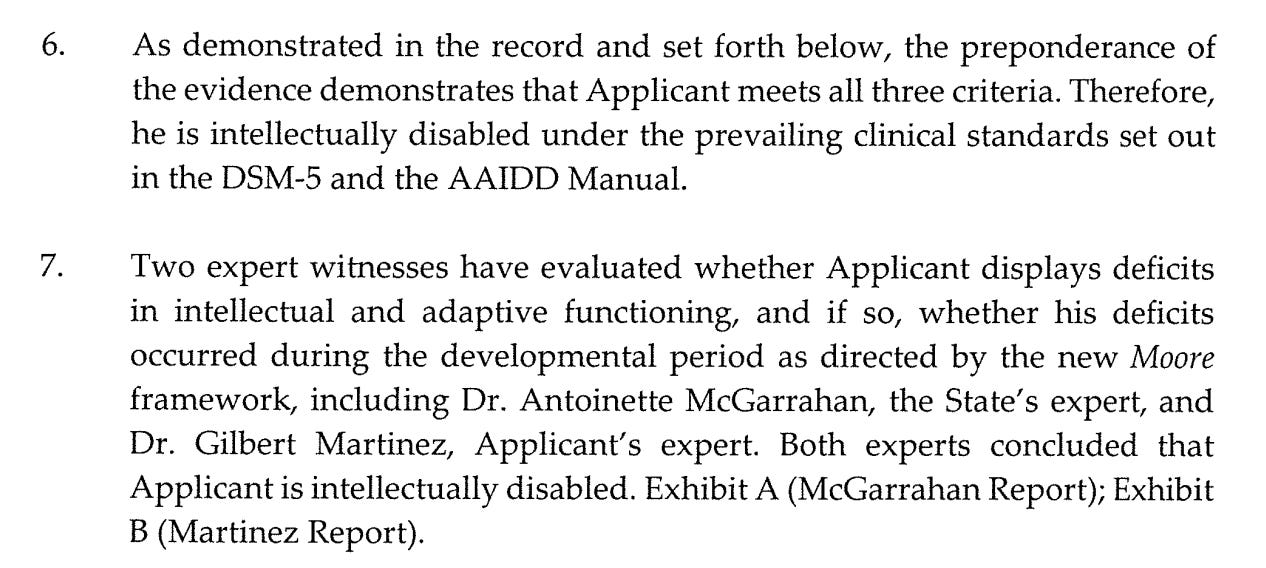
Three years earlier, in July 2023, Texas — which repeatedly sparred with the U.S. Supreme Court over standards for assessing intellectual disability, most notably in the case of Bobby James Moore — had acknowledged in state court that Busby was intellectually disabled under the Supreme Court’s standards set out in Moore’s case.
In submitting its proposed findings of fact and conclusions of law to a state court judge, Texas had noted that both its expert and Busby’s expert agreed that he was intellectually disabled:
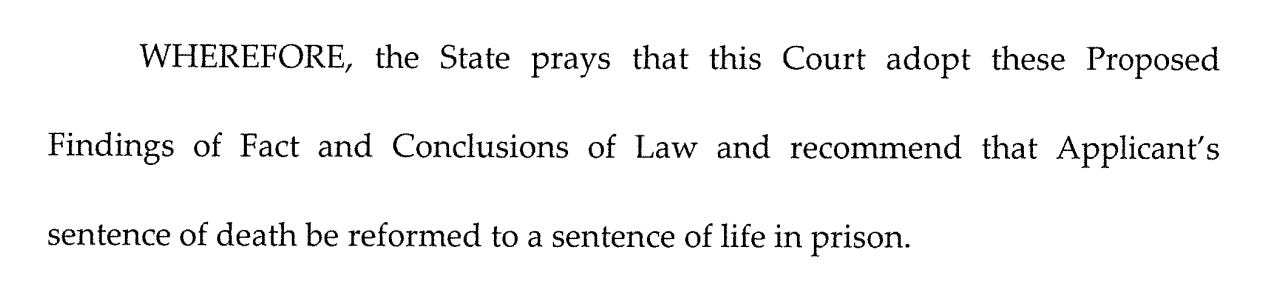
As such, the state asked the judge to alter his death sentence to a life sentence:
Less than three years later, however, Texas officials killed Busby with its lethal injection drugs. Busby was pronounced dead at 8:11 p.m. CT May 14, per the Associated Press.
How that happened, the officials who pursued it, and the courts that allowed it to happen are a damning presentation that shows how ill-suited we are to carry out the death penalty in the United States.
The state judge back in 2023 denied the request to convert Busby’s sentence, deciding that his own recollections from the 2005 trial over the 2004 killing of Laura Crane led him to disagree with the state’s expert and Busby’s expert about Busby’s intellectual disability. This was in conflict with the Moore decisions, which stressed repeatedly that “adjudications of intellectual disability should be informed by the views of medical experts.“
When Busby’s counsel returned to federal court once an execution date was set, the lawyers asked U.S. District Judge Reed O’Connor to reopen Busby’s habeas case to address the dual errors of O’Connor’s prior decision and the state court’s decision. A decade earlier, before the Moore cases and other developments, a different judge hearing the case had denied a request for funding for such an expert. (The case was later reassigned to O’Connor, who, in 2015, denied Busby’s habeas petition.)
On April 15, O’Connor denied the request to reopen the proceeding, finding that Busby “failed to establish the existence of extraordinary circumstances warranting relief“ under the rule.
The case then went to the U.S. Court of Appeals for the Fifth Circuit, which considered the permissibility of Busby’s claim — which Texas opposed now — under the already limited standards for federal litigation in state death penalty cases.
On May 8, the court blocked Busby’s execution.
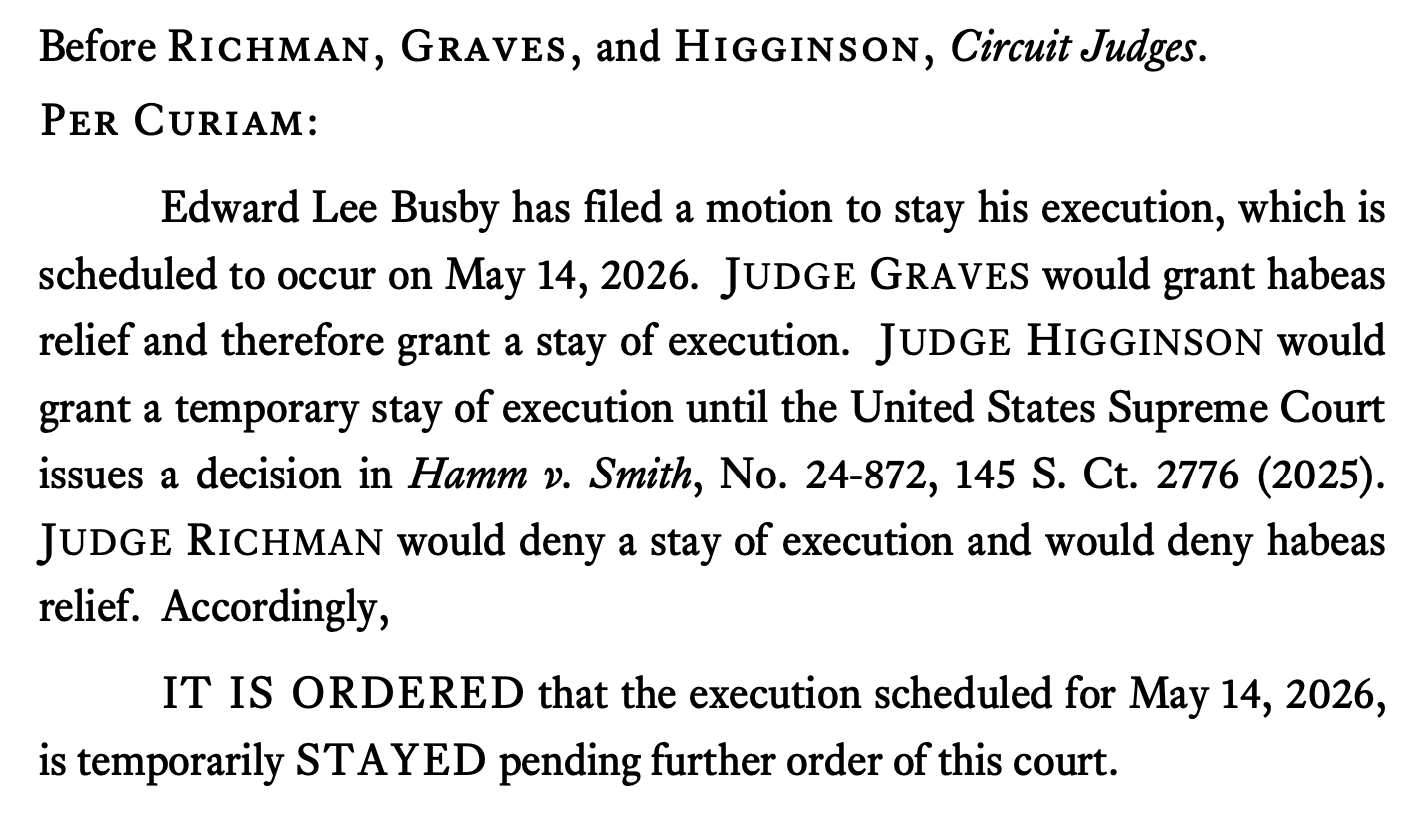
It was a relatively left-leaning panel for the Fifth Circuit, to be sure. Judges James Graves and Stephen Higginson, both Obama appointees, ultimately cast the votes for granting the stay of execution, while Judge Priscilla Richman, a George W. Bush appointee who has at times split with the furthest-right members of the Fifth Circuit, voted against a stay of execution.
All three judges wrote opinions, with Higginson essentially stating that the execution should not proceed while Hamm v. Smith, a case out of Alabama addressing how states can and should consider multiple IQ scores when making disability determinations in capital cases, is under consideration by the Supreme Court.
He wrote in part:
In a matter of life and death, we must be certain that we apply the proper constitutional rule as to whether and how to determine intellectual disability before states may execute defendants for capital crimes, especially when it is a rule that the Supreme Court imminently will clarify.
Graves, on the other hand, would have gone further and granted Busby’s underlying habeas request. As he wrote:
Every intellectual disability expert to have offered an opinion in this matter has concluded that Busby is intellectually disabled. This is not a situation where one expert says he is and one expert says he is not. Moreover, the state properly attempted to concede the issue in the state trial court based on the evidence. But the state trial judge refused to accept the medical community’s consensus and chose to rely on his own “recollections.”
In dissenting as to that conclusion, Richman applied “the less demanding burden of proof to Busby’s claim (preponderance of the evidence as opposed to clear and convincing evidence)” under the Antiterrorism and Effective Death Penalty Act (AEDPA) of 1996 in ruling on whether Texas courts ”unreasonably determined that, in light of the facts adduced in the state court proceedings, Busby failed to establish that he is intellectually disabled.”
After reviewing evidence presented and adopted by the Texas trial court and appeals court, Richman concluded, “I cannot say this decision ‘was based on an unreasonable determination of the facts in light of the evidence presented,’” leading her to a vote denying Busby’s habeas claim.
To that, Graves responded:
Judge Richman now attempts to go back through previous evidence that was not offered for the purpose of establishing whether Busby is intellectually disabled and somehow contradict the only medical experts to have offered reports on whether Busby is intellectually disabled. There is no support for such a proposition. She also offer no support to establish that a trial judge’s “recollections” of a trial some 20 years ago somehow carry more weight than any actual expert offered by either the state or the defense.
As such, the execution was to be on hold — at least until Hamm v. Smith is decided, which is expected to happen by the end of June.
But, that wasn’t OK with Texas, which went to the Supreme Court on May 11, asking for the justices to vacate the Fifth Circuit’s stay of execution.
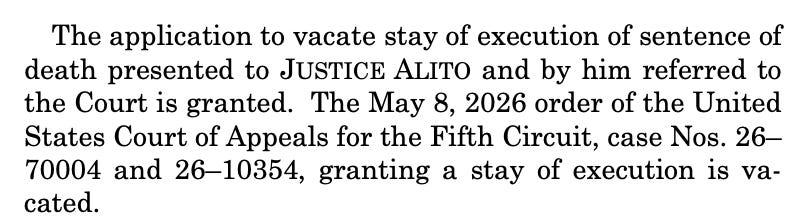
Busby’s lawyers opposed the request, but the Supreme Court, in a one-paragraph, unsigned order tossed out the Fifth Circuit’s stay of execution — allowing Texas to proceed with the execution.
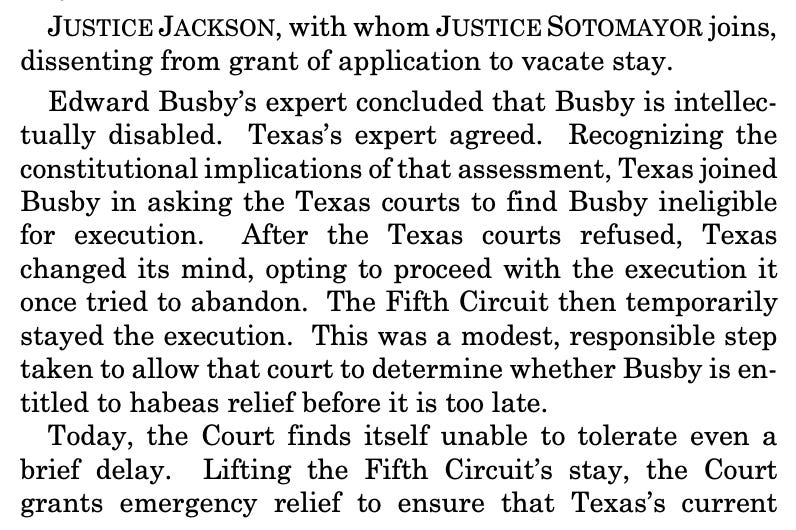
Kagan simply noted that she would have denied the request, but Jackson, joined by Sotomayor, wrote a brief, but striking, two-paragraph dissent.
Hours later, Busby was declared dead.
It was, news reports noted on May 14, Texas’s 600th execution since it resumed executions after the U.S. Supreme Court’s short-lived moratorium on executions in the 1970s.
Closing my tabs
For those who don’t know what this is, it’s my effort to give a little thank you to paid subscribers. “Closing my tabs” is, literally, me looking through the stories and cases open — the tabs open — on my computer and sharing with you all some of those I was unable to cover during the week but that I nonetheless want to let you know that I have on my radar. Oftentimes, they are issues that will eventually find their way back into the newsletter as a case discussed moves forward or something new happens that provides me with a reason to cover the story more in depth.
This Sunday, these are the tabs I am closing:
