

The Sixth Circuit jumps out ahead of SCOTUS to block Michigan's conversion therapy ban
In doing so, the appeals court also shows how conveniently standing law is used. Also: SCOTUS rejects DOJ's stay request in a case about immigration judges' speech rights.

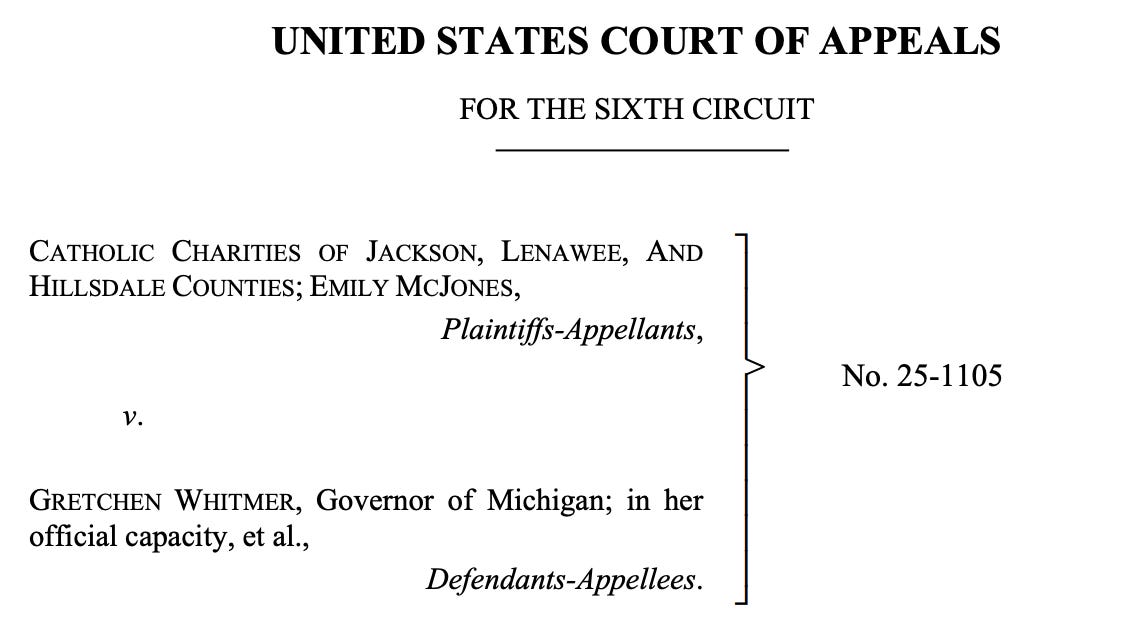
Earlier this week, the U.S. Court of Appeals for the Sixth Circuit did something somewhat unusual — jumping ahead of the U.S. Supreme Court to issue a decision likely to be resolved in large part by a forthcoming high court decision.
On December 17, the appeals court issued a 2-1 decision blocking Michigan’s conversion therapy ban for minors — a law aimed at protecting children from therapy seeking to change a child’s sexual orientation or gender identity — in a case in which it had heard arguments on October 23.
The Supreme Court, meanwhile, heard oral arguments in a similar case out of Colorado on October 7. In other words, more than two weeks after the Supreme Court arguments, the Sixth Circuit chose to do, essentially, the same thing with Michigan’s law — despite the fact that, months from now when the Supreme Court rules, the Sixth Circuit will be bound by that decision, regardless of the December 17 Sixth Circuit decision.

Judge Raymond Kethledge, a George W. Bush appointee, apparently didn’t want to let the Supreme Court speak for him — deciding the Michigan case brought by Catholic Charities and others before the Supreme Court issued its decision and declaring that the law regulated speech, not conduct:
HB 4616 proscribes counseling (or not) based solely on the therapist’s message: if the counseling “seeks to change an individual’s sexual orientation or gender identity,” the therapist can lose her license; but if the counseling supports “a gender transition,” the counseling is lawful. As applied to these plaintiffs, therefore, the Michigan law restricts speech, not conduct.
Given that, he continued, the state did not “come close” to showing that the law should be upheld under strict scrutiny. Ultimately, he ordered the case to be “remand[ed to the district court] for prompt entry of a preliminary injunction consistent with this opinion.“
He was joined in his opinion by Judge Joan Larsen, a Trump appointee from Michigan.
Judge Rachel Bloomekatz, a Biden appointee, dissented, highlighting the unusual decision to proceed with the case — and making it clear that was not her choice.
[T]he majority opinion reaches this result even though all agree that the Supreme Court is poised to resolve the same issue in Chiles v. Salazar. Neither the plaintiffs nor the majority opinion provides a single example of our court pushing forward to decide an appeal when, as here, the Supreme Court held oral argument in the controlling case before we did. I would not make this case the first.
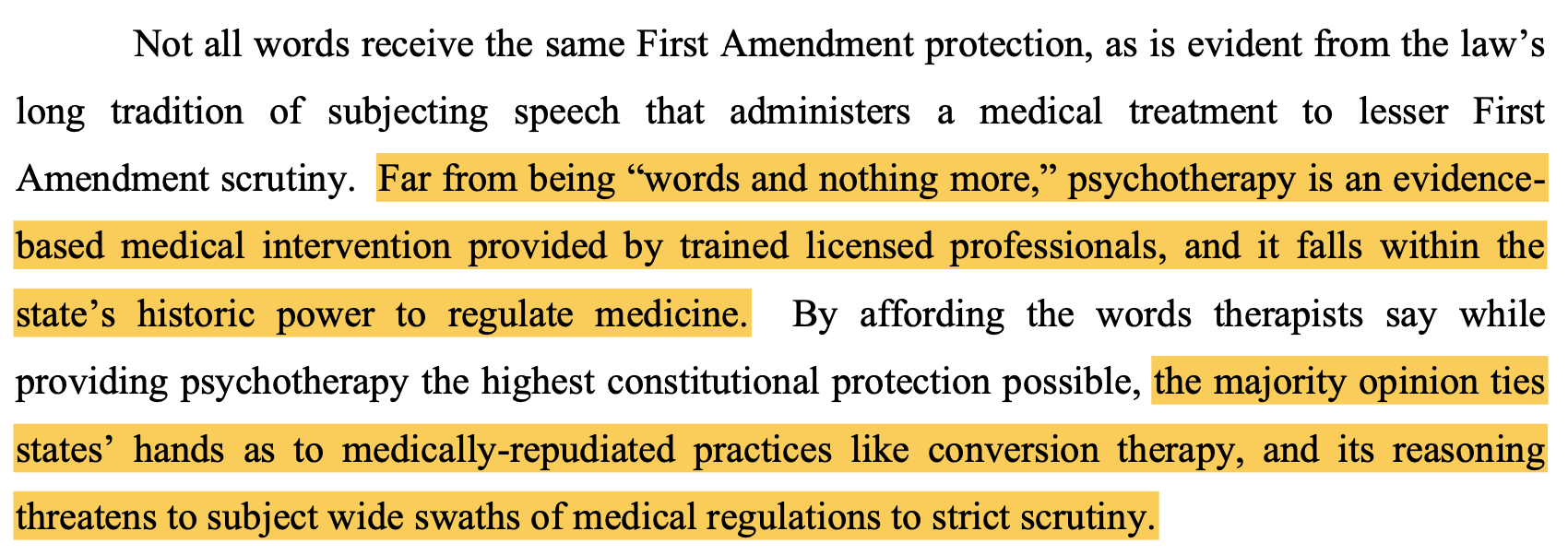
But, as Bloomekatz continued, “given that we are pressing to the merits,“ she did so — forcefully. On the substance, Bloomekatz wrote in summary:
Nonetheless, the final decision here will be coming from the Supreme Court sometime in the new year — and expected before the end of June.
One final note.
In addressing standing, Kethledge was solicitous of the claimed chill of the plaintiffs’ speech allegedly caused by the law:
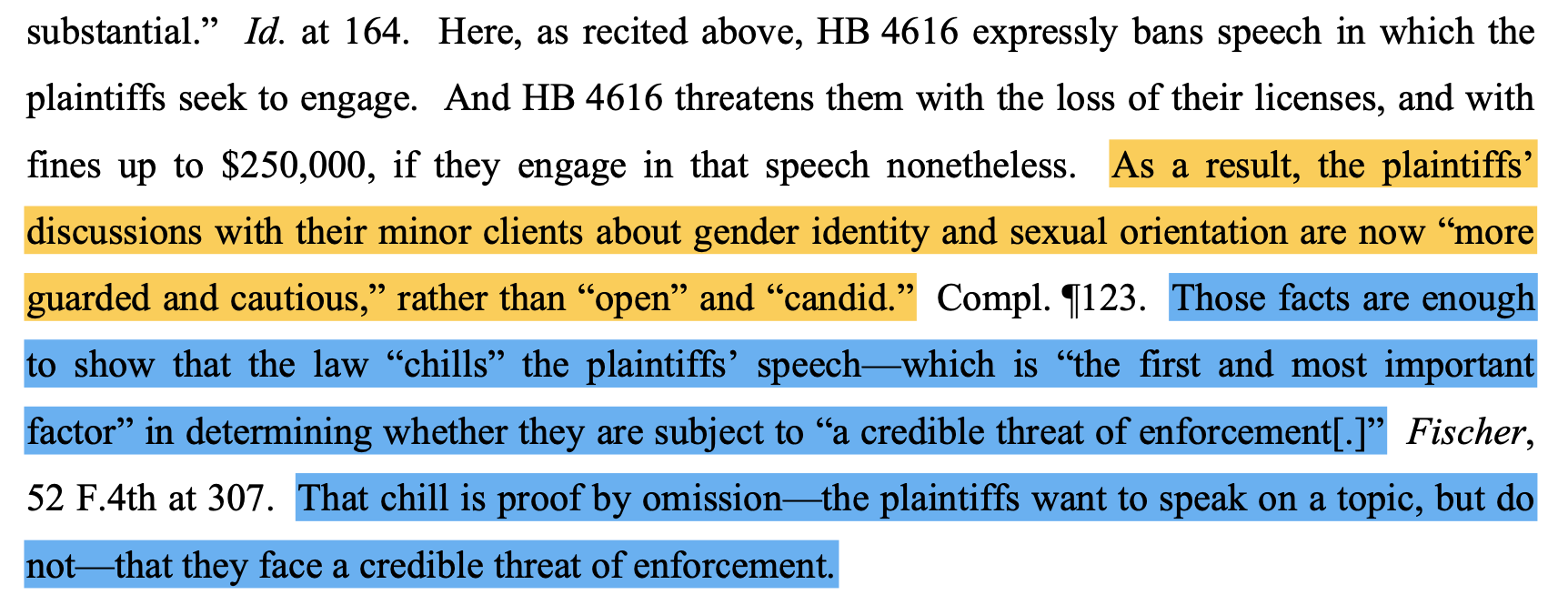
The law, Kethledge wrote, made the plaintiffs “more cautious” about how they carried out the conduct that could run them into trouble with the law. “That chill is proof by admission — the plaintiffs want to speak on a topic, but do not — that they face a credible threat of enforcement,“ he wrote.
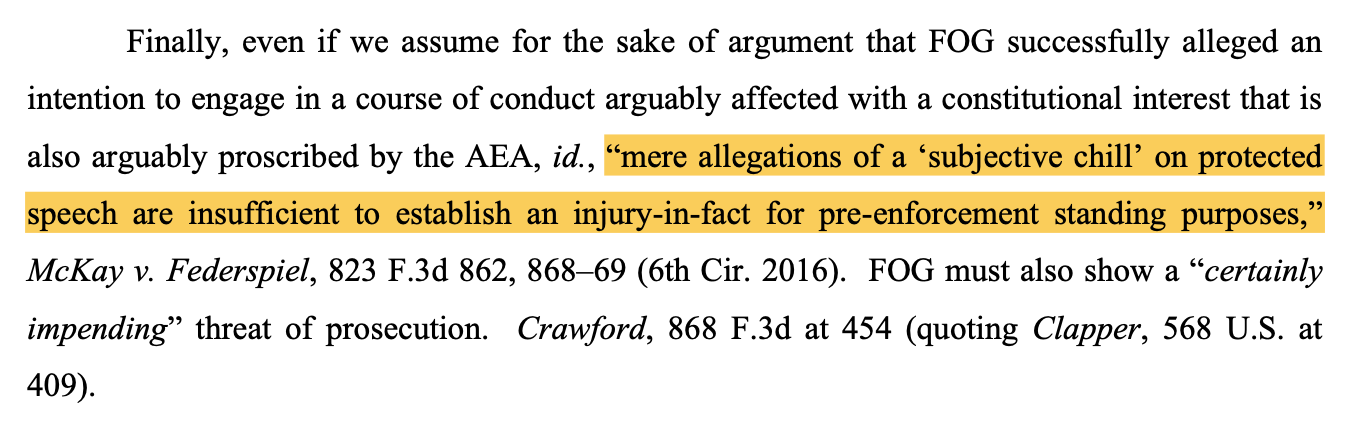
That would be fine if the Sixth Circuit hadn’t, just this past year, rejected a First Amendment challenge to Tennessee’s anti-drag law on standing grounds in an opinion that ignored the chill of those plaintiffs’ speech clearly intended by the law.
In that case, Judge John Nalbandian, a Trump appointee, wrote for another 2-1 court that a drag group — Friends of George’s — lacked standing to challenge the law. In part, he wrote:
He was joined by Judge Eugene Siler, a George H.W. Bush appointee.
Judge Andre Mathis, a Biden appointee, dissented. It is an extensive dissent, and I don’t want to relitigate that case here, but I do want to highlight a key paragraph from Mathis. He explained that this did not just involve “mere allegations” of chill:

When Catholic Charities is “more guarded and cautious,” it has standing in the Sixth Circuit.
When Friends of George’s “alter[s] the content of their productions,“ it lacks standing in the Sixth Circuit.
Immigration judge free speech news
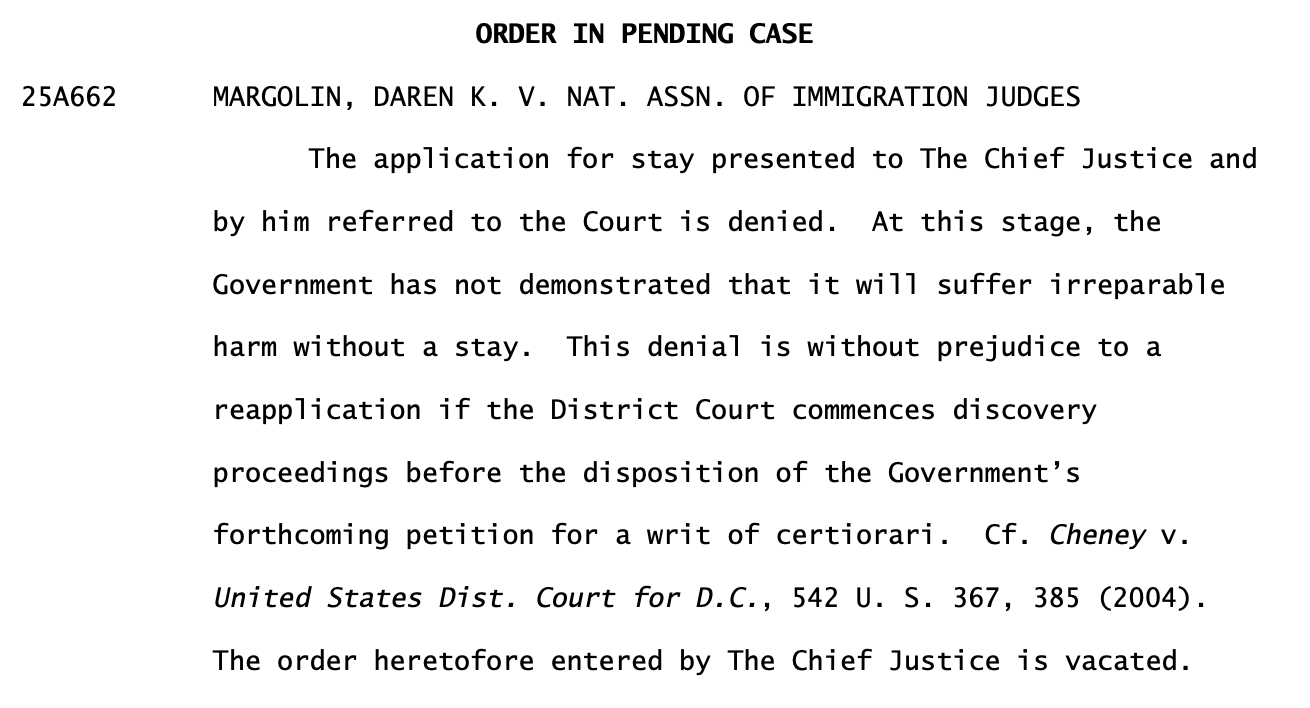
To keep up with the First Amendment content this weekend, Josh Gerstein at Politico covered Friday’s order from the U.S. Supreme Court rejecting a Justice Department stay request in a prior restraint case brought by immigration judges.
“[T]he justices turned down an emergency request to halt a lawsuit over the government’s effort to bar immigration judges from speaking publicly about their work,“ Gerstein wrote of the brief order:
Ramya Krishnan, senior staff attorney at the Knight First Amendment Institute at Columbia University — which brought the lawsuit on behalf of the National Association of Immigration Judges (NAIJ) — issued a statement responding to the order:
The Supreme Court was right to reject the government’s request for a stay of proceedings. It should also quickly reject the government’s soon-to-be filed cert petition. The restrictions on immigration judges’ free speech rights are unconstitutional and it’s intolerable that this prior restraint is still in place.
Law Dork will have more on this challenge as called for in the new year.
I guess standing depends on the politics of the judges.
Every time I see a photo of the Supreme Court with the scaffolding up it reminds me of masked ICE agents.