

Supreme Court's conservatives OK trans sports bans
Kavanaugh wrote the court's opinion, but Sotomayor dissented to explain for the liberal trio what the court got wrong about equal protection law.

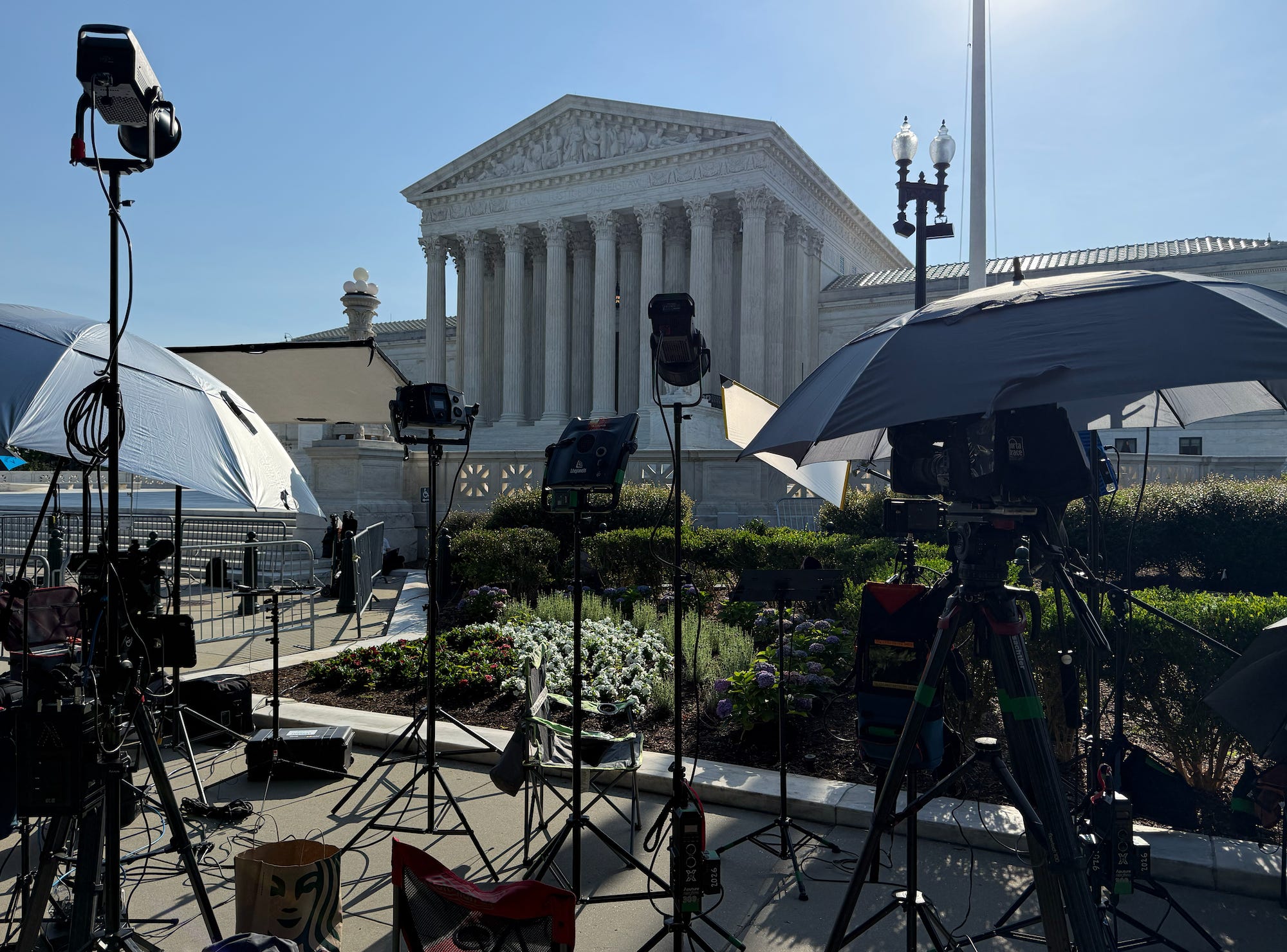
The U.S. Supreme Court on Tuesday held that states can bar transgender girls and women from playing on girls and women’s sports teams.
In an opinion by Justice Brett Kavanaugh that was extensively focused on the “sports context,” the court held that neither the Equal Protection Clause of the Fourteenth Amendment nor Title IX of the Education Amendments of 1972 (in light of the sports-specific language of 1974’s Javits Amendment1) bar the Idaho or West Virginia laws.
On the equal protection front, Justice Sonia Sotomayor dissented in West Virginia v. B.P.J., joined by Justices Elena Kagan and Ketanji Brown Jackson. (The trio also would have held the Idaho case, Little v. Hecox, to be moot, unlike the majority, but that is ultimately a factor that doesn’t matter for the analysis of the laws.)
Although the court’s ruling is itself harmful and could have implications for other cases, it was not as wide-ranging of a ruling as anti-trans forces would have wanted. It also was written at points with a softer tone — urging “respect” for all and denouncing vilification — as was suggested at oral argument.
In one of the eight times the Kavanaugh invoked the “sports context,” for example, he explicitly disclaimed a broader interpretation of Tuesday’s opinion.
“Sports are different from, say, a typical employment or educational opportunity where equal protection often may require that the government generally treat an individual without regard to the individual’s sex,” he wrote. “In the sports context, by contrast, everyone agrees that the States may maintain separate women’s and men’s teams—in other words, that the States may make distinctions based on sex—because of the inherent physical differences between women and men.“
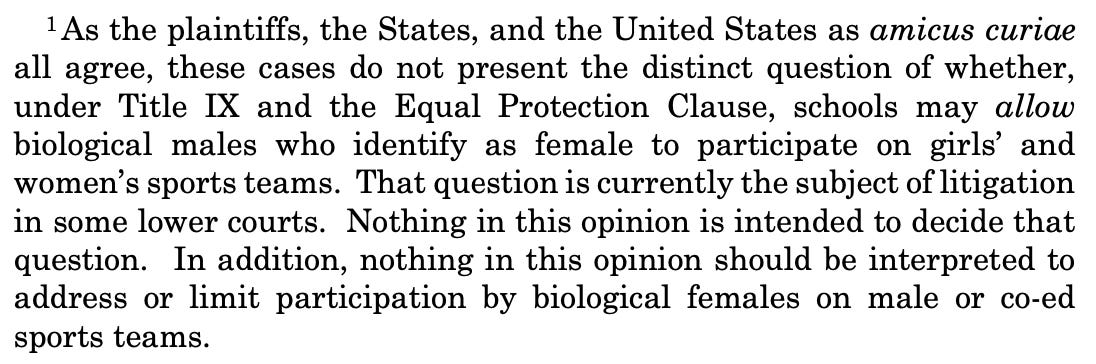
The case also did not address or resolve questions about state laws allowing trans girls and women to compete on women’s teams, as Kavanaugh noted in a footnote:
That is not to disclaim the significance of the ruling, however, coming just one year after the Supreme Court also upheld Tennessee’s ban on gender-affirming medical care for trans minors in U.S. v. Skrmetti.
In Kavanaugh’s opinion, he never once calls the people involved in these cases “transgender girls” or “transgender women,” despite that being who he was failing to protect on Tuesday. He generally — at least 13 times — instead referred to “biological males who identify as” girls or women. Even when referring to transgender people, it was by using a non-gendered term like “transgender athletes” or “transgender students.” This erasure is stigmatic, despite his effort at other points to put forward a softer tone.
On the legal front, there were three questionable moves that could have consequences for later cases.
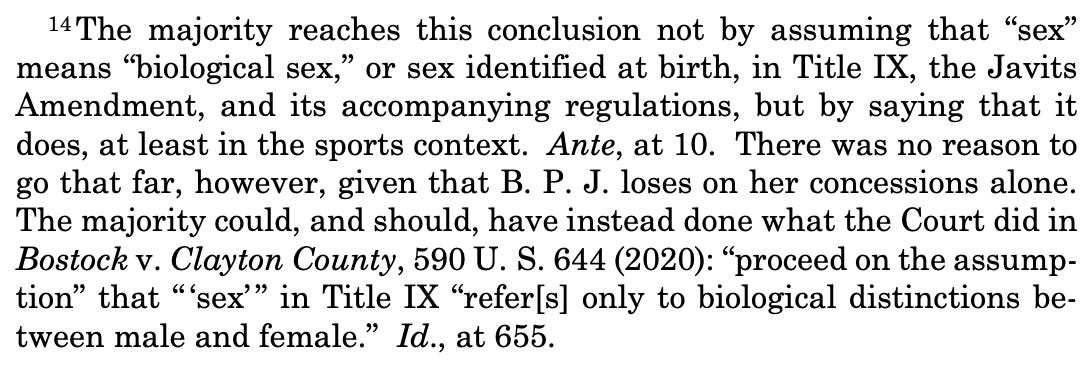
The opinion also went further than it needed to go in the Title IX section. Kavanaugh wrote, “The term ‘sex’ in the 1972 Title IX statute, the 1974 Javits Amendment, and the 1975 Title IX regulations cannot plausibly be interpreted to refer to anything other than biological sex,” despite that the student challenging the West Virginia law on the basis of Title IX was “not disputing in this case that West Virginia can have its definition of sex” as “biological sex.”
As Sotomayor noted, while she and the other Democratic appointees agreed on the Title IX front in this case in the sports context because of the Javits Amendment, it also was because Becky Pepper-Jackson, the West Virginia plaintiff referred to as B.P.J. in court filings, “does not dispute that, for the purposes of this case, ‘sex’ in Title IX means ‘biological sex,’ or sex identified at birth.“ Because of that, Sotomayor wrote that the court didn’t need to decide that here:
Kavanaugh also made a jumble of certain aspects of sex-discrimination law, as Sotomayor detailed at length in her opinion’s dissent, where she wrote that the “majority badly errs in two ways” on that front alone and added that “this Court’s equal protection precedents require a very different approach to B.P.J.’s claim than the one the majority follows today.“
To give one key example, in an extended discussion of the people affected by the laws, a “subclass” in the challengers’ sex-discrimination claim, Kavanaugh and Sotomayor presented contrasting visions for equal protection — only one of which was based in past precedent (the one pressed by Sotomayor).
According to B. P. J., transgender girls and women who both receive gender-affirming treatment and have never experienced endogenous male puberty neither possess any inherent athletic advantage nor pose any safety risks because of their sex identified at birth. As B. P. J. tells it, this distinct subclass is thus similarly situated to cisgender girls and women and yet is still being excluded. It is this overbreadth, she argues, that leads to the equal protection violation.
For the dissenters, Sotomayor argued that the court should have — as the U.S. Court of Appeals for the Fourth Circuit sought to do — sent the case back to the district court for further factual development related to that claim.
That’s not what Kavanaugh or the court did. Instead, while calling the subclass discussion “a useful construct,” he employed it here to dismiss the claim:
[I]f a State’s interests do not apply to an especially large subclass within the class specified by the State’s law, then that fact may demonstrate that the relationship between the State’s classification and the State’s interests is not close enough. But as long as the relationship is sufficient as a general matter, the State is not constitutionally required to grant individualized exemptions to specific athletes or subclasses.
That is not, Sotomayor countered, what the law has stated with respect to sex discrimination claims.
“To the majority, the fit here [between the state’s claimed interests and the ban] is simply good enough,” she wrote. “In so concluding, the Court elevates the reasoning of earlier dissents and lowers the State’s burden for justifying the use of sex classifications in potentially all cases.”
Finally, Kavanaugh noted that the court “need not definitively resolve whether rational basis review or intermediate scrutiny applies to transgender classifications” because, he had already explained that the court viewed the law as surviving intermediate scrutiny under the sex-discrimination claim. Even there, though, Kavanaugh flubbed. He wrote:
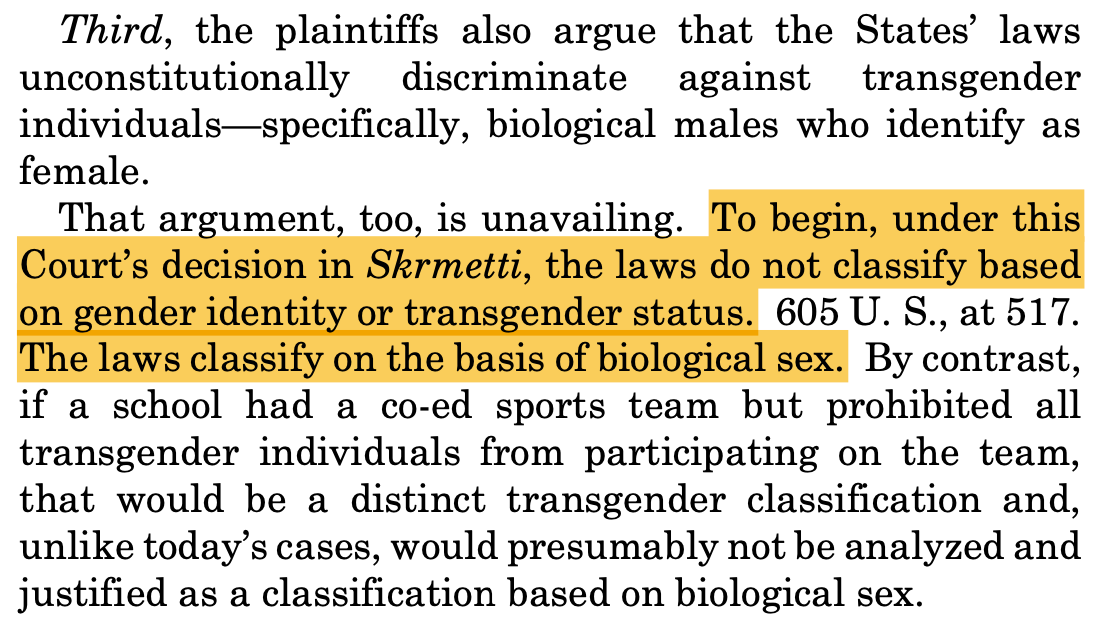
This isn’t even the weak argument Chief Justice John Roberts made in Skrmetti. It’s a next-level argument that gives itself away in the “[b]y contrast” sentence, where Kavanaugh referred to his hypothetical law as containing a “distinct transgender classification.” There is no reason why a law can’t classify based on both sex and transgender status, and the laws before the court showed that.
There is much more to be said and written about West Virginia v. B.P.J. — including Justice Clarence Thomas’s hateful concurrence and Justice Ketanji Brown Jackson’s illuminating opinion looking toward a better time — but the first-line news Tuesday is this: The Supreme Court ruled against transgender people again, and Justice Kavanaugh did so in a way that will make certain arguments more difficult and was sloppy at points, but, despite that, there is hope for future cases in different contexts.
As Kavanaugh wrote regarding the Javits Amendment, “The Javits Amendment directed the then-Department of Health, Education, and Welfare (HEW) to promptly issue ‘regulations implementing the provisions of’ Title IX with respect to ‘the prohibition of sex discrimination.’ §844, 88 Stat. 612. The amendment further specified that the regulations ‘shall include with respect to’ ‘athletic activities reasonable provisions considering the nature of particular sports.’“
I did ban two people from commenting due to their now-deleted anti-trans comments. My place; my rules.
I think this significantly understates how challenging this decision is from a trans perspective. Kavanaugh’s opinion does not even refer to the plaintiffs by their correct pronouns, instead calling them “biological males” throughout. It gives almost no scaffolding for future challenges - and gestures very clearly to how bathroom bans and other restrictions on single sex spaces would fall under its logic.