

Birthright citizenship, firing powers, the National Guard, and Trump's made-up "peace prize"
A Trump era Friday in December is not a normal Friday in December.


A Friday in Washington, D.C. in December of 2025 is not like a normal Friday in December.
This is the Trump era, so everything is happening.
The U.S. Supreme Court announced on Friday afternoon that it will be hearing a pivotal case over the legality of President Donald Trump’s executive order aiming to end birthright citizenship.
The U.S. Court of Appeals for the D.C. Circuit issued a decision on Friday morning that would upend the way so-called independent federal agencies operate.
And, a Justice Department lawyer defending the continued National Guard deployment in Los Angeles told a federal judge that, if the National Guard is properly federalized at any point, any decision to extend that federalization is completely unreviewable by the courts.
All in a day. And that wasn’t all.
My morning trip to the allergist was complicated by one of the more brazenly corrupt actions of this moment — even by Trump’s low standards.
The Kennedy Center was hosting the FIFA World Cup draw on Friday morning.
Beneath that simple sentence, however, were a number of stories, which most embarrassingly involved FIFA President Gianni Infantino physically presenting Trump with its “inaugural FIFA Peace Prize” — a “prize” pretty transparently created for Trump, who is mad he didn’t get the Nobel Peace Prize.


What’s more, FIFA was at the Kennedy Center for free, as The Washington Post earlier reported — a decision that disrupted previously scheduled performances and was almost certainly the result of Trump’s takeover of the arts institution.
FIFA, with its history of corruption, jumping in to prop up a corrupt presidency is not surprising, but it is a reminder of just how transparently corrupt this moment is.
A handful of people were protesting Trump, his administration, and FIFA — in varying degrees and for various sometimes related reasons — a couple blocks away from the Kennedy Center in the view of vehicles or pedestrians headed to the World Cup draw.
The protest happening in the shadow of the Watergate Complex might have been a bit too on the nose. But, also, maybe not.
The birthright citizenship case at SCOTUS
At the other end of the National Mall, the U.S. Supreme Court issued a handful of orders — including the order that it will be hearing the Justice Department’s appeal in one of the cases challenging Trump’s January 20 executive order aiming to end birthright citizenship.

No court has sided with the Trump administration on the merits of the executive order, which many judges have found likely violates both the Fourteenth Amendment and federal law.
The case the court took — Trump v. Barbara — is DOJ’s appeal of a loss below in a class-action challenge that was brought following June’s Supreme Court decision ending universal injunctions (while acknowledging that certain types of cases, like class-action cases, could have nationwide effect).
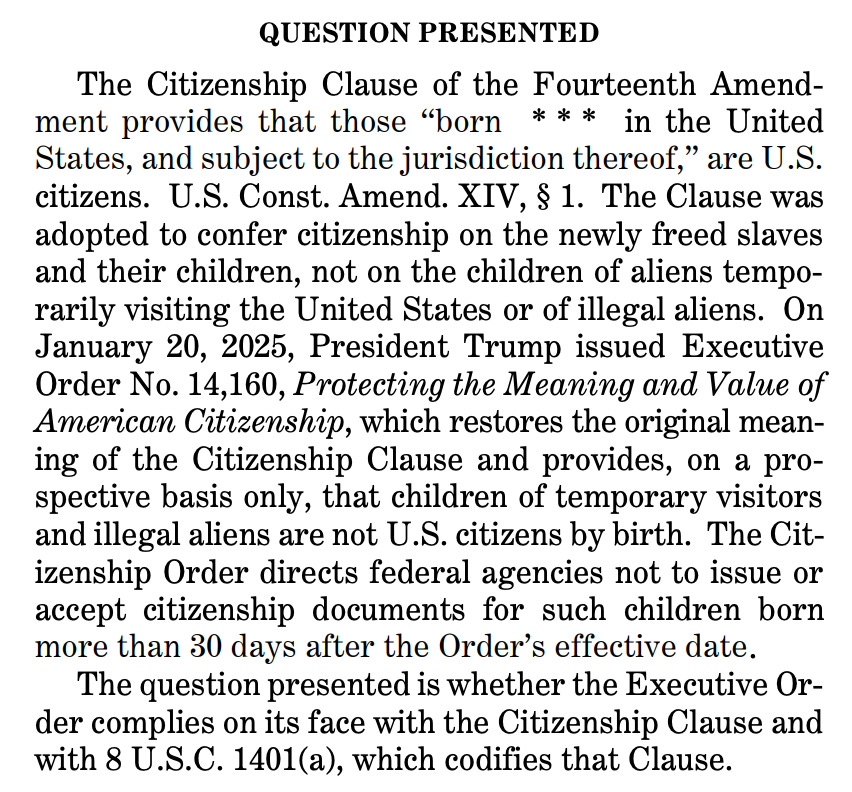
At the Supreme Court, DOJ will certainly fight for Trump’s executive order, but, as I have discussed previously, this is a case where DOJ has been slow-walking its defense.
Although nothing is certain with this Supreme Court majority, this would be a decision as lawless as any in our lifetimes. It would not be a difference of opinion, an alternative path, or even a politicized decision. It would be a decision effectively overturning a key portion of the Fourteenth Amendment, and it would need to be treated as such.
Don’t take my word for it. As U.S. District Judge Joseph Laplante wrote in granting provisional class certification and the preliminary injunction in the Barbara case, “the Executive Order likely contradicts the text of the Fourteenth Amendment and the century-old untouched precedent that interprets it,“ as well as the related statutory provision.
Laplante — a George W. Bush appointee — continued, addressing the other cases challenging Trump’s order:
The three other district courts assessing the constitutionality of the Executive Order also found that the plaintiffs would likely succeed. See Doe v. Trump, 766 F. Supp. 3d at 285 (finding that plaintiffs are “exceedingly likely to prevail on the merits of their constitutional and statutory claims”); State v. Trump, 765 F. Supp. 3d at 1152 (finding likelihood of success on the merits because government’s arguments do not have “text or precedent to support its interpretation of the Citizenship Clause [and] rehash[] losing arguments from over a century ago”); CASA, Inc. v. Trump, 763 F. Supp. 3d at 743 (finding a strong likelihood of success on the merits because “[t]he Executive Order flouts the plain language of the Fourteenth Amendment to the United States Constitution, conflicts with binding Supreme Court precedent, and runs counter to our nation’s 250-year history of citizenship by birth.”).
Of course, as we have seen many times this year, a district court win does not predict a Supreme Court win when Trump is involved.
But, this either is a case where those district courts will have their work affirmed — or it will be as strong a sign as the Supreme Court could give that the rule of law is over in America.
It doesn’t, however, take as dramatic a step as that to cause concern.
Multi-member independent agencies
The Friday decision from the D.C. Circuit will, if it stands, do significant damage to the way the federal government operates.
The 2-1 decision featured an opinion from Judge Gregory Katsas holding that agencies that have been treated as independent agencies — in statute by Congress, in action by presidents, and in decisions by courts — are not.
The decision, further, was issued as a prelude of sorts to Monday’s argument’s in Rebecca Kelly Slaughter’s case over Trump’s effort to fire her without cause as a member of the Federal Trade Commission. As discussed at Law Dork recently, that case presents the question whether the justices should overturn a 1935 precedent, Humphrey’s Executor, that has allowed Congress to restrict the removal of officials in certain positions. Although the Supreme Court has limited that in recent years, officials heading up bipartisan, multi-members boards and commissions were generally still thought to be protected under Humphrey’s Executor.
That included the National Labor Relations Board and Merit Systems Protection Board, among a significant handful of other federal agencies. Until Friday.
“[T]he NLRB and MSPB wield substantial powers that are both executive in nature and different from the powers that Humphrey’s Executor deemed to be merely quasi-legislative or quasi-judicial. So, Congress cannot restrict the President’s ability to remove NLRB or MSPB members,“ Katsas wrote.
Katsas — who worked for Trump in his first administration before being appointed to the appeals court — was joined in that opinion by Judge Justin Walker, another Trump appointee.
Judge Florence Pan dissented, highlighting that “[s]uch ‘independent’ government entities have existed in our country in some form since 1790,” that the Interstate Commerce Commission (ICC) was created 138 years ago as “the first nonpartisan expert independent agency,” and citing Humphrey’s Executor as “confirm[ing] that such agencies are constitutional.”
Pan — a Biden appointee — highlighted the possible breadth of the effect of Katsas’s reasoning:
Today, approximately thirty-three independent agencies apply specialized expertise to make merit-based decisions on behalf of the American people, in diverse areas like commerce, public safety, and energy. And numerous courts of law — such as the Tax Court, the Court of Appeals for the Armed Forces, and the Court of Appeals for Veterans Claims — serve as independent adjudicators, even though they are housed within the Executive Branch.
But, for now, the opinion is on hold — with the mandate withheld in the cases until the full court decides, if asked, whether to rehear the cases en banc.
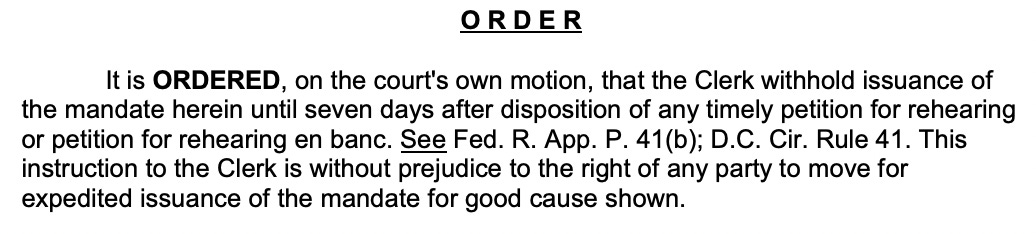
So, what was this Friday opinion about?
Katsas and Walker gave the Supreme Court an opinion to look to on the Friday before the justices’ key argument in Slaughter’s case that presented a way to “distinguish” — i.e., further water down — Humphrey’s Executor without formally overruling it.
More than watering it down, however, Katsas’s reasoning would essentially eviscerate Humphrey’s Executor. Under their reasoning, even Slaughter — on today’s FTC — might not have the protection of Humphrey’s Executor.
As Pan wrote of the majority in her dissent, “Their determination that the MSPB cannot be independent — even though it is purely adjudicatory and does not touch upon core constitutional functions assigned to the President — suggests that no agencies can be independent.“
The National Guard
The ongoing wait in the Supreme Court’s consideration of DOJ’s request that the justices allow National Guard deployment in Chicago during litigation continued on Friday, with no order as of publication.
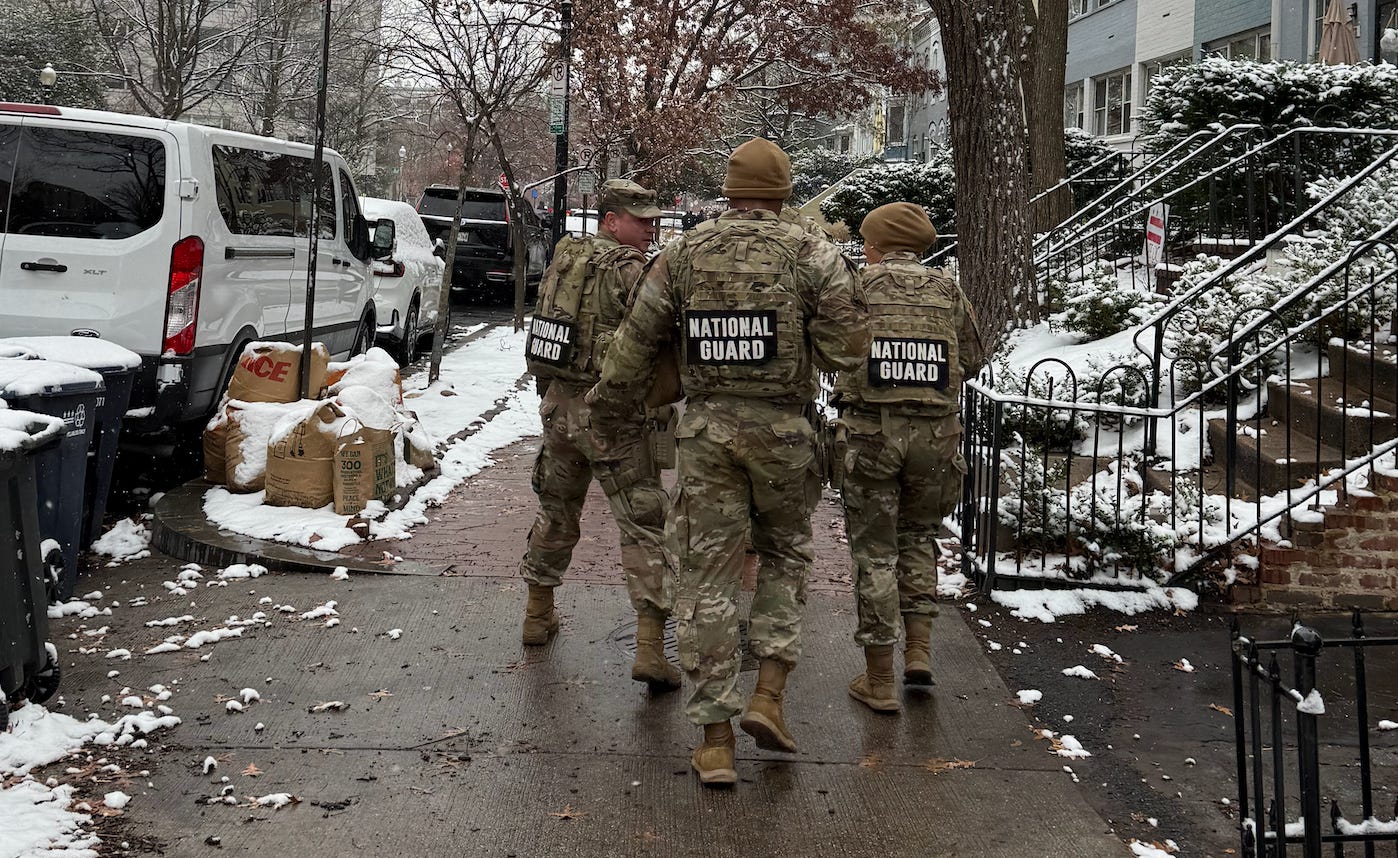
But, the issue of Trump’s effort to send troops into American cities remained front in center — both literally, as I passed four National Guard troops walking down New Hampshire Avenue toward the Kennedy Center on Friday morning, and in a hearing over the continued presence of federalized National Guard troops in Los Angeles.
U.S. District Judge Charles Breyer — a Clinton appointee and brother of the retired Supreme Court justice — was considering whether to grant California’s request for a preliminary injunction blocking the National Guard.
Regardless of whether they were appropriately federalized initially, the argument basically went, the National Guard federalization can’t possibly still be justified.
Breyer seemed to agree.
After Eric Hamilton, the Justice Department lawyer defending the deployment, unsuccessfully urged Breyer that the continued National Guard deployment is completely unreviewable by federal courts if the initial federalization is legitimate, Hamilton moved on to arguing that a small amount of violence — Hamilton primarily pointed to one incident of Molotov cocktails being thrown into a federal building recently — would justify continued federalization.
“There’s a danger of rebellion today?” Breyer asked. “You actually think that?”
After some prodding, Hamilton eventually told Breyer, “The ... uh ... facts here give rise to at least a danger of rebellion,” which is covered by the law at issue.
The question of whether deployment continued to be justified today prompted one comment from Breyer that fit with the theme of this Friday — and the Trump era.
“Crises come and crises go, that’s how it works,” the 84-year-old Breyer told Hamilton. “They do come and go.”
Frankly, any other Supreme Court would have declined to hear this birthright case - the executive order is clearly unconstitutional as adjudicated by the lower courts. However, there are 6 Supreme Court justices who have one significant goal: eliminate the 14th amendment and the rights of women, LBQT, non-Christians and immigrants. That said, my guess is these 6 seditious justices plan to limit birth right citizenship to those persons "lawfully" in the United States . . . Good luck defining “lawfully.”
By gum they did it again—a 2-1 R panel on a high profile case in a 7-4 D court.