

Former military lawyers say use of JAG lawyers in Minnesota violates the Posse Comitatus Act
Although recent litigation has focused on troop deployments to American cities, a new challenge in Minnesota looks at DOJ's use of JAG lawyers in non-military cases.

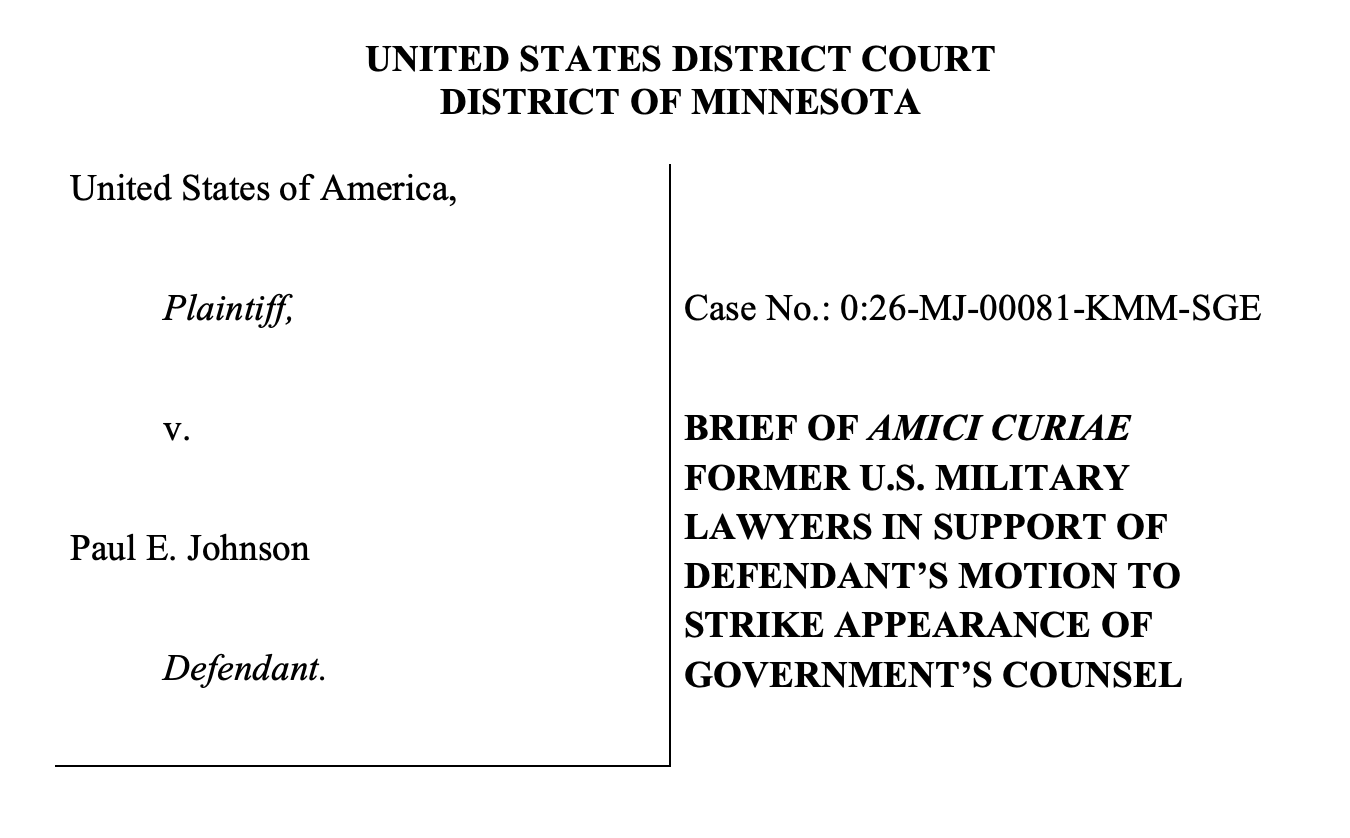
In Minnesota, a new fight is brewing over whether the Trump administration is violating the Posse Comitatus Act — the federal law that strictly limits the use of members of the military to carry out domestic law enforcement.
While recent litigation has focused on troop deployments to American cities, the newest challenge is to the Justice Department’s use of U.S. military lawyers in the U.S. Attorney’s Office in Minnesota to carry out ordinary domestic law prosecution totally unrelated to the military.
On Tuesday, the challenge — raised by a defendant in a criminal case — received support from former military lawyers, who argue that the move violates the Posse Comitatus Act and Army regulations.
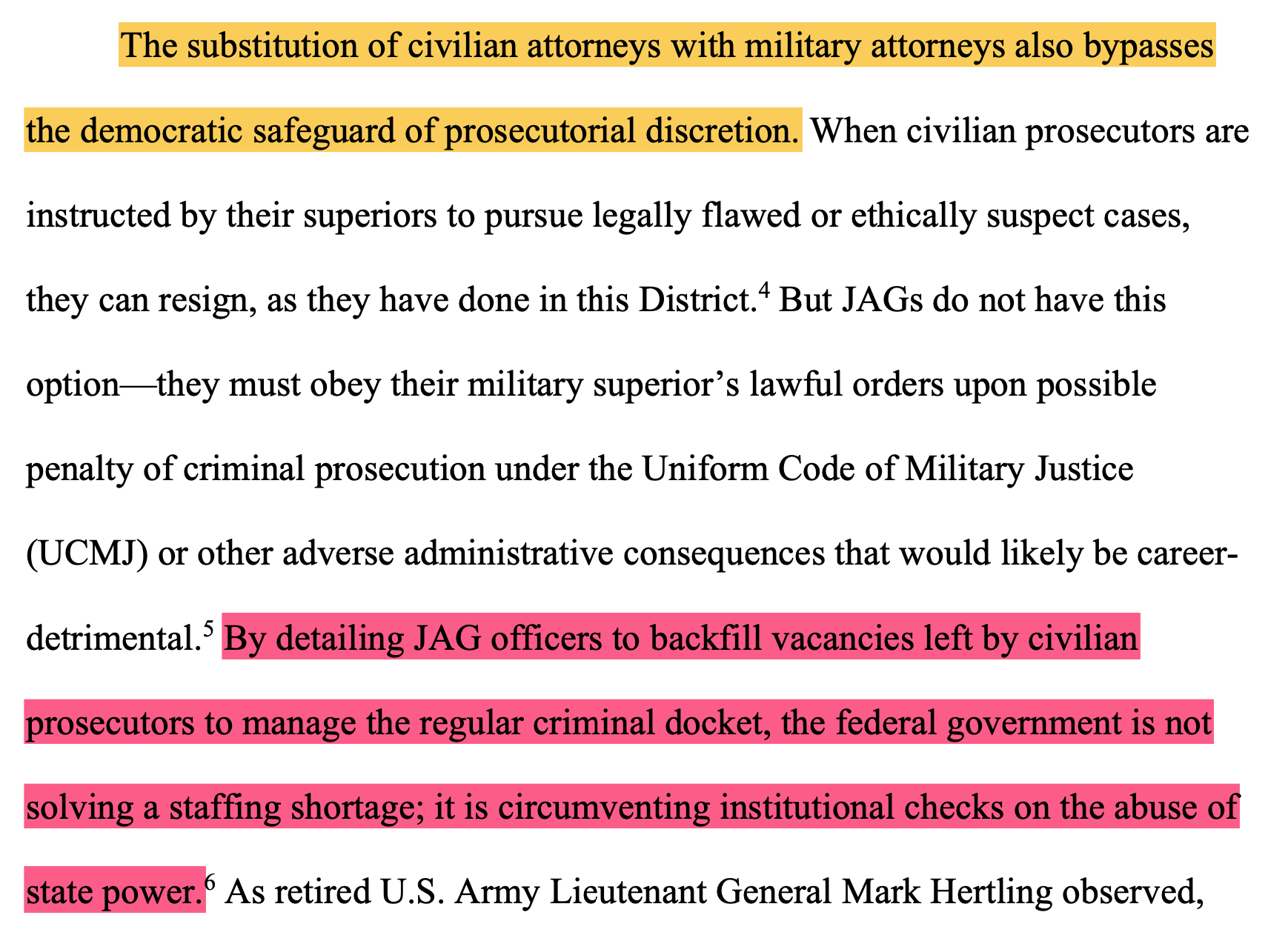
“By detailing JAG officers to backfill vacancies left by civilian prosecutors to manage the regular criminal docket, the federal government is not solving a staffing shortage; it is circumventing institutional checks on the abuse of state power,“ lawyers from the Protect Democracy Project and the law firm of Dorsey & Whitney argue in an amicus curiae brief filed submitted Tuesday in U.S.A. v. Paul E. Johnson on behalf of the former military lawyers.
They went on to warn: “By assigning a JAG to prosecute a civilian offense completely devoid of a military nexus, the government has crossed a perilous line — a clear line drawn by Congress and memorialized in the Army’s own regulations.”
As such, the former military lawyers joined Johnson in arguing that the JAG lawyer prosecuting his case should be removed from it.
The Defense Department noted the Minnesota effort on January 16: “In Minnesota, the department is working with law enforcement and Justice Department partners by assigning military judge advocates to assist the U.S. attorney’s office with its mission there.“ The move that prompted quick skepticism from multiple corners.
In mid-February, it was one of those military lawyers assigned to the office who was the first individual in the Trump administration found in civil contempt for the government failing to comply with orders in the case of Rigoberto Soto Jimenez, a man who had been improperly detained, be returned from Texas to Minnesota with all of his property. Although he was returned to Minnesota, his identification documents were not returned to him.
As Fox9 reported at the time, Special Assistant United States Attorney Matthew “Isihara, who is a JAG attorney with the Department of War (Defense) on special assignment to assist with all the federal habeas filings, said he has been assigned nearly 130 cases in just the last month.”
U.S. District Judge Laura Provinzino found Ishihara in civil contempt on February 18 in Soto Jimenez’s case, although the daily fine that she imposed beginning two days later was never assessed because the government came into compliance with her earlier orders by returning Soto Jimenez’s ID documents to him.
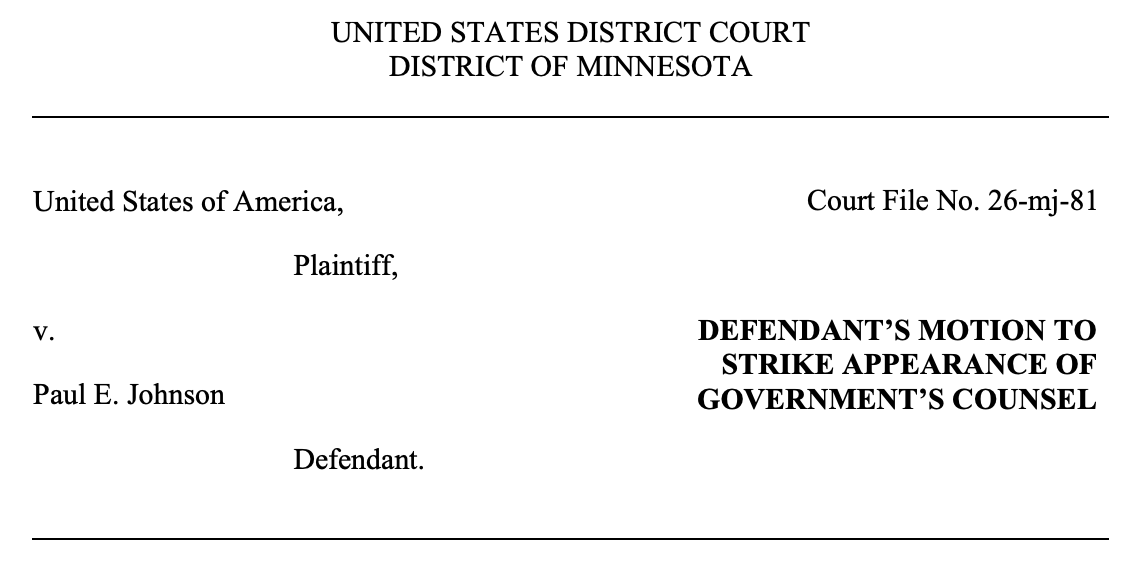
Two days before Isihara was found to be in civil contempt, however, the validity of the appearance of a different JAG lawyer, Michael Hakes-Rodriguez, in a criminal case in Minnesota was challenged by the defendant, Paul E. Johnson.
A week earlier, Hakes-Rodriguez, a 2024 law school graduate who became a JAG lawyer in 2025, filed the information against Johnson — a direct charge from a prosecutor, rather than a grand jury indictment. The case began when a criminal complaint was filed against him by a Homeland Security agent in late January.
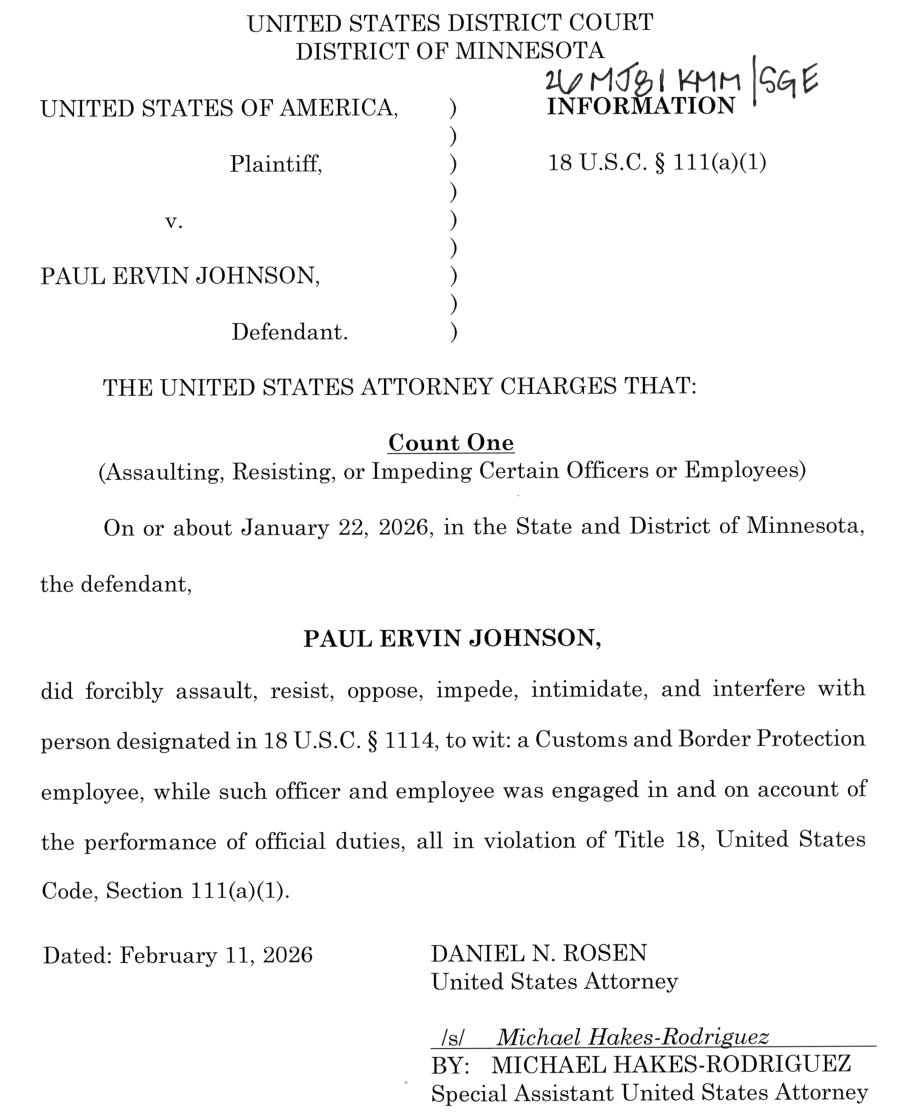
The charge relates to allegations, detailed in the complaint, about a January 22 interaction between Johnson and immigration agents.
In Johnson’s February 18 motion to remove Hakes-Rodriguez from the case, he argued, “Mr. Hakes-Rodriguez is engaged in a direct, active use of military personnel against a civilian as the sole prosecutor advancing this case against Mr. Johnson. The Constitution does not authorize this, and the Posse Comitatus Act forbids it.”
In opposing the request1, Hakes-Rodriguez argued that the Posse Comitatus Act “expressly exclude[s] any statutory grants of authority and, as more fully set forth below, various statues authorize the appointment of military SAUSAs.“
The opposition, primarily, looked at a law addressing the use of military officers in other roles and another law that allows the attorney general to appoint special attorneys to explain how, read in conjunction, this was such a “statutory grant of authority” that allows the use of JAG lawyers in this way despite the Posse Comitatus Act’s general prohibition.
First, Hakes-Rodriguez noted:
Under 10 U.S.C. § 973(b)(2)(B), “an officer of the armed forces may hold or exercise the function of a civil office in the Government of the United States that is not described in subparagraph (A) when assigned or detailed to that office or to perform those functions.”
It should also be noted — given that this is an argument about striking Hakes-Rodriguez as counsel from the case — that this is not the precise language of the law.
Here it is:

No, it’s not substantially different, but it does seem like accurately quoting federal law in filings in court is not too much to ask.
In any event, Hakes-Rodriguez argued that Section 973(b)(2)(B)’s grant of authority, when combined with the law that allows for the appointment of special assistant United States attorneys — and a related law that details the authority of those attorneys — “confirm that the Attorney General may accept the detailed military personnel to serve as SAUSAs.“
As to the Posse Comitatus Act, Hakes-Rodriguez argued that under the relevant precedent from the U.S. Court of Appeals for the Eighth Circuit:
Mr. Hakes-Rodriguez’s detail as a SAUSA does not violate the PCA because (1) he is assigned to the DOJ on a full-time basis, (2) to perform a well-defined prosecutorial function in an entirely civilian capacity as a regularly and properly appointed SAUSA, (3) is being supervised in the work related to his detail entirely by civilian supervisors within the District of Minnesota United States Attorney’s Office. In this limited capacity, Mr. Hakes-Rodriguez’s participation in this case does not subject any citizen to the exercise of military power in any regulatory, proscriptive, or compulsory manner.
As such, “the United States“ asked the court to deny Johnson’s request.
On Tuesday, the former military lawyers argued that DOJ is wrong — on policy and legal fronts. The former military lawyers — “eleven former U.S. military judge advocate officers (JAGs) who served as military attorneys in the Army, Navy, Air Force, Marine Corps, and Coast Guard” — asked to submit the brief and argued that DOJ’s actions are illegal and that DOJ’s filing ignored the larger purpose of both the Posse Comitatus Act and the military law DOJ relied upon.
Quoting the U.S. Supreme Court, the lawyers argued that the broader law — Section 973(b) — is aimed at “prohibit[ing] an active-duty military officer from holding or exercising the functions of certain civil offices to ‘ensure civilian preeminence in government.’”
The section DOJ quoted, they explained came about because of a practice of “active-duty JAGs serving as SAUSAs and prosecuting petty offenses committed by civilians on military installations.“ In 1983, Ted Olson — who was then the head of the Office of Legal Counsel in DOJ — argued that, as the lawyers wrote on Tuesday, “[A]bsent a specific statutory exception, this practice violated the general prohibition set forth in 10 U.S.C. § 973(b).“
That quickly led to the adoption of Section 973(b)(2)(B) — the provision at issue here — the same year.
The congressional reports relating to the provision make clear its intended limitations, as the amicus brief explained:
The accompanying House Conference Report stated that the amendment permitted JAG Corps personnel to continue assisting DOJ attorneys “with cases related to military installations and other military matters.” …
[T]he Senate Report stressed that “this provision does not sanction or endorse any use of military attorneys beyond that permitted under that interpretation.” Id. (emphasis added).
In short, the former military lawyers explained, “Congress never authorized JAG officers to be general criminal prosecutors in civilian courtrooms. Read together, the relevant statutory provisions do not authorize a JAG officer to prosecute a civilian for an offense lacking a nexus to the military.“
In addition to broadly disagreeing with the government’s application of the Posse Comitatus Act to this challenge — arguing, in part, that Hakes-Rodriguez is exercising regulatory, proscriptive, and compulsory power here — the former military lawyers highlighted why this use of members of the military in this particular way is contrary of the law:
Divorced from a military purpose, a JAG officer’s assignment as a prosecutor of a civilian falls squarely within the prohibited scope of the Posse Comitatus Act and manifests the danger that Congress sought to avoid: the unlawful substitution of civilian law enforcement personnel with military personnel, threatening to render the civilian community subordinate to military commands.
Beyond that, the former military lawyers highlight a unique danger of allowing military lawyers to prosecute non-military cases:
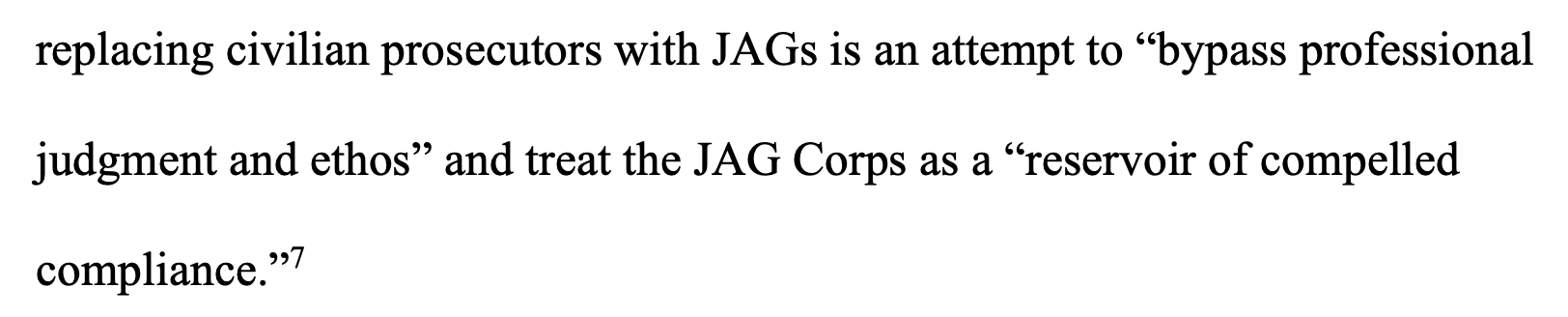
Finally, the former military lawyers highlighted an additional concern outside of the Posse Comitatus Act, explaining how the assignment of JAG lawyers in this way violated Army regulations. The regulations, they argued, “explicitly limit such appointments to cases in which ‘the Army has an interest.’ Absent any such interest here, the appointment is ultra vires“ — or, unlawful.
“Removal of government counsel from this case is not just appropriate, but necessary,“ the former military lawyers’ brief concludes.
Hakes-Rodriguez’s signature block title for himself, purportedly a Special Assistant U.S. Attorney, read “Assistant U.S. Attorneys,” in contrast to another filing in the case made opposing a different motion the same day, in which his title was listed as “Special Assistant United States Attorney.”
Thank you for providing excellent detail on this. This was one that I had completely missed and is so important.
The amicus brief does a great job of explaining why it's so dangerous to assign military lawyers to act in a civilian capacity. Some of your readers (not naming names, note) may find it too complex to fully understand, though.
Thankfully, you bolded the bits that might help them. Poor dears.
Leave it to the professionals, purveyors of illegality par excellence, under the lawless DOJ of Todd Blanche, (with brash PR malfeasance helpfully provided by his secretary, Pam Bondi), to devise a multi-layered method of abusing military lawyers, (who are actually very badly needed in their proper role), to pursue utterly illegal — even lawless — programs, in pursuit of cruel persecution of vulnerable persons unfortunate enough to have sought safety on American soil.
It all appears patently illegal, as lower courts likely will find. But who knows what fresh “doctrine”the “big brains” of SCOTUS may devise to extend, hide, or endorse this latest illegal maneuver of the current criminal president and his lawless regime of official incompetents?