


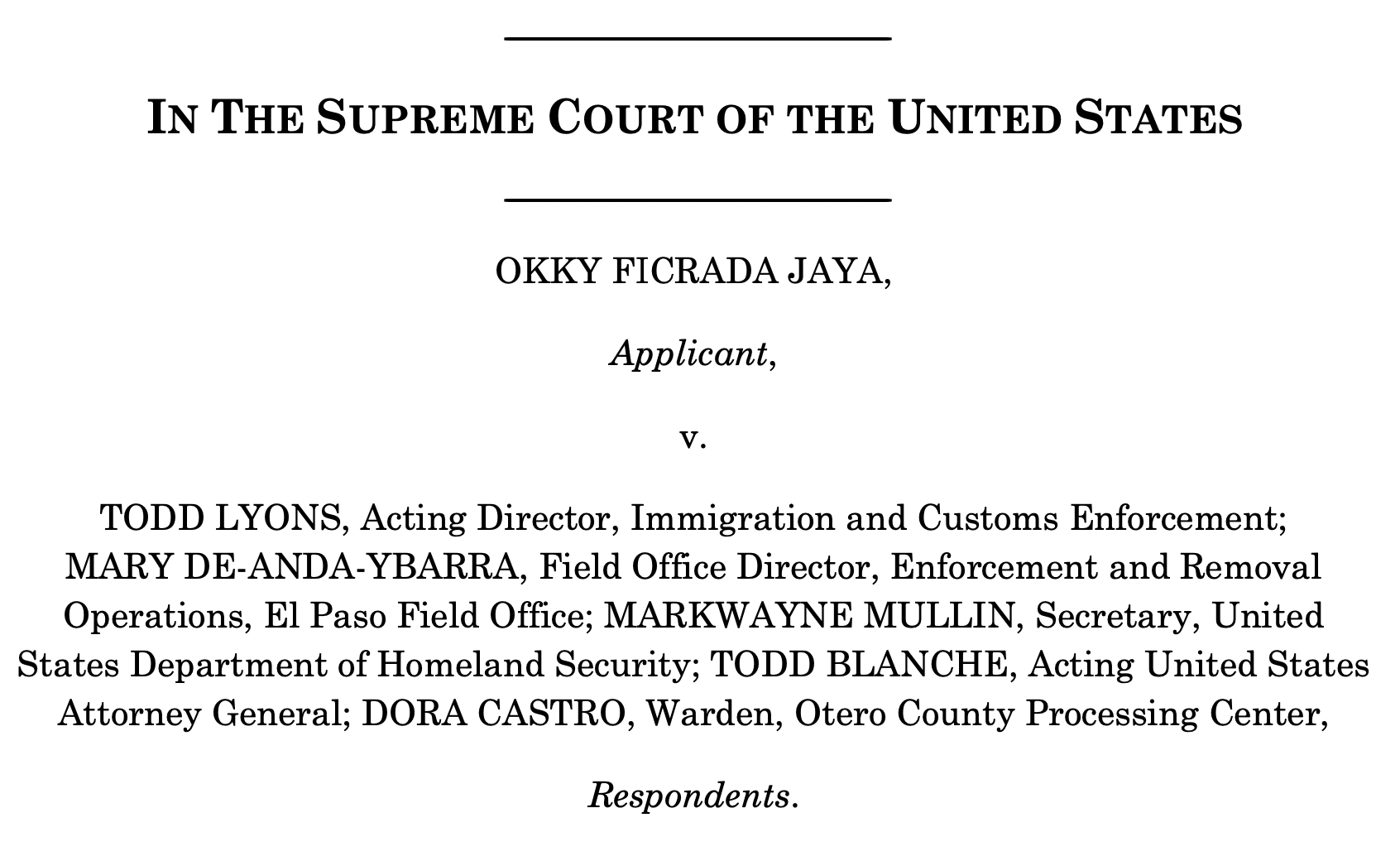
[Update, 2:25 p.m. July 9: The application discussed below, from a student seeking a stay of removal to Indonesia, was denied by Justice Elena Kagan, acting as circuit justice, on Thursday with no reasons given.]
There are regularly U.S. Supreme Court shadow docket filings from people seeking stays of removal — deportation — and they are almost always denied without explanation.
I do think, in this moment, that it is worth looking at one of these. On Tuesday, the Supreme Court Public Information Office provided journalists with a copy of one such request, as is the normal practice. It is not available on the Supreme Court’s public docket, so I have uploaded it.
Tuesday’s case involves a person who is a citizen of Indonesia and has been in the U.S. since 2011 on a student visa. Okky Ficrada Jaya was diagnosed with paranoid schizophrenia at some point in 2021, had problems while adjusting to the diagnosis, and was placed into removal proceedings because of a belief that he had stopped attending classes. He was challenging the removal effort, however, and was released on bond in 2022.
Then, the second Trump administration began. At that point, this is what Jaya’s lawyer explained happened:
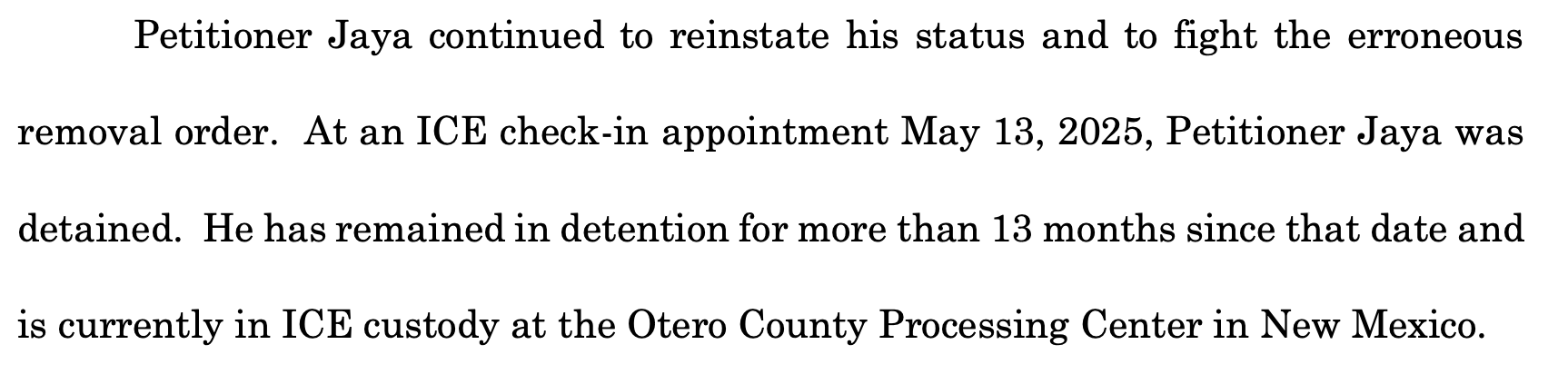
The request later stated, “Petitioner Jaya is not a criminal; he should not be detained by ICE any longer; and he should not be removed from the United States,“ adding:
[H]e should be allowed to return to California to continue his university studies and medical treatment for schizophrenia. California State Polytechnic University, Ponoma (CalPoly Ponoma) has recently documented that Petitioner Jaya was admitted in Fall 2023 as a student and is eligible to take classes upon his release from ICE detention.
Although the immigration judge — not an Article III judge, but rather a Justice Department employee — found that Jaya was a danger to his community and flight risk based largely on a 2021 incident, Jaya’s lawyers explained that that incident had been considered when Jaya was granted release on bond in 2022:
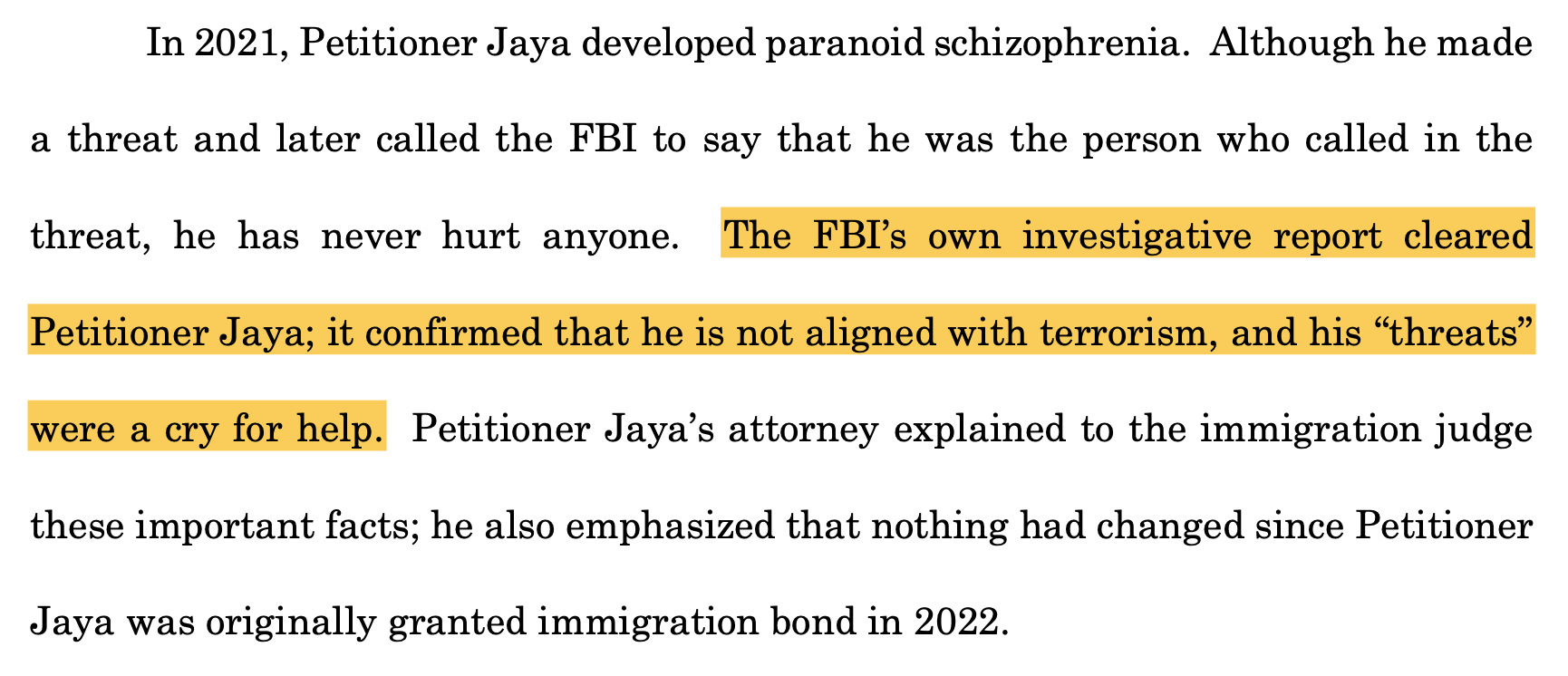
That was then. Further, Jaya’s lawyer noted that:
Prior to his detention [in 2025], his schizophrenia was being adequately treated by a team of medical professionals in Southern California; when he was receiving proper medications—viz., prior to his detention by ICE—Petitioner Jaya posed no danger to anyone.
A student diagnosed with schizophrenia while in school who was receiving treatment and seeking to remain in the U.S. was detained when he appeared at an ICE check-in and has remained detained since for more than a year.
It’s highly unlikely that the Supreme Court will grant relief here, given the extremely wide latitude the government has when making these determinations.
And yet.
This as an example of the sort of cases reaching the Supreme Court that almost never get any news coverage, yet have extreme implications for those involved. It also is yet another example of the unnecessary cruelty the Trump administration is putting people through in service of its anti-immigrant extremism.
Appeals court upholds academic freedom
Closing my tabs
For those who don’t know what this is, it’s my effort to give a little thank you to paid subscribers. “Closing my tabs” is, literally, me looking through the stories and cases open — the tabs open — on my computer and sharing with you all some of those I was unable to cover during the week but that I nonetheless want to let you know that I have on my radar. Oftentimes, they are issues that will eventually find their way back into the newsletter as a case discussed moves forward or something new happens that provides me with a reason to cover the story more in depth.
This Tuesday, these are the tabs I am closing:
