

Florida's year of executions masks broader discontent with the death penalty
Beneath an alarming number of executions in 2025, there are signs of continued growing opposition. Also: USA Today's ICE propaganda. And, for paid subscribers: Closing my tabs.

America is far less interested in the death penalty than President Donald Trump and Florida Gov. Ron DeSantis’s actions this year suggest.
On his first day back in office, Trump told America that he was “restoring the death penalty.” In an executive order, Trump claimed, “Capital punishment is an essential tool for deterring and punishing those who would commit the most heinous crimes and acts of lethal violence against American citizens. … Our Founders knew well that only capital punishment can bring justice and restore order in response to such evil.“
The false premise and false aims aside, it is true that the death penalty has been more present in the U.S. this year — a stark turnabout from former president Joe Biden’s decision to commute most of the death sentences of those on federal death row to life sentences without the possibility of parole in the closing days of 2024.
By the end of this week — if the final two scheduled executions of 2025, in Georgia and Florida, are not stopped — 48 people will have been executed in a dozen states this year.
Although that 15-year high has been used by supporters of capital punishment like Trump to claim a reinvigorated support for the punishment, the Death Penalty Information Center highlighted — along with the publication of its end-of-year report published on Monday — that “public opinion polls recorded historically low support for the death penalty, and the highest opposition in 50 years.”
At the same time, DPIC also noted that those public opinion numbers aren’t just opinion. The discomfort is also reflected in new death sentences: There were 22 people sentenced to death in 2025 — a continued low number that represents about 10% of the number of death sentences handed down yearly three decades ago.
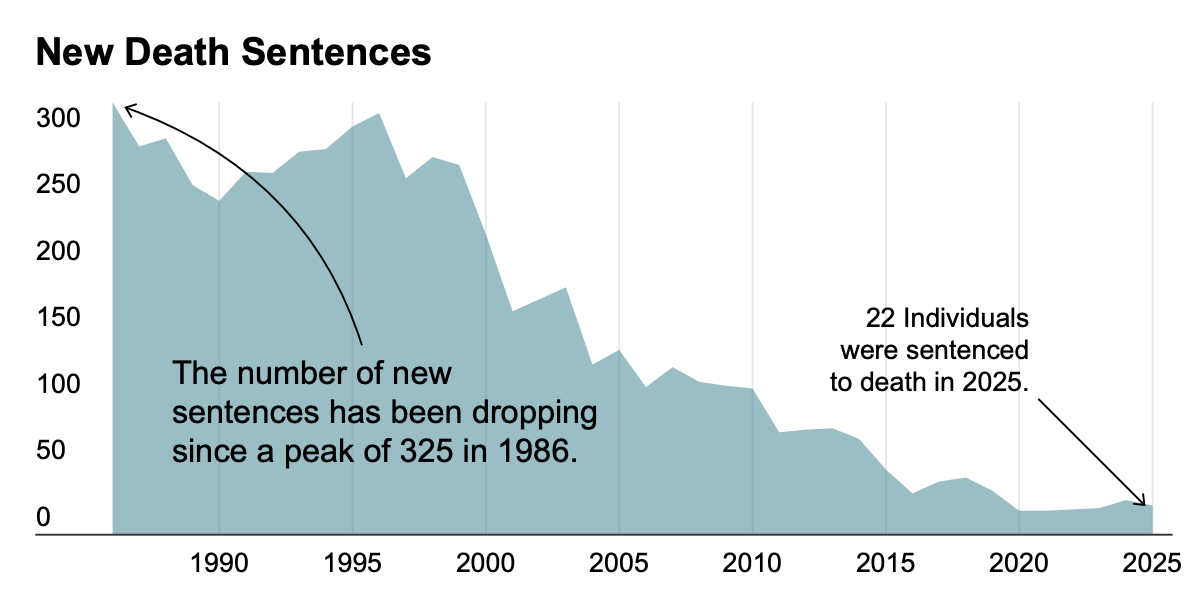
As DPIC detailed, however, even that 22 number is the result of two states that allow non-unanimous juries to recommend death at the sentencing phase:
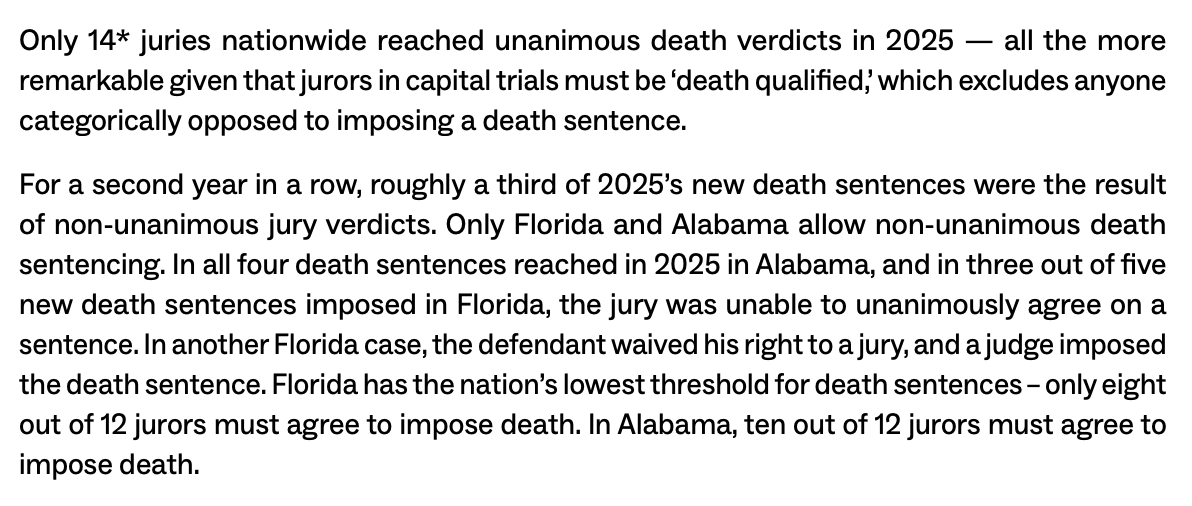
Only 14 juries recommended death sentences unanimously this year.
Despite the low number of new death sentences, the execution number is alarming. Nearly two times as many executions are likely to have taken place this year over last year’s 25 executions.
But, even the disturbing “48 executions” number paints a deceptive picture.
If Florida kills Frank Walls on Thursday, the state under DeSantis’s leadership will have carried out more executions than the next four states combined at 19 executions.
The “dozen states” figure similarly paints a deceptive picture. Most of those executions — 34 of the 48, if both scheduled executions take place this week — took place in just four states: Florida’s executions and five each in Alabama, South Carolina, and Texas.
In contrast, a majority of the states that have carried out executions this year did not carry out more than two executions throughout the year. Six states fit that bill currently. If Georgia proceeds with killing Stacey Humphreys on Wednesday, it will be its first execution this year — making it the seventh such state.
Every execution deserves close skepticism so long as the death penalty continues to exist, but it is important not to let the final number of 2025 executions tell more of a story than there is.
USA Today’s unacceptable coverage
Over the weekend, USA Today embarrassed itself by running ICE propaganda.

The publication, in the first of a two-story “series,” worked with ICE to, essentially, embed itself with a family of ICE agents and agree not to name them — despite being federal employees paid with tax dollars — as they spout pro-ICE propaganda.
It is astounding that this piece went up the editorial line, and Lauren Villagran was given the OK to do it:
John and his family agreed to talk to USA TODAY – with permission from their superiors – to counter what they see as false impressions of their work.
To cover their perspective, which has been largely absent from the public debate on immigration, USA TODAY went behind the scenes of the Trump administration’s deportation campaign. In November, we spent three days with ICE in Kansas City, part of the Chicago field office tasked with immigration enforcement in a sprawling, six-state region of the Midwest that includes Missouri, Kansas, Kentucky, Illinois, Indiana and Wisconsin.
And then, once “cover[ing] their perspective,” the publication allowed the family to do so without public accountability — again, despite that they are doing public jobs and seeking news coverage of their work:

The absurdity of the piece, the framing, and the anonymity immediately followed with her big quote from “John” in the piece:
John recalled that, as an airman, “I had people wanting to buy me lunch in an airport or, you know, looking at me like I’m some sort of hero.
“Then when I come to this side of the aisle – where I’m still putting my life on the line to enforce the law and wanting to create a safer America – now all of a sudden, I’m not that hero.”
What are they doing here? Don’t worry. The piece tells us.
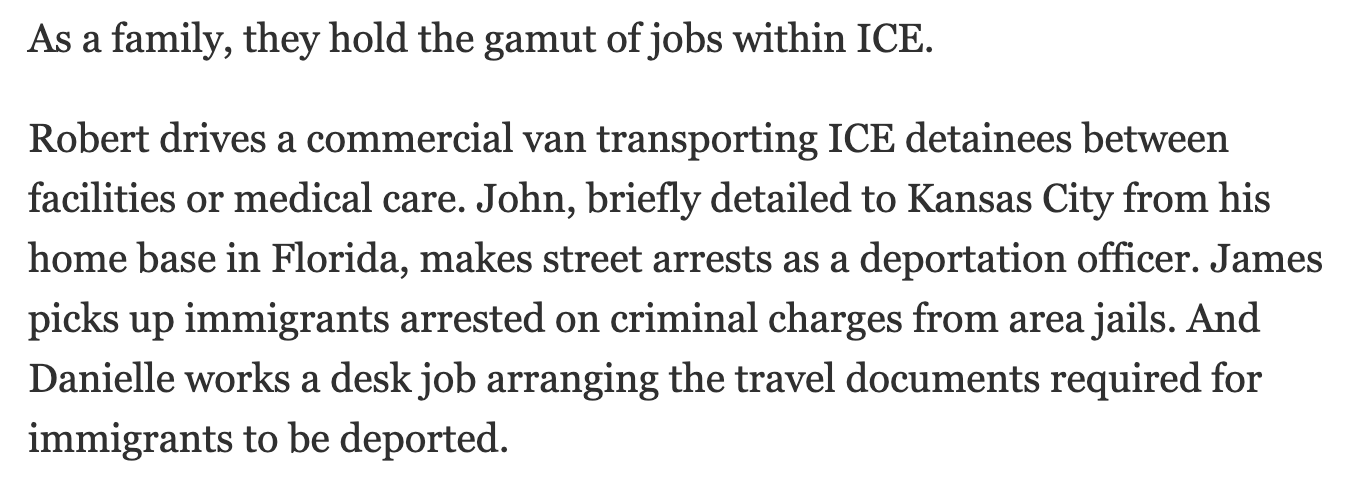
And USA Today gave them — and ICE and, with it, the Trump administration — nearly 3,000 words “to counter what they see as false impressions of their work,” with no public accountability.
The second story in the USA Today “series,” by Trevor Hughes, is an “Exclusive look inside ICE: How the agency operates in Trump’s America.“
The overarching problem with the series is the complete lack of agency the writers attribute to their ICE sources. From the USA Today vantage-point, the ICE officers are just doing their jobs. Never do the stories interrogate those people’s choices to be in these jobs at this moment.
The second story instead simply frames the Trump administration’s actions as nothing more than the “‘pendulum swings’ of enforcement strategies” — while literally declaring that this is “both sides” journalism:
To report on the perspective of both sides, USA TODAY journalists spent several days this November in Kansas City, accompanying ICE officers as they detained suspects, collected detainees from local jails, and loaded others onto a charter flight to Texas for eventual deportation.
We also spoke with Kansas City-area migrant advocates and local elected officials who say the expanded immigration enforcement is tearing communities apart, turning neighbor against neighbor and sparking heated confrontations over the tactics now being deployed.
Even that, though, is a bit overstating what Hughes did. Yes, there are quotes from advocates and lawyers, but they are primarily there to set up the “both sides” as activists threatening (or perpetrating) violence or being worried about “feelings” and ICE officers being worried about the law.
To understand the “balance” in the piece, it references ICE Supervisory Detention and Deportation Officer Keone Feliciano 16 times. Here is one of those times, about halfway through the roughly 2,000-word article:
Feliciano said the threat of violence from community members won’t dissuade his Kansas City team from following their orders. He takes pride in the work his agents do targeting criminal offenders through surveillance and documentation.
At one point, Hughes stated that “making an asylum claim, especially during the Biden years, could qualify some people to remain free while their cases were pending.” Despite that, the article never discussed how the Trump administration is attempting to all but end asylum claims in the United States. And, beyond that, it never discussed the purpose of — or law surrounding — asylum aside from letting Feliciano and friends use it as a hook to attack Biden administration.
Closing my tabs
For those who don’t what this is, it’s my effort to give a little thank you to paid subscribers. “Closing my tabs” is, literally, me looking through the stories and cases open — the tabs open — on my computer and sharing with you all some of those I was unable to cover during the week but that I nonetheless want to let you know that I have on my radar. Oftentimes, they are issues that will eventually find their way back into the newsletter as a case discussed moves forward or something new happens that provides me with a reason to cover the story more in depth.
This Monday, these are the tabs that I am closing:
