

Eleventh Circuit, on an 8-5 vote, holds that Florida's anti-drag law is likely constitutional
A majority of the court, however, disagreed with Judge Andrew Brasher that the court should rule on whether the statewide injunction entered in the case was an improper "universal injunction."

The full U.S. Court of Appeals for the Eleventh Circuit, on an 8-5 vote, held that Florida’s anti-drag law is likely constitutional in a lawsuit brought by Hamburger Mary’s of Orlando.
Judge Andrew Brasher wrote the majority opinion for the en banc court, rejecting Hamburger Mary’s challenge to the law on both overbreadth and vagueness grounds and allowing the state to enforce the 2023 while litigation proceeds.
A majority of the court, however, disagreed with Brasher, a Trump appointee, that the court should — or could — rule on whether the statewide injunction entered in the case was an improper “universal injunction.”
The 2023 law prohibits “knowingly” admitting “a child to an adult live performance.“
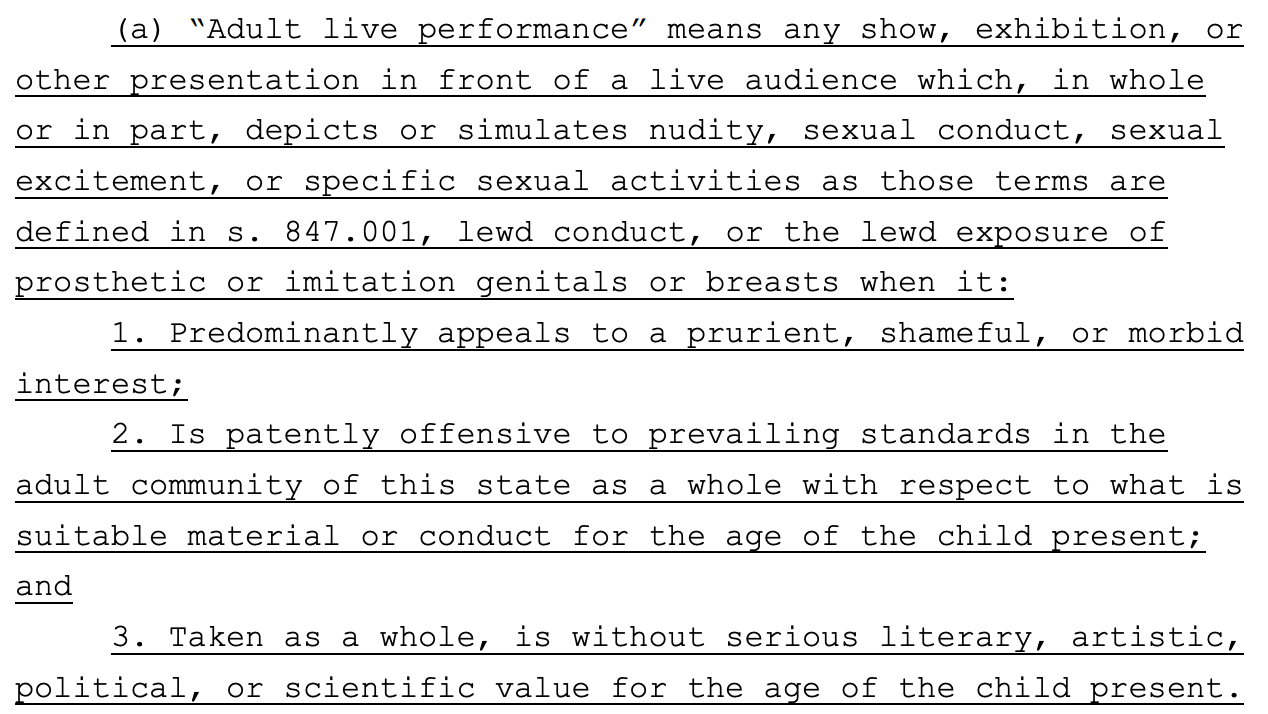
But, despite stating that there is a requirement that a violation be done “knowingly,” the law also states:

The Tuesday ruling vacated the June 2023 injunction issued by the district court and, in effect, reversed an earlier appeals court panel decision from May 2025 that had affirmed the injunction on a 2-1 vote. (That opinion, however, was formally vacated in December 2025, when the appeals court took the case en banc.)
Brasher, a Trump appointee, summed up the two primary arguments as such:
First, Hamburger Mary’s argues that the use of the word “lewd” makes the Act overbroad and vague, expanding the ban beyond speech that may be constitutionally regulated as obscenity. Second, Hamburger Mary’s argues that the use of the phrase “the age of the child present” in two of the Act’s criteria makes it unconstitutionally overbroad and vague, as it imposes an age-variable standard for testing whether speech is obscene.
Rejecting those claimed, Brasher wrote for the majority, “The Supreme Court of Florida’s definition of ‘lewd’ eliminates any overbreadth, and the use of the phrase ‘age of the child present’ does not render the Act unconstitutionally vague.“
Judge Robin Rosenbaum, writing for the five dissenting judges, pointed out that “what the Act gives with one subsection, it takes away with another.” Specifically, “the Act effectively imposes strict liability“ due to the fact that “neither ignorance of a minor’s age nor a minor’s or adult’s affirmative misrepresentation of a minor’s age—even through a convincing form of identification—saves a citizen from a violation.“
Brasher did not even address that exceptionally important issue in his opinion.
In addition to the strict liability question, Rosenbaum focused on how the law creates what she referred to as “squishy and opaque sliding-scale age standards.“ Specifically, she wrote:
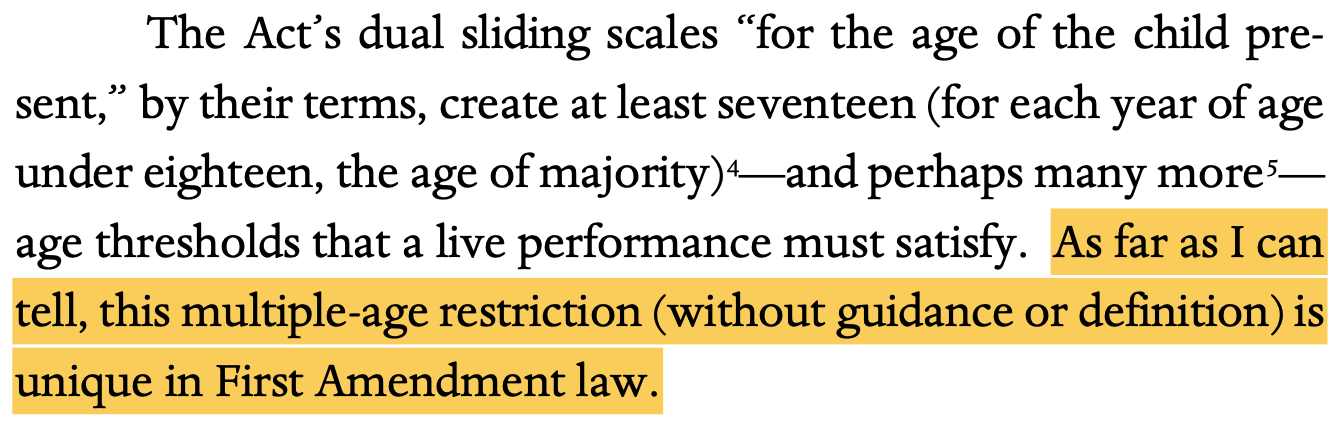
What Rosenbaum, an Obama appointee, is referring to is the idea that, in other laws focused on minors, there is just one dividing line — generally between 17 and 18. Here, however, by focusing on “the age of the child present,” businesses need to consider whether a show that might be deemed appropriate for a 15-year-old would be deemed to be “lewd” as to a 14-year-old.
Brasher, however, insisted that this wasn’t an issue because “it is difficult to imagine any sex-based performance that predominantly appeals to a prurient interest being suitable for a child of any age.“
This is such a fundamental misunderstanding of both law and what it means to grow up that it’s difficult to respond to this dismissive claim. Is Brasher really so dense as to not be able to imagine — to make this really easy — a performance that would be appropriate for a 15-year-old and inappropriate for a 5-year-old?
Where does this lead? As Rosenbaum wrote:
A constitutionally vague law that applies to speech and live performances and carries serious consequences for violations can be very effective at chilling even protected speech—especially protected speech that Florida does not like. And the Act’s history suggests that’s what Florida sought to do with respect to drag.
It’s true.
More than four years ago now, Law Dork published its first report on Florida’s effort to go after drag performances. And that, in turn, detailed the long history of this sort of effort to restrict expression by queer people.
In a separate dissenting opinion from Judge Nancy Abudu, a Biden appointee, she focused on legislative history and how it is properly used by judges.
In conclusion, though, she wrapped that discussion together with both the case and the bigger picture:
In this case, the Act’s legislative history, coupled with its vague terms, supports Hamburger Mary’s claim that Florida’s legislature sought to chill protected speech. The Majority’s opinion cements (hopefully only temporarily) that legislative accomplishment.
On that front, Melissa Stewart, lawyer for the challengers, told Law Dork on Tuesday, “Today, the Eleventh Circuit held that the State may criminalize speech it dislikes and strip parents of their right to determine what is appropriate for their own children. We believe that the First Amendment’s protections are more robust than that. This litigation is not over, and we will continue fighting to protect free speech in the state of Florida.“
Unfortunately, Brasher had more to say on Tuesday.
“We conclude that the district court erred in granting an injunction that applied against anyone and everyone in Florida,“ he wrote, citing the U.S. Supreme Court’s 2025 decision from Justice Amy Coney Barrett in Trump v. CASA addressing “universal injunctions.”
Despite the way he wrote it, this was not the opinion of the court. It was, instead, the minority view in a 6-7 vote on whether the court should rule on that issue.
Normally, we would call that a dissent.
Both Brasher’s writing and the court’s treatment of this section of his opinion are unfortunate at best, more likely misleading, and — I think — ultimately wrong.
The court stated:
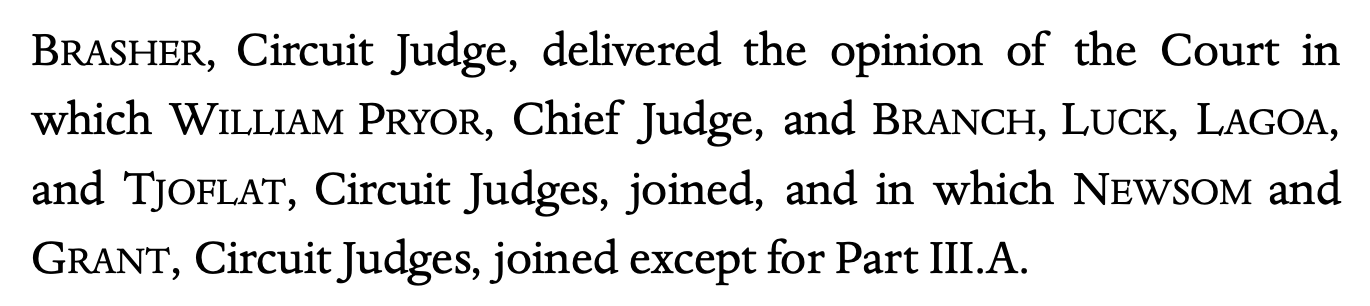
That’s just not accurate. Part III.A is not agreed to by a majority of the court, so it is not “the opinion of the court.”
It is almost understandable why that language is wrong, though, because Basher basically appears to have worked hard to hide the fact that he did not have majority support for this part of what he wrote. In the opening of the opinion, he summarized matters as follows:
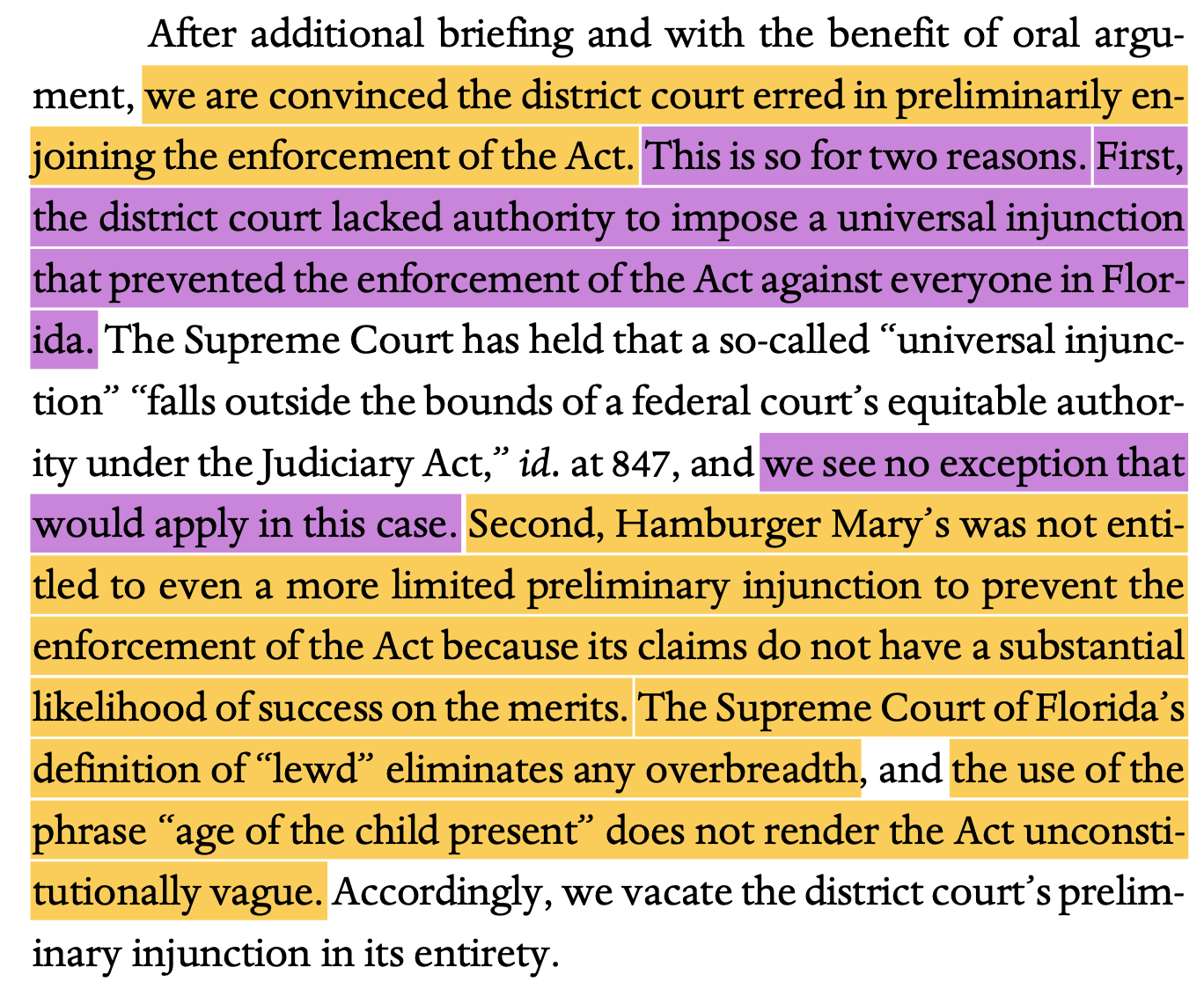
While Brasher might be voting to vacate the injunction “for two reasons,” the court did not do so.
Don’t take my word for it. The way Brasher handled this led a majority of the judges on the court — including two of those who agreed with him on the merits — to specifically disclaim this part of what he wrote.
Judge Britt Grant, joined by Judge Kevin Newsom, wrote that they were only “concurring in part.” Although she suggested Brasher’s conclusion was “[f]air enough,” Grant nonetheless wrote for the pair:
[N]o matter how certain we may be that the district court erred in the scope of its injunction, we should not say so. Because we conclude that the statute is constitutional, any follow-on decision about the district court’s earlier injunction is simply advisory.
Both Grant and Newsom are, like Brasher, Trump appointees.
Rosenbaum — for herself, Abudu, and Judges Adalberto Jordan (Obama), Jill Pryor (Obama), and Embry Kidd (Biden) — went further, both on the procedural point and as to the substance of Brasher’s writing.
“[A] reader may wonder why six of my colleagues also opine that universal injunctions are not available when a law does violate the Constitution by being overbroad,” she wrote. “Good eye.“
First, she noted, “[W]hat would my colleagues’ universal-injunction ruling be if they had their way? It would be an advisory opinion—pure and simple,“ adding that “Article III does not empower us to issue advisory opinions ….”
That was, essentially, putting a sharper point in dissent on Grant’s partial concurrence.
Substantively, though, Rosenbaum went on to note how in this very case, Justice Brett Kavanaugh — joined by Barrett — noted that “a First Amendment overbreadth challenge … presents its own doctrinal complexities about the scope of relief“ and how Justice Sam Alito — joined by Justice Clarence Thomas — in CASA noted that the opinion “left unresolved” questions about “third-party standing.”
Of that, Rosenbaum wrote:
In other words, Justices Kavanaugh and Barrett, like Justices Alito and Thomas in CASA, thought a different rule might apply to universal injunctions in the First Amendment overbreadth context. That is, at least four members of the six-member majority in CASA expressed hesitation to rule universal injunctions are not available when the government enacts an overbroad law. And that doesn’t even consider the three CASA dissenters.
She went on to also note Brasher’s failure to address both Supreme Court and Eleventh Circuit precedent regarding overbreadth cases.
All of this to say: The Eleventh Circuit did enough damage to the First Amendment on Tuesday with its ruling on the merits of Florida’s anti-drag law. Do not be confused by Brasher’s effort to suggest he was also rewriting the law as to the scope of available relief in overbreadth claims.
Florida … drag … Ron DeSantis’s white go-go boots
Yeah, was hoping you would cover. It is as depressing as I thought it would be.