


In his final month in office, Virginia Attorney General Jason Miyares, a Republican, is working with the Trump administration to try and undermine state law and attack undocumented immigrants on his way out the door.
But, a quick-acting nonprofit — the Dream Project — is seeking to stop him.
After losing his re-election bid in November to Democrat Jay Jones, rather than going quietly, Miyares is trying to shoehorn in at least one more right-wing policy that the Republicans couldn’t achieve at the ballot box.
Since 2020, Virginia’s Dream Act has provided eligibility for in-state tuition and state financial assistance to graduates of Virginia high schools who have lived in Virginia for at least two years “regardless of citizenship or immigration status.“
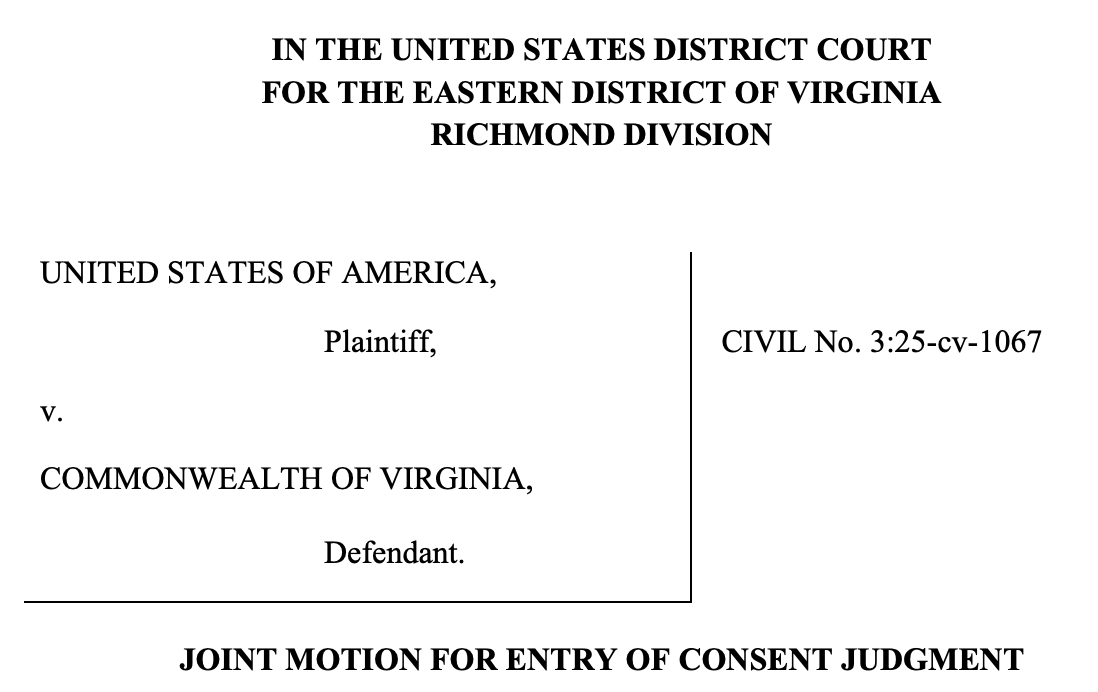
Over the holidays, the Justice Department and Miyares sought to bring and quietly resolve litigation declaring the Virginia laws unconstitutional “insofar as they apply to aliens unlawfully present in the United States.”
On December 29, the Justice Department filed a lawsuit challenging Virginia’s law, arguing that it violates the Supremacy Clause due to a federal law that barring provision of higher-education benefits to undocumented individuals “on basis of residence“ in a state. A day later, Miyares, in a filing signed by Virginia Solicitor General Kevin Gallagher, joined DOJ in a motion asserting, essentially, that Virginia agrees that its law is preempted by federal law. In the joint motion, DOJ and Virginia, in relevant part, stated:
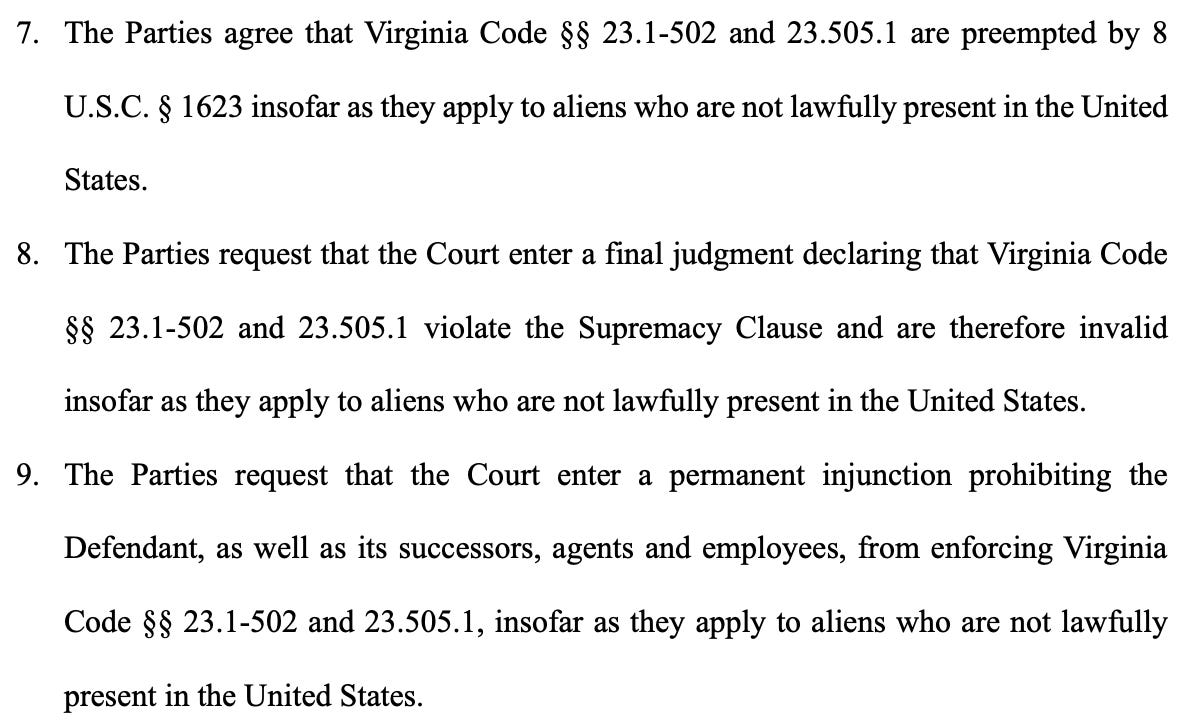
Yes, they sought to manufacture a court order declaring Virginia law invalid.
This would not be the first such manufactured lawsuit over this issue. As Law Dork covered previously, this happened earlier in 2025 in cases in Texas and Oklahoma.
As discussed then, although DOJ’s argument has initial appeal, the problem is that the federal law is solely about residency. Policies enacted in roughly two dozen states since the 1996 law was passed provide benefits that are premised on other bases — like graduation from an in-state high school, as in Virginia.
Enter the Dream Project. A day after the joint motion was filed, the nonprofit, represented by lawyers at the Legal Aid Justice Center and ACLU Foundation of Virginia, filed a motion to intervene in the case, as well as a request for the court to hold off on agreeing to issue DOJ and Virginia’s proposed consent judgment order until resolution of the Dream Project’s intervention motion could be resolved.
“Intervention is timely, necessary, and essential to ensure that the Court hears from the Dream Project before approving or enforcing a consent decree that will conclusively determine their rights,“ the lawyers explained.
Specifically, the lawyers detailed in their memorandum of law supporting their intervention request, “[W]ithin a day of the filing of the complaint, the Attorney General of Virginia abdicated his duties and entered into a collusive agreement with the United States to abandon this critical protection for Virginia students.“
The lawyers noted that this is not a necessary path, as similar litigation brought by DOJ in other states — Illinois, Minnesota, and Kentucky — “involve active defense by attorneys general or intervenors, and thus adversarial testing of the constitutionality of those states’ analogous statutes.“
The Trump administration and Miyares apparently would rather get a court order blocking the Virginia law without “adversarial testing,” so, rather than waiting for Jones to take office later this month, DOJ filed on December 29.
The quick action of the Dream Project, however, might successfully slow this effort down until Jones takes office in less than two weeks on January 17.
The case has been initially assigned to U.S. District Judge Robert Payne, a senior status George H.W. Bush appointee who has been on the bench since 1992.
Some broad thoughts on 2026
I talked with Thor Benson about the U.S. Supreme Court, the Trump administration, and 2026.
Check it — and his Madness newsletter — out!
Closing my tabs
For those who don’t know what this is, it’s my effort to give a little thank you to paid subscribers. “Closing my tabs” is, literally, me looking through the stories and cases open — the tabs open — on my computer and sharing with you all some of those I was unable to cover during the week but that I nonetheless want to let you know that I have on my radar. Oftentimes, they are issues that will eventually find their way back into the newsletter as a case discussed moves forward or something new happens that provides me with a reason to cover the story more in depth.
This Monday, these are the tabs I am closing:
