

DOJ's slow-walking of the law firm cases continues, pushing appeals well into 2026
The Trump admin has often rushed to the Supreme Court this year. In the law firm cases, though, DOJ — even though it lost below — is moving the appeals as slowly as possible.

Nine months ago this week, a federal judge issued the first court order blocking the first of President Donald Trump’s executive orders attacking law firms.
More than seven months ago, the same judge, U.S. District Judge Beryl Howell, issued the first final judgment striking down one of these executive orders, the one targeting the Perkins Coie law firm.
Since then, similar orders, issued by judges appointed by presidents of both parties, have been entered in all of the cases where law firms fought back. In all, four firms have secured rulings blocking Trump’s executive orders: Perkins Coie, Jenner & Block, WilmerHale, and Susman Godfrey.
Following an appeals court order issued on Tuesday in response to a Justice Department request from Monday, however, briefing in the appeals of those cases will not even start until at least February — pushing any arguments, let alone ruling, off significantly further.
As Law Dork has covered previously, DOJ has slow-walked these cases — never seeking stays pending appeal as the Trump administration has done in so many cases this year, including regularly running to the U.S. Supreme Court, and waiting to even appeal the judgments until the closing days of the government’s 60-day deadline for doing so.
With this week’s move from DOJ, this slow-walking of these bad cases continues.
At the district court level, only DOJ’s Chad Mizelle — Attorney General Pam Bondi’s chief of staff at the time and sometimes “Acting Associate Attorney General,” the No. 3 position at DOJ — and Deputy Associate Attorney General Richard Lawson (No. 2 to the No. 3, if you can track that) were on the briefs. Mizelle argued personally in defense of the executive order at the original Perkins Coie temporary restraining order hearing.
The same practice — only two senior, political appointees on the case — continued at first at the D.C. Circuit.
On September 23, when DOJ had done nothing with the appeals for more than a month after the fourth appeal was filed, the U.S. Court of Appeals for the D.C. Circuit set a 30-day deadline for the parties — DOJ and all four firms — to “file motions to govern further proceedings in these cases.“
Of that order, I noted at the time that the appeals court was corralling the parties into a path forward.
That day, perhaps coincidentally, Axios’s Mike Allen broke the news that Mizelle was leaving DOJ “in the next few weeks.”
With the 30-day clock running, the slow-walk campaign got a boost: The government shutdown. As DOJ filed in many civil cases, on October 6, DOJ filed a motion for a stay “in light of lapse of appropriations.”
Perkins Coie, having the executive order blocked by the district court, did not oppose the request. (Technically, it “t[ook] no position” on it.) By time that motion was filed, just one name remained.
Lawson was the last man standing.
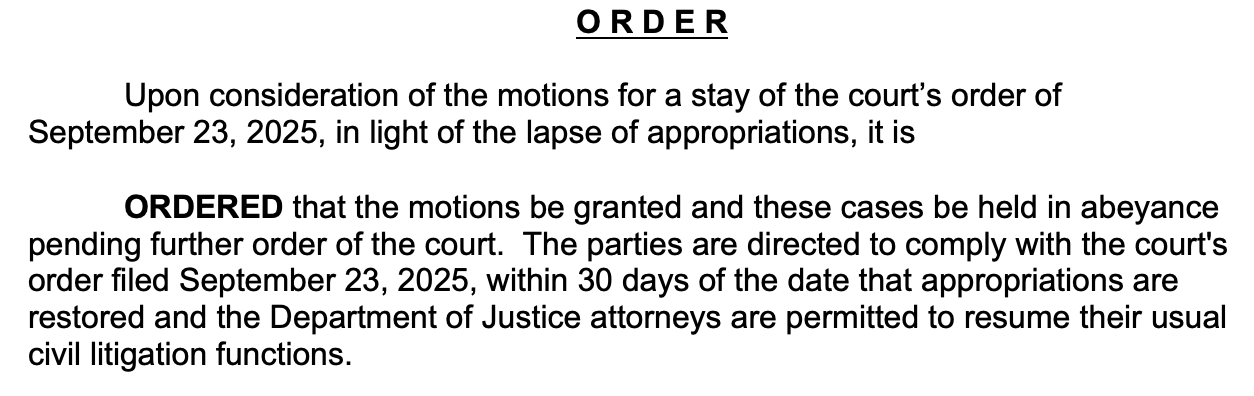
Two days later, the court granted the request in all four cases, ordering the parties to comply with the September 23 order “within 30 days” of the shutdown ending and DOJ attorneys being “permitted to resume their usual civil litigation functions.”
Then, mid-shutdown, more happened.
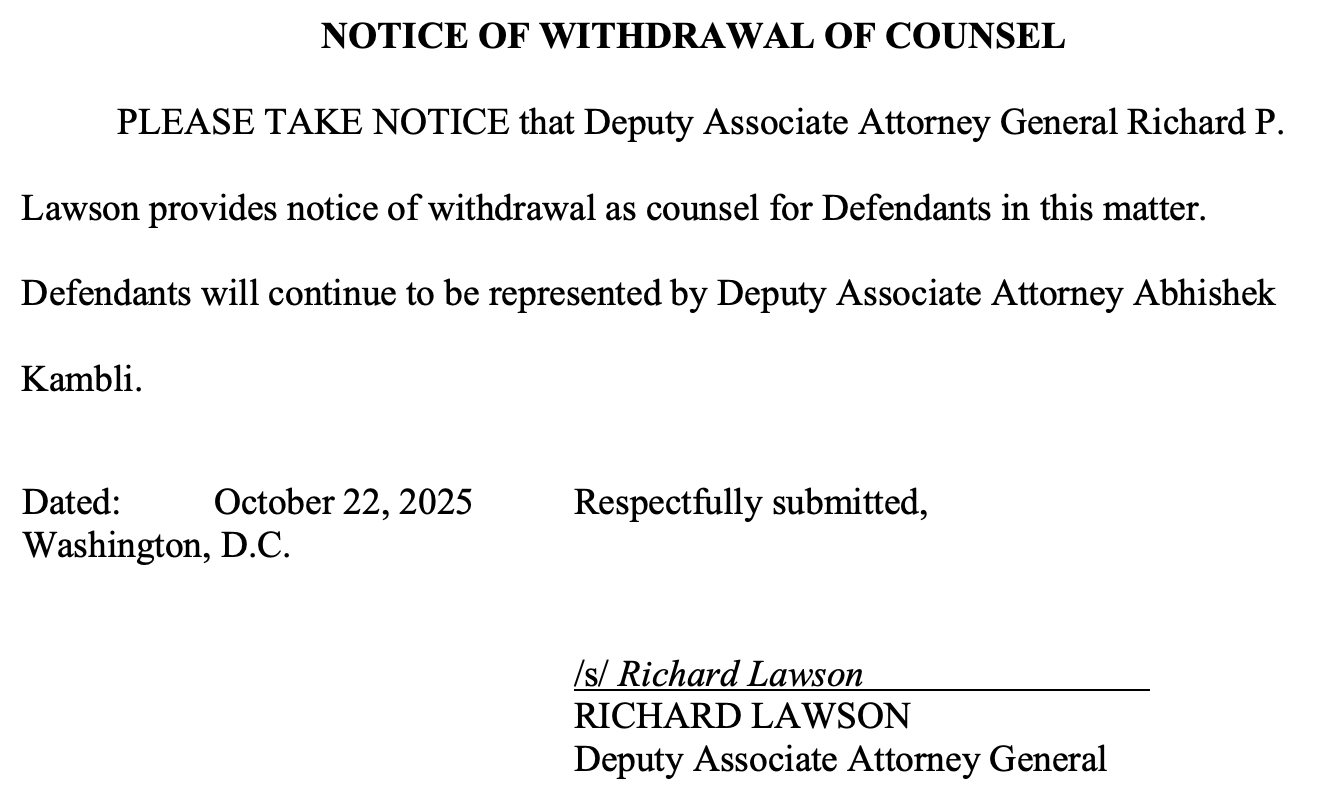
On October 22, Deputy Associate Attorney General Abhishek Kambli entered an appearance in the case on behalf of DOJ, and Lawson withdrew as counsel in the cases.
(Mizelle — husband of U.S. District Judge Kathryn Mizelle, a Trump appointee from his first term — appears to have returned to Florida to troll people on X. Lawson also left DOJ; he is now the vice chair of litigation at the America First Policy Institute, where both he and Bondi were before joining the Trump administration.)
On the night of November 12, Trump signed the bill ending the shutdown, meaning that the D.C. Circuit September 23 order would kick back into place and the parties would need to “file motions to govern further proceedings in these cases” in 30 days — so, by Friday or next Monday, at the latest.
Given all of this build-up, you will never guess what happened this Monday.
DOJ asked for an extension.
Now, this is not just any extension. Kambli, the lawyer who entered an appearance in the case on October 22 and became the sole lawyer representing DOJ as of that date, asked a federal appeals court on December 8 “for a 45-day extension of time“ — more than the time the court initially gave the parties on September 23 — because, Kambli wrote, “The undersigned counsel and his wife recently welcomed their third child, and is currently on paternity leave through January 5, 2026.“
In other words, a lawyer signed onto these cases on October 22, knowing there was a 30-day deadline in these cases when the shutdown ended, knowing he was the only lawyer representing the government in these cases at that point, and knowing that he was planning on being out of the office for a big chunk of time in the near future.
Now, this is not — at all — an issue with parental leave. And, if this had been the lawyer on the case since March — if Lawson had done this — it would be a nonissue. But, this was a situation where a lawyer told the court he was taking on representation — as the sole government attorney on these four constitutional cases defending a presidential executive order — knowing that he’d be putting up the out-of-office message in short order.
Of course — and, again, because the firms have the executive orders blocked by the district court judgments — Perkins Coie did not oppose this request to move the appeal even further down the calendar. (WilmerHale, Jenner & Block, and Susman Godfrey took no position on the request.)
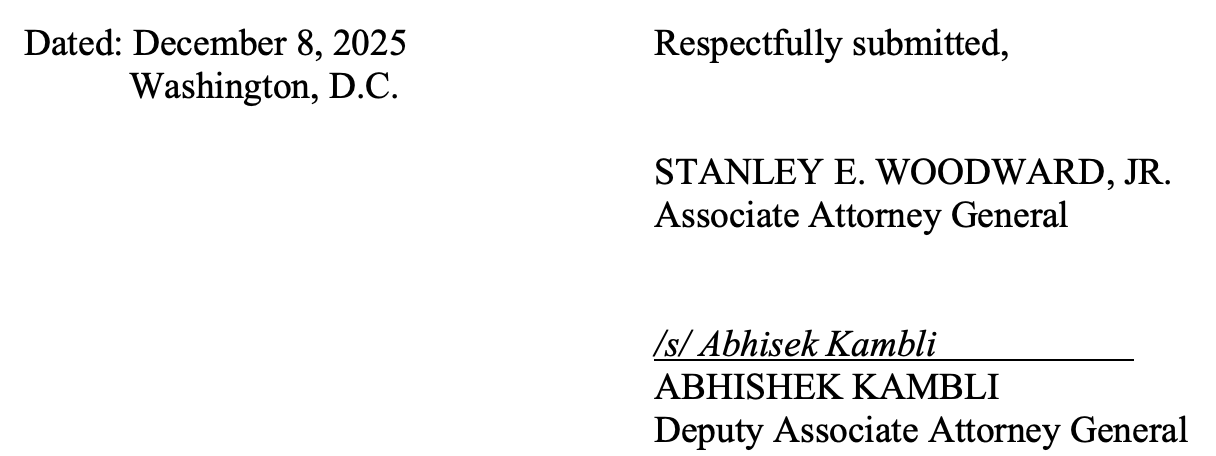
Notably, although he has not entered an appearance in the case, Associate Attorney General Stanley Woodward was also listed on the filings requesting the extension. (In other words, the people who took over Mizelle and Lawson’s roles are now on these cases.) As such, if the appeals court had denied the request, Woodward could have done the work.
On Tuesday, though, the D.C. Circuit granted the request — giving the parties until January 26 to file the motions requested originally on September 23.

Why did I write all of this?
These are loser cases for DOJ. Defending these executive orders makes the lawyers who do so look bad in court, and it appears that only the senior-most political appointees are willing to do it.
Given that, it’s not all that surprising that the DOJ lawyers stuck with these cases are doing all they can to slow them down short of giving up their defense of Trump’s lawless actions altogether.
And, yet, they are still defending Trump’s lawless actions.
So, as they keep slow-walking these cases, I’m going to keep pointing it out.
Oh, that canny DoJ—it certainly picks its “emergencies” doesn’t it?
It’s fairly clear Pam Bondi and the Department of Justice see their role as acting as Trump’s personal counsel, to defend his personal conduct as his personal counsel, and to cover up any evidence of Trump’s illegal behavior. Bondi’s had her little elves busy redacting any evidence implicating Donald’s wrongdoing in the Epstein filed, and Rep. Thomas Massie waived a copy of a document he had received from the Epstein files in which every line had been blacked out. I don’t usually agree with Massie about much, but I do agree with his call to release then unredacted files. The only things which should be redacted from the files are the names of the victims. The perpetrators’ names should not be redacted.