

DOJ is barely even a functional law firm at this point. Each day there is more proof.
Jeanine Pirro's effort to subpoena the Fed hit a wall. At the same time, DOJ was also forced to "clarify" arguments made in court about the Pentagon's new press policy.


The Justice Department is barely even a functional law firm at this point.
DOJ — which had been known as a place where some of the best lawyers would take a pay cut to work at, because the opportunities for exciting, important work were so plentiful and the colleagues were of such high quality — is not DOJ any longer.
There is no other way to say it.
And there is more proof of that depressing reality each day.
On Thursday, DOJ filed a notice nearly a week after the summary judgment hearing in a key case over the Defense Department’s new, restrictive press policies, with DOJ “clarify[ing]” two pivotal statements made at the hearing about whether the policy sets objective or subjective standards for granting or denying press passes and what communications by reporters the government believes could be criminal ones.
On Friday, Judge James Boasberg quashed subpoenas issued by the U.S. Attorney’s Office in D.C. against the Federal Reserve, with the judge finding the government presented “no evidence whatsoever” of a crime that could be properly investigated and that, as such, “asserted justifications for these subpoenas are mere pretexts.”
These are, simply put, two paragraphs I would not have ever expected to write about the Justice Department in any of my time covering it — even during the worst moments of the John Ashcroft or Alberto Gonzales tenures during the George W. Bush administration (some very bad actors!) or even Jeff Sessions’s tenure during the first Trump administration (some very bad policies!).
The Pentagon press policy
In the DOD case, The New York Times has challenged the new policy, and summary judgment arguments — arguments on which both sides say mean they should win the case outright — were held on March 6.
After the Defense Department changed the standards for granting and rescinding Pentagon Facility Alternate Credentials, or a Pentagon building pass, to reporters and required all journalists to sign an acknowledgment that they “understand” the new policies, most of the press corps refused and left.
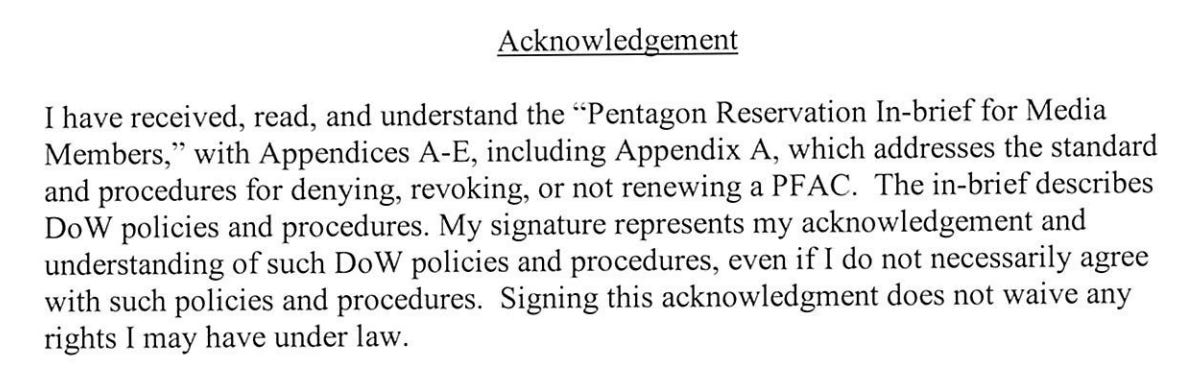
The Times sued, and on March 6 arguments were held over both sides motions for summary judgment. In key part, these are stated “reason[s] for denial, revocation, or non-renewal” of a building pass to a reporter:
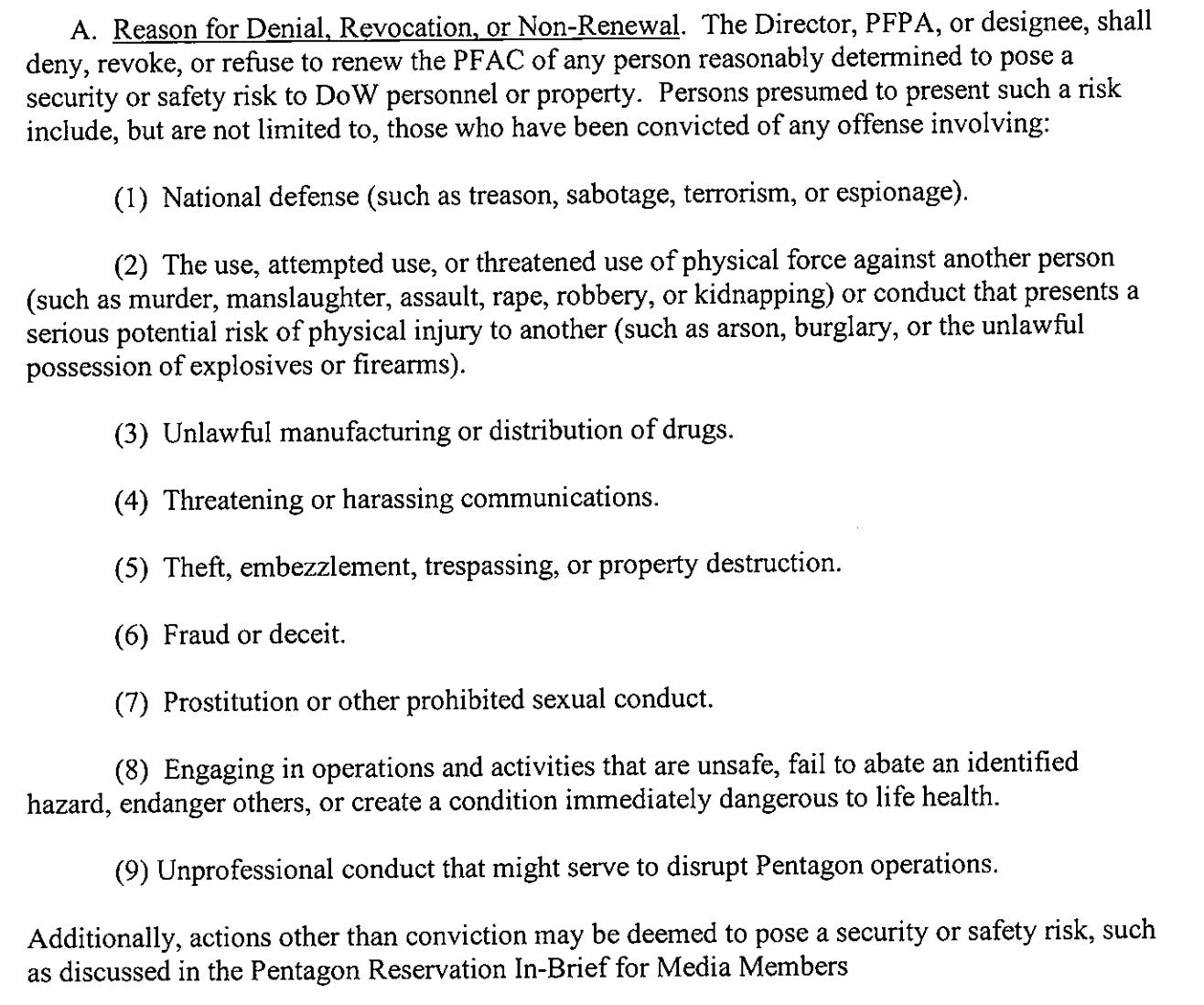
At the hearing, here’s the exchange Michael Bruns, a trial attorney with the once-vaunted Federal Programs Branch of DOJ’s Civil Division, had with U.S. District Judge Paul Friedman, an 82-year-old Clinton appointee born during World War II, about those “reasons” for revocation:
FRIEDMAN: So, while we are still on the subject of meaningful standards, the very recent Supreme Court decision in Minnesota Voters vs. Mansky said that you need, quote, objective workable standards.
Are the standards here objective?
BRUNS: I would say that they are more subjective.
FRIEDMAN: More what?
BRUNS: Subjective than objective. It will look at objective facts such as the convictions, as well as whether or not someone solicited information. But as recognized in Sherrill [v. Knight], in terms of security, the experts at the Department should be allowed considerable leeway, that’s a quote from Sherrill, in exercise, quoting again, subjective judgment.
FRIEDMAN: Okay. Go ahead.
BRUNS: Sticking with Sherrill, the lower court in Sherrill entered the relief that plaintiffs are seeking in this case. In Forcade v. Knight, the lower court remanded to the Secret Service to devise and publicize narrow and specific standards for the issuance or denial of press pass applications. The D.C. Circuit overruled that requirement and recognized that assessing security risks does not lend itself to detailed articulation to narrow and specific standards or the precise identification of all factors that may be taken into account.
This is why the Department is entitled to exercise its discretion and exercise its subjective judgment in identifying whether someone is a security or a safety risk in the headquarters of the American military.
Six days later, DOJ filed a “notice of clarification” asserting, essentially, “We realized our answer won’t work.” Here’s the relevant “clarification” filed by Civil Division Assistant Attorney General Brett Shumate, Assistant Branch Director Joseph Borson, and Bruns:
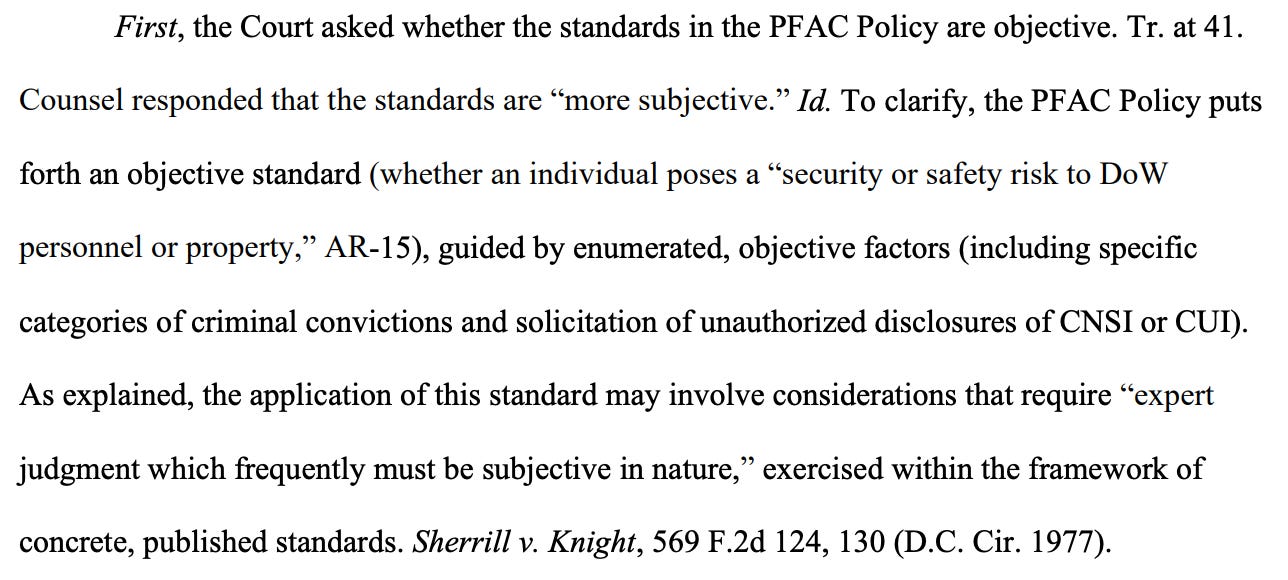
The “more subjective … than objective” standard that Bruns described on March 6 became “an objective standard … guided by enumerated, objective factors” that “may involve considerations that require expert judgment which frequently must be subjective in nature” on March 12, if you think that’s different.
In a response filed on Friday, the Times’s lawyers from Gibson, Dunn & Crutcher called the “clarification” out for what it was.
“Defendants attempt to walk back that case-ending concession—but, unable to deny the Policy’s grant of standardless discretion, they settle on the doublespeak that it is an ‘objective’ standard that will be implemented ‘subjective[ly],’“ the Times’s lawyers wrote. “Even setting aside the incoherence of that explanation, Defendants’ letter does not change what the Policy says: PFACs may be suspended, revoked, and denied under the very same impermissibly vague “national security” standard the D.C. Circuit found unconstitutional in Sherrill v. Knight.“
This is just on example from this hearing, and one of the two “clarification[s]” issued after the fact, but, suffice it to say, this is not what a lawyer should be doing — and it’s certainly not something that would have been expected out of the Federal Programs Branch in the past.
The Trump admin’s stumbling effort to target the Fed
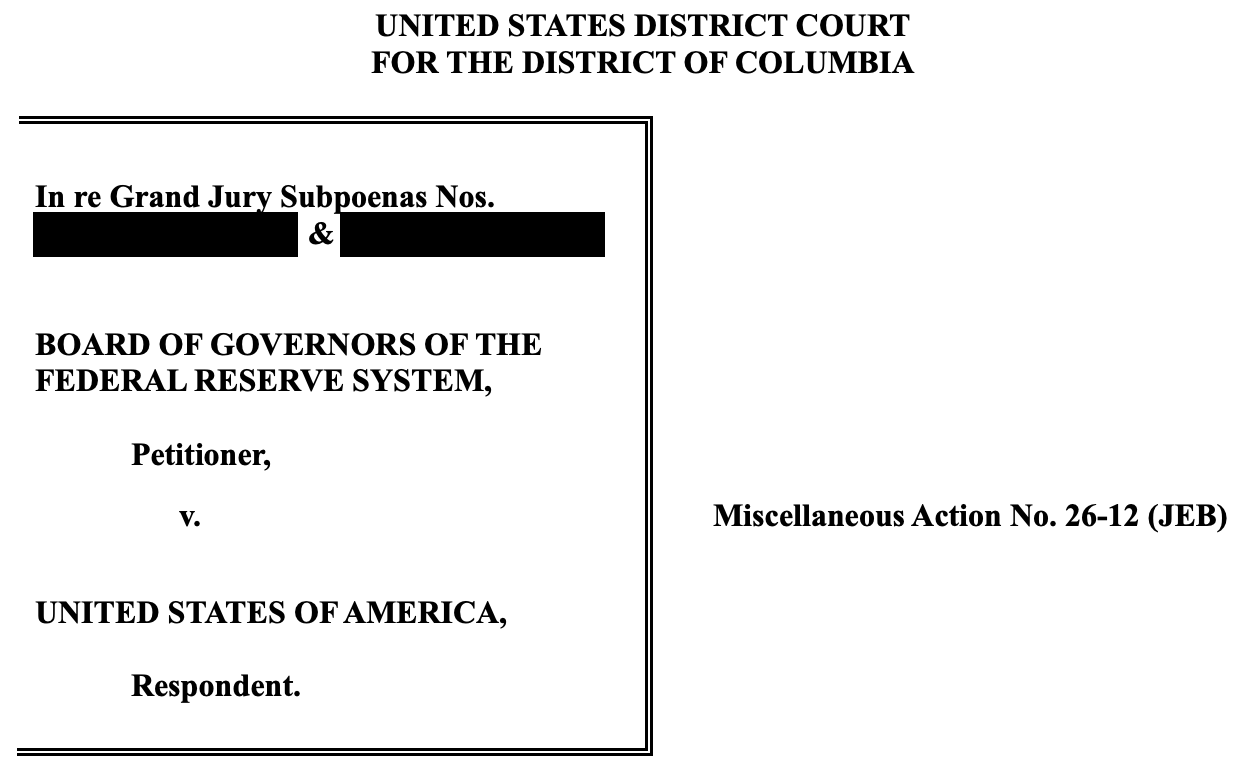
On Friday afternoon, Chief Judge James Boasberg unsealed a March 11 order quashing two DOJ subpoenas to the Federal Reserve. The subpoenas issued by the U.S. Attorney’s Office in D.C., run by Jeanine Pirro, were challenged by the Fed under seal back in early February as having been brought for an improper purpose.
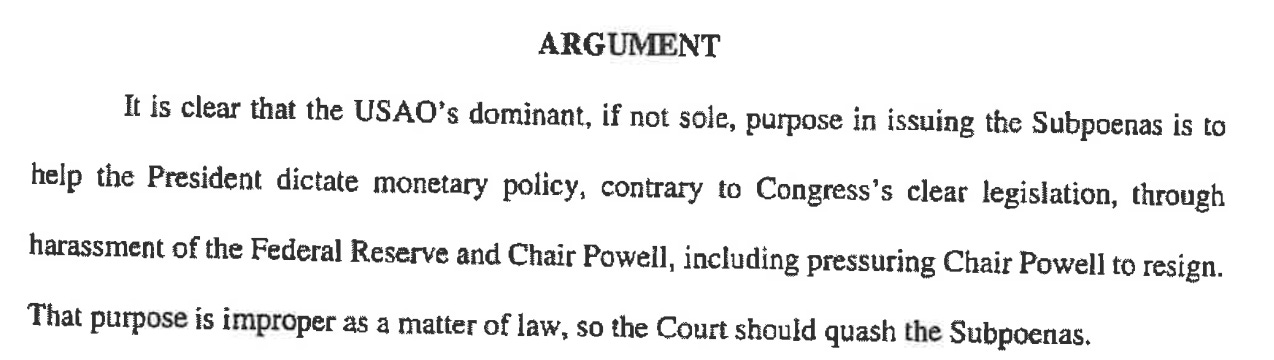
The argument was direct and simple, as captured in the King & Spalding lawyers’ summary:
Ten days later, on February 13, Pirro’s office responded. The lawyer who Pirro had previously worked with in New York, Steven Vandervelden, signed the filing and was the only lawyer listed on it besides Pirro. As was covered by Bloomberg Law’s Ben Penn when Vandervelden was involved in Pirro’s unsuccessful effort to indict the members of Congress involved in last year’s video that prompted Trump’s outrage, Vandervelden is currently a dance photographer.
As Penn explained on February 11, “Vandervelden maintained an active photography studio when presenting federal charges to the grand jury against the six members of Congress for creating a video reminding military service members of their rights to refuse unlawful orders.“
Two days later, this was Vandervelden’s response to the Fed:
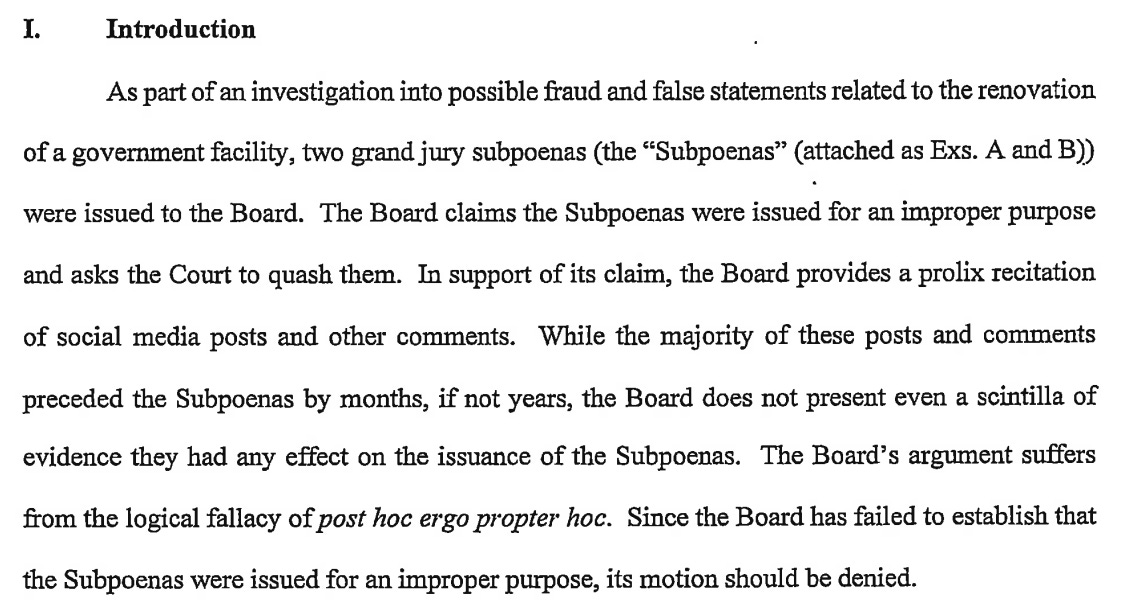
In reply, the Fed’s lawyers noted, “The USAO agrees that its Subpoenas should be quashed if their dominant purpose was improper, Opposition to the Motion to Quash Subpoenas (Opp.) at 5, and the record here demonstrates that it was indeed improper,” adding, “Tellingly, the Opposition proffers no legitimate basis for the criminal investigation.”
In his opinion rejecting DOJ’s arguments and granting the Fed’s motion to quash the subpoenas, Boasberg — who has spent more than his fair share of time dealing with Trump administration arguments and defenses of the past year — did not mince words.
Citing “one of at least 100 statements that the President or his deputies have made attacking the Chair of the Federal Reserve and pressuring him to lower interest rates,“ Boasberg explained, “the President has been unable to push rates lower through social-media posts.“ Noting that, as such Trump had “hinted at other options” to “get him out,” Boasberg continued:
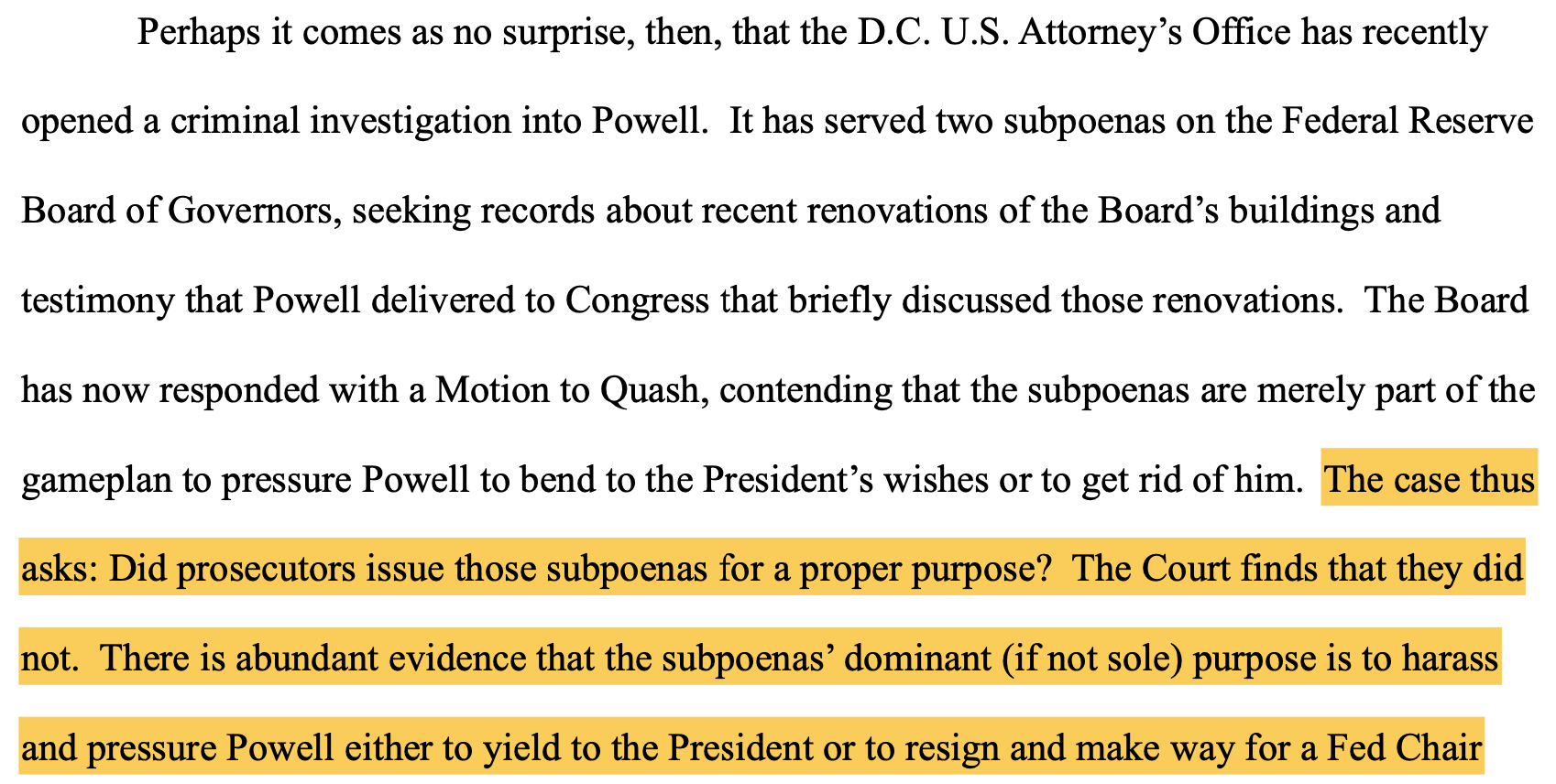

As I noted on Friday, this is an astounding statement from a federal judge about the executive branch, generally; the Justice Department, more particularly; and these subpoenas, specifically.
This is not the way the government was seen by federal judges, and it was not at all the way the Justice Department acted or the defenses it had to attempt to justify the government’s actions.
But, in 2026, it’s all in day work for those who remain working under Attorney General Pam Bondi.
So glad Judge Boasberg is hanging tough. He is a super hero in the fight to save democracy.
As always, thank you for your excellent work.
I’ve been a practicing lawyer for over 40 years. The degradation and disintegration of DOJ is a tragedy that will haunt us for years. I’m glad my lawyer father and judge uncle aren’t alive to see this. Especially as Black attorneys, we looked to DOJ as the colleagues we knew upheld the highest standards and the rule of law. Our system has always been fragile. These people have broken it.