

D.C. Circuit Trump appointees again block contempt inquiry into Alien Enemies Act flights
Rao and Walker hold that Boasberg must "terminate" the contempt inquiry. In an 80-page dissent, Childs makes the case — without saying so directly — for en banc review.

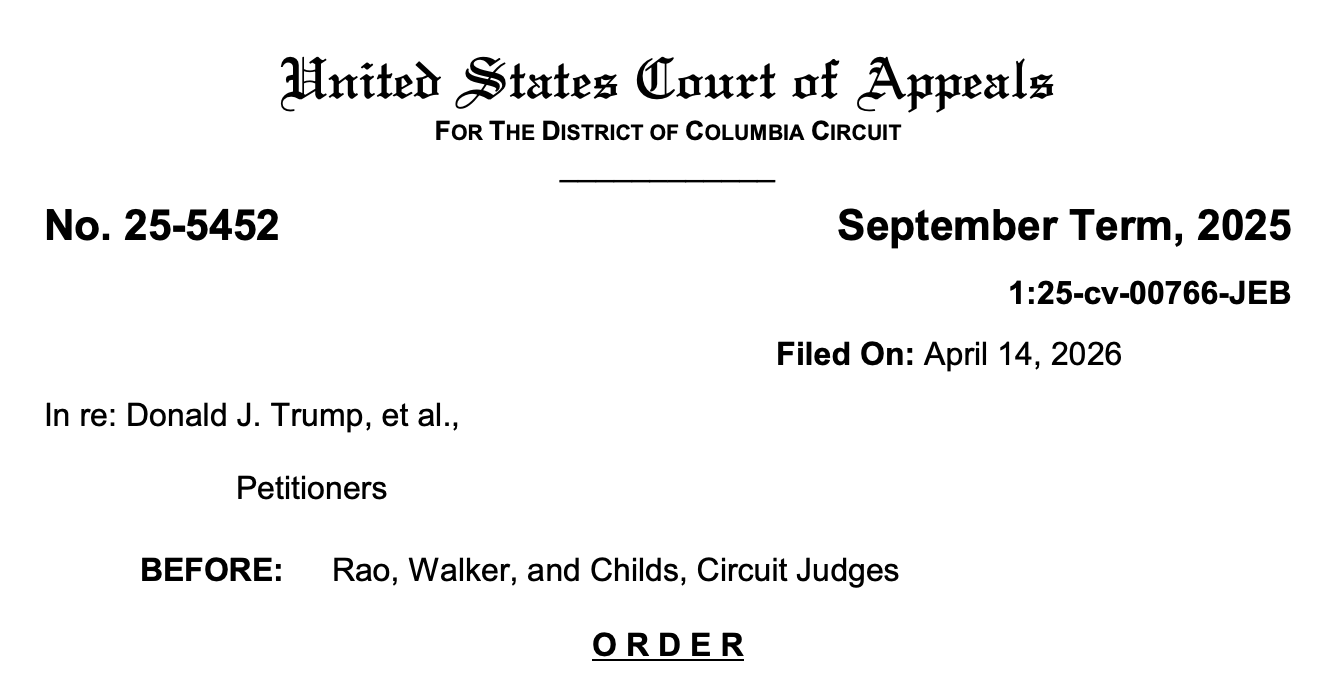
On Tuesday, two Trump appointees to the U.S. Court of Appeals for the D.C. Circuit blocked U.S. District Judge James Boasberg from proceeding with his effort to decide whether to hold any members of the Trump administration in criminal contempt for their March 15, 2025 actions relating to President Donald Trump’s invocation of the Alien Enemies Act of 1798.
In all, it was the fourth time in the past year that two Trump appointees on the 11-judge appeals court have stopped the district court judge’s efforts to determine whether criminal contempt is appropriate in the case.
“The district court’s improper and unnecessary investigation, with its shifting scope and justification, intrudes upon the Executive in a manner for which mandamus is the only adequate remedy,“ Judge Neomi Rao wrote for the court.
Tuesday’s ruling from Rao, joined by Judge Justin Walker, came 13 months after Trump on March 14, 2025 secretly signed an order invoking the 1798 law — which had previously only been invoked in wartime — to try and quickly deport Venezuelans the administration had decided belonged to Tren de Aragua (TdA), a Venezuelan gang.
In an 80-page dissent, Judge J. Michelle Childs made clear her view that mandamus was inappropriate here: This was not the time to take such drastic action, and the Trump administration hadn’t shown it should get mandamus under the law.
“Mandamus … should only issue on days where it is needed to restore, and not upset, the balance of power in our government,” Childs wrote. “But today is not one of those days.“
She also warned that letting this ruling stand as a precedent would have consequences both for district courts’ contempt powers and for executive branch authority.
A request for en banc review by the full D.C. Circuit is expected.
The long path to Tuesday
On March 15, 2025, as preparations appeared to be underway to start deportations under the powers of the Alien Enemies Act, a lawsuit was filed before Boasberg. After initially granting a temporary restraining order blocking the removal of the named plaintiffs, Boasberg scheduled a 5:00 p.m. hearing to consider whether to grant classwide relief. After Justice Department lawyer Drew Ensign could provide no clear answers at the hearing about whether there would be AEA deportations over the weekend, the plaintiffs’ lawyers told the court that — during a break where Ensign was to get an answer to that question — two flights had taken off. Boasberg granted a classwide TRO during the hearing, which was followed up by a written order.
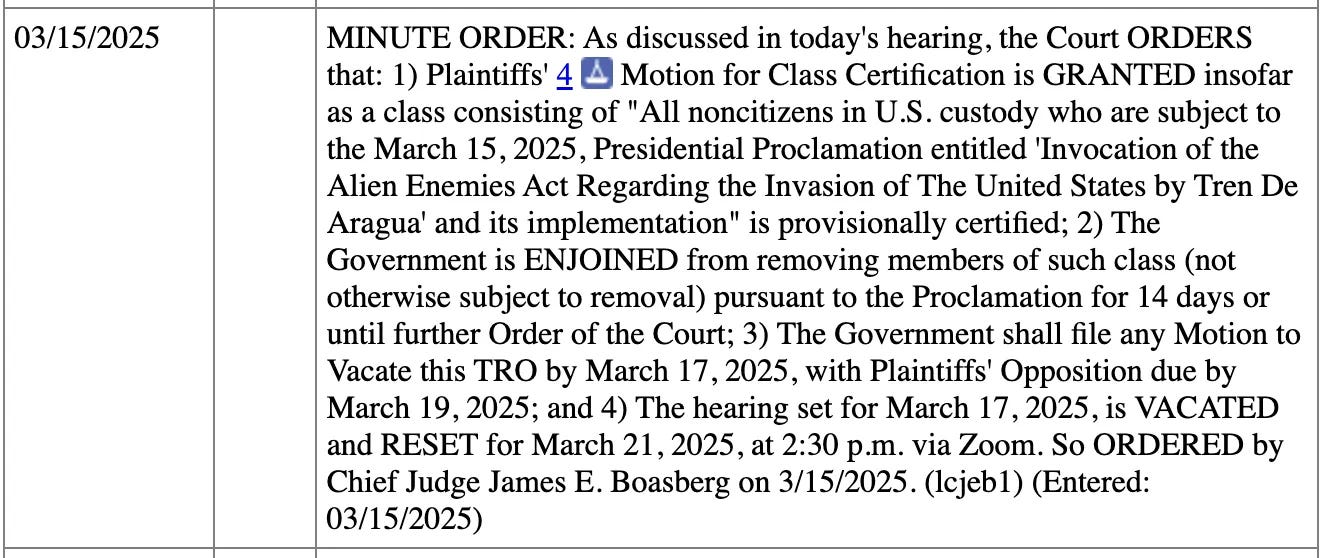
Despite that — and despite discussion from Boasberg about turning around the flights if needed to comply with the order — the Trump administration decided to continue with the flights that had already left the U.S., ultimately sending those people to El Salvador’s CECOT prison. A little more than month later, on April 17, 2025, Boasberg issued an order finding “probable cause” that the Trump administration was in criminal contempt over those actions regarding the March 15 AEA flights.
The next day, on Friday, April 18, 2025, the first of four orders from Trump appointees stopping Boasberg’s effort came down. That 2-1 “administrative stay” remained in effect until nearly four months later, when that 2-1 panel granted mandamus and vacated the “probable cause“ order on August 8 — a decision that the full D.C. Circuit let stand on November 14 (with a majority of the court, however, making clear that Boasberg could proceed to consider contempt). The case returned to Boasberg, who did proceed with the contempt inquiry on November 19. After more back and forth, including admissions that then-Homeland Security Secretary Kristi Noem made the decision not to return the flights, Boasberg issued an order on December 8 requiring testimony the next week from one former DOJ lawyer (now, whistleblower) and one current DOJ lawyer (Ensign) about what happened. On December 12, however, DOJ returned to the D.C. Circuit to stop the testimony. That day, a new 2-1 panel issued a new “administrative stay” blocking the testimony order.
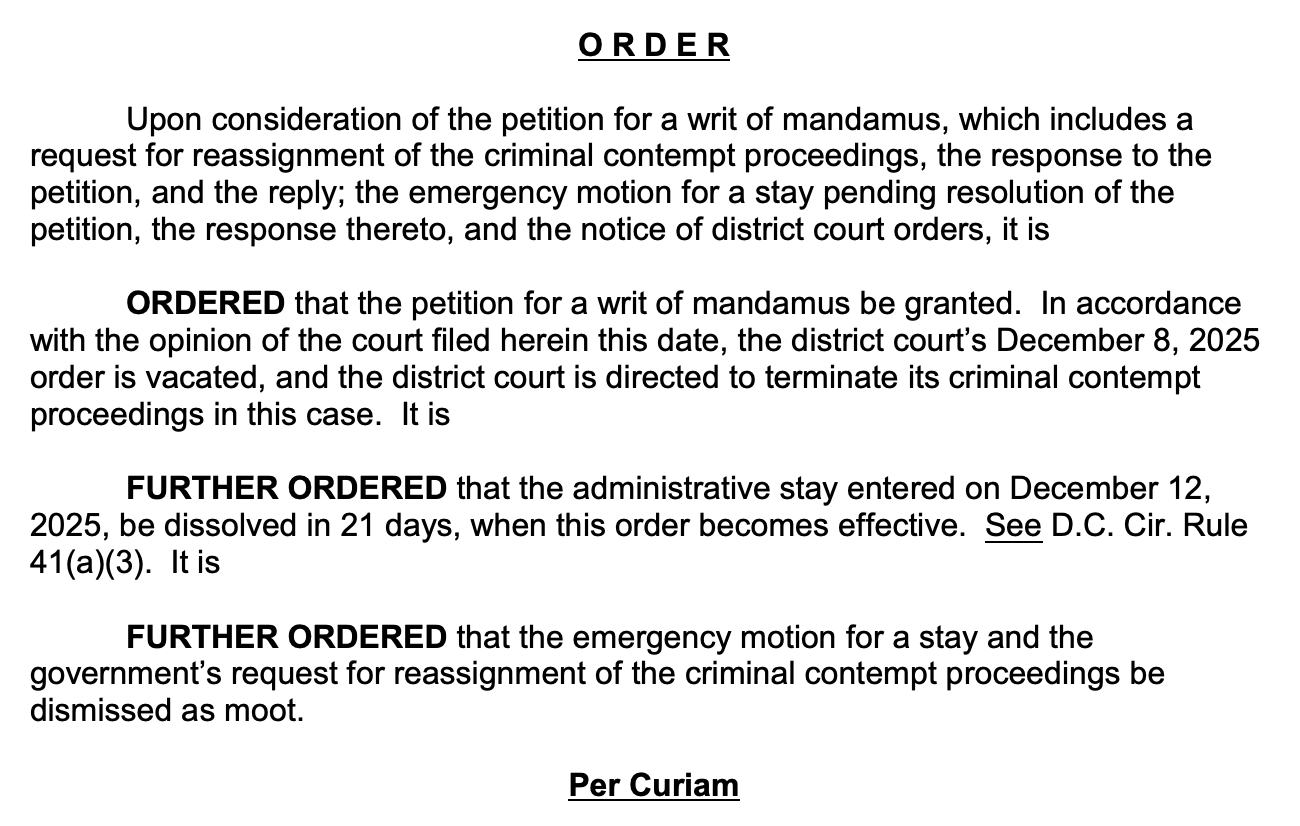
On Tuesday, more than four months later, the 2-1 panel issued a new mandamus order — vacating Boasberg’s December 8 order and “direct[ing]” the district court “to terminate its criminal contempt proceedings.”
The majority opinion
Rao, one of the most extreme judicial appointees from Trump’s first term, had been on the first panel as well so has granted the Trump administration relief from this contempt inquiry four times. On Tuesday, she wrote for the court, “Mandamus is appropriate again to forestall unwarranted judicial intrusion into Executive Branch decisionmaking regarding matters of national security.“
In addition to holding that the government had no other way to “attain the relief it seeks“ and that mandamus is appropriate here, Rao held in key part that “the government has a clear and indisputable right to termination of this judicial investigation because it is premised on an order that is insufficiently clear and specific to sustain a charge of criminal contempt.“
Rao then wrote for the court:
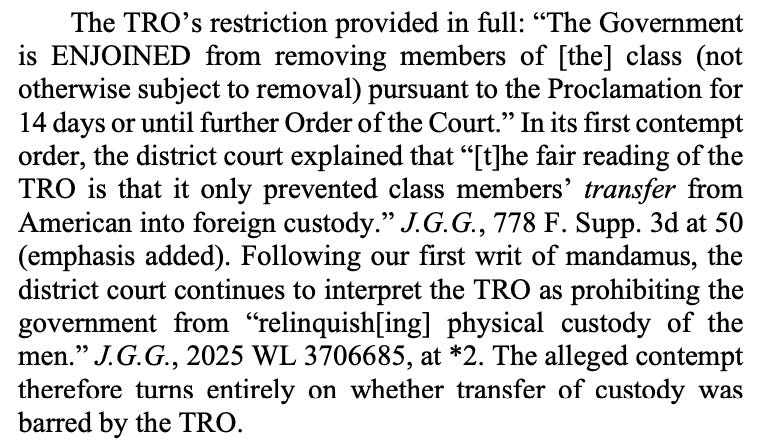
She then wrote, “Criminal contempt cannot lie for transferring custody when the TRO was entirely ‘silent’ as to that requirement,” adding that context made no difference to her: “An objective interpretation of the TRO’s text and surrounding circumstances … fails to provide a clear directive not to transfer custody of the plaintiffs.”
Rao did acknowledge Boasberg’s statements at the March 15 evening hearing about turning the planes around.
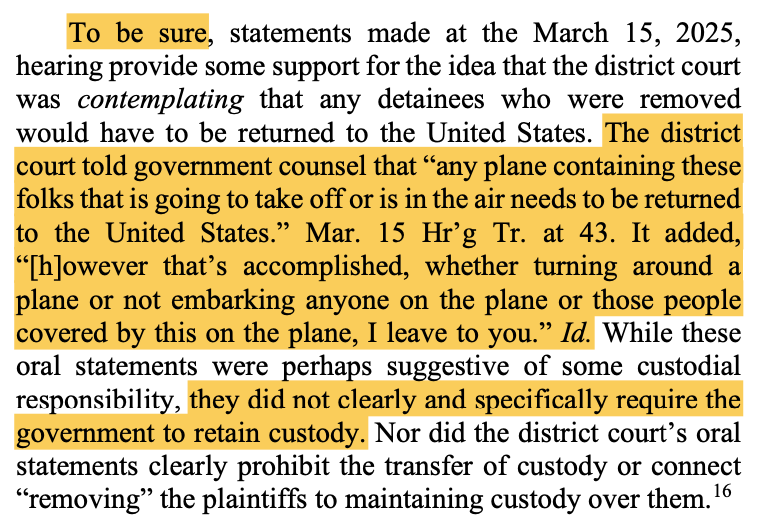
Rao then noted, however, that “oral statements” at the hearing “were of limited value in light of the district court’s assurance that it would ‘issue a minute order memorializing this so you don’t have to race to write it down.’”
Walker wrote a concurring opinion all about that. Seriously
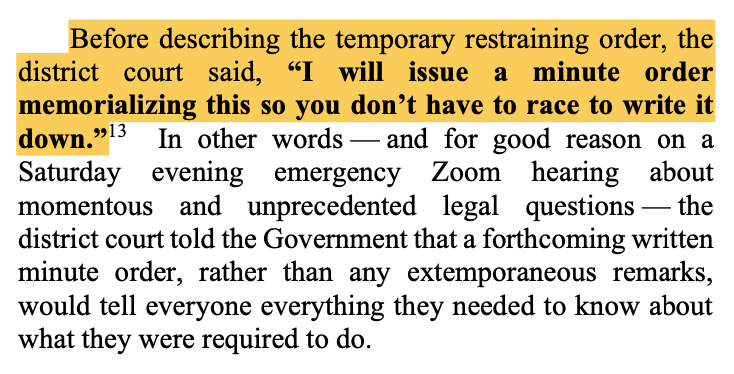
Because of that, Walker wrote that “the written order superseded the oral order.“ With that in hand, he continued:
What did the Government do to people covered by the written order once that order was issued?
The answer appears to be: Nothing. As the majority opinion explains, the written order covered only people who had not already been removed from the United States.
As such, he concluded, “That is enough to resolve this case.“
The dissent’s warning
Childs was incredulous on several grounds.
First, procedurally, she noted that the majority relied on the vacated “probable cause” order both for the majority’s conclusions and to assert what Boasberg already had concluded, despite the fact that vacating the order means it should no longer be relied on by any court for any purpose. As to Boasberg, she explained:
In obedience to that earlier panel’s writ of mandamus—which vacated its probable cause order and factual findings—the district court dutifully and carefully started on a clean slate, calling a hearing for testimony about the actions of the alleged contemnors.
In short: Of course he was engaging in factfinding. The appeals court tossed out his earlier order.
Then, as to the timing, she noted, “We have never reviewed an interlocutory order in an indirect criminal contempt proceeding like the one before us, where no referral has been made and no contempt trial has even begun.”
In short: Why are we doing this now?
Substantively, Childs wrote that the government met none of the conditions for mandamus:
The Government has failed to show that it has no other form of relief available to it. The Government has not shown that it has a clear and indisputable right to relief under controlling law, despite advancing several theories. Nor has the Government shown that mandamus is the appropriate relief for this court to provide under the circumstances before us.
As to other possible relief, Childs concluded that “adequate alternative means for relief plainly exists, the appeal of a contempt judgment,“ and, as such, “the Government’s showing here is inadequate because it merely reflects an interest in being free from the normal procedures of litigation.“
As to the “clear and indisputable right,“ she noted that “[t]he Government presented us with a smörgåsbord of bases to determine it has a clear and indisputable right to relief,” but that “[t]he majority takes up none of these arguments,“ instead — per Childs — basing its ruling on a position that “the Government has a clear and indisputable right to mandamus because, on the merits, contempt cannot be found for the disobedience of an order that is not clear and specific.“
Not so, Childs responded.
“There is … no authority to support that this court may short-circuit a criminal case that only the district court has the authority to initiate,“ she wrote — just winding up.
She continued:
The majority emphatically proclaims [mandamus] is necessary because the district court is a runaway train for investigating contempt. This is a distraction. At its core, the majority’s analysis declares today that there can be no crime if an order violated was not one perfectly written, rather than determine if one was perfectly understood. Such an approach is unsound.
Diving into the dispute over the March 15 orders, she wrote, “I reject the contention that only the written minute order constitutes the injunction. The context of the hearing supports that the court’s order comprises of what it stated on the record and the language of its written minute order.“
In addition to discussions at the hearing, Childs also pointed to the order itself:
[L]ook to the first line of the district court’s minute order: “As discussed in today’s hearing, the Court ORDERS . . . .” Min. Order 4, Mar. 15, 2025 (emphasis added). The district court incorporated by reference the hearing discussion about the details of the injunction, the class, and the basis for the new briefing schedule.
She went on to show — grammatically and in the context of what was happening inside and outside of the hearing — “just one of the many ways in which to analyze the district court’s order that leads to a different result than the majority.”
After doing so, she concluded:
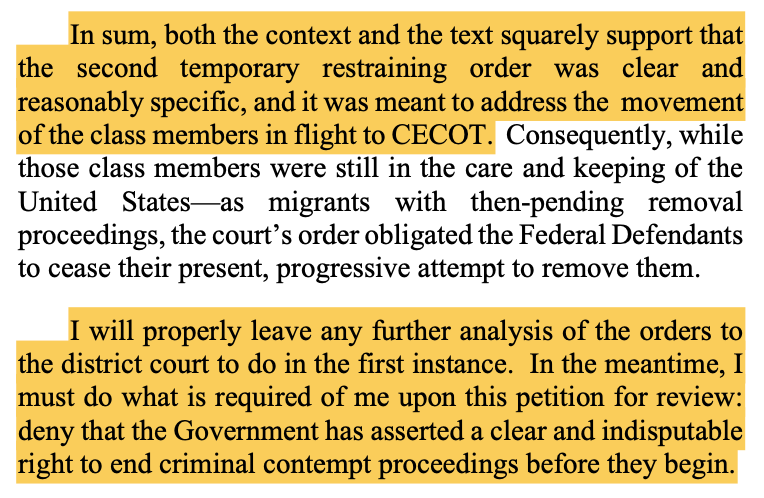
This was not, she wrote, just about Tuesday’s decision, either. In looking outward, Childs warned of the precedent the majority set in doing so.
“Now, any litigant can argue, based on their preferred interpretation of a court’s order, that they did not commit contempt before contempt findings are even made,” she wrote. “And now, in any challenge where one may wave the wand of separation of powers, the Government knows it can petition this court for mandamus to relieve it from such proceedings.“
I appreciate your making these matters of fairness and consequence more accessible to The People in your summaries. We are being inundated from many sides by a relentless push for executive power.
Power to the people!
Neomi Rao has placed herself as the James Ho of the DC Circuit, tossing her hat in as a potential Scotus Justice nominee. I mean, Rao's "reasoning" on her published pro-trump rulings has put her in a stratum occupied by a few dozen other district and appellate judges nominated by trump/Federalist Society, later to be confirmed by the GOP-majority Senate.
"We are not 'political hacks' ", cries J Coney Bryant...uh-huh.