

100 days of Kavanaugh stops and the justices who silently allowed them — and a bill to change that
The Shadow Docket Sunlight Act is being introduced on Wednesday. And, Justice Kavanaugh still isn't saying if he's having second thoughts on his September opinion.

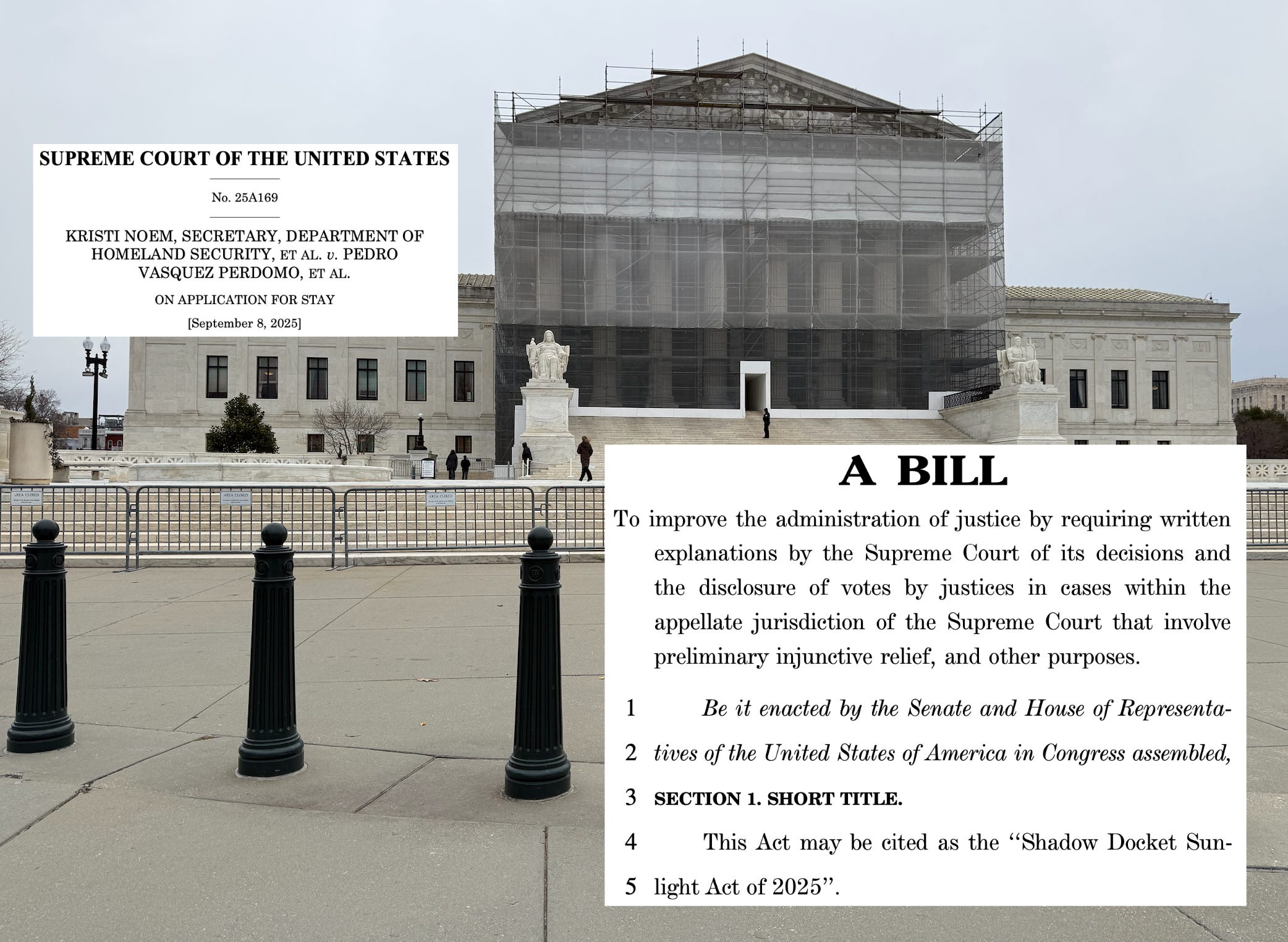
On September 8, the U.S. Supreme Court allowed the Trump administration to engage in racial profiling in its aggressive immigration raids.
Specifically in the case in question, Noem v. Vasquez Perdomo, the court’s Republican appointees allowed ICE to target Spanish-speaking people who look Latino at certain low-wage job sites in the Los Angeles area while litigation challenging the effort was ongoing.
It was a shadow docket ruling that highlighted nearly all of the concerns raised by the shadow docket.
Without full briefing or arguments, the justices effectively reversed two lower court orders blocking the administration’s efforts. Despite the abbreviated consideration on the shadow docket, which Justice Brett Kavanaugh has inaptly insisted should be called the “interim” docket, the consequences are very real.
The result of the Vasquez Perdomo decision has been story after story, nationwide, of the Trump administration taking the shadow docket ruling and running with it — freely targeting people who look like the people they want to target.
Beyond that, we do not even technically know the vote of the justices in the September 8 order. It could have been 6-3 or 5-4.
We know the three Democratic appointees dissented from the order because Justice Sonia Sotomayor wrote an extensive dissenting opinion, joined by Justices Elena Kagan and Ketanji Brown Jackson.
From the majority, however, the public got very little. The one-paragraph order of the court gave no reasoning, simply stating that a stay was granted and providing procedural information about the stay.
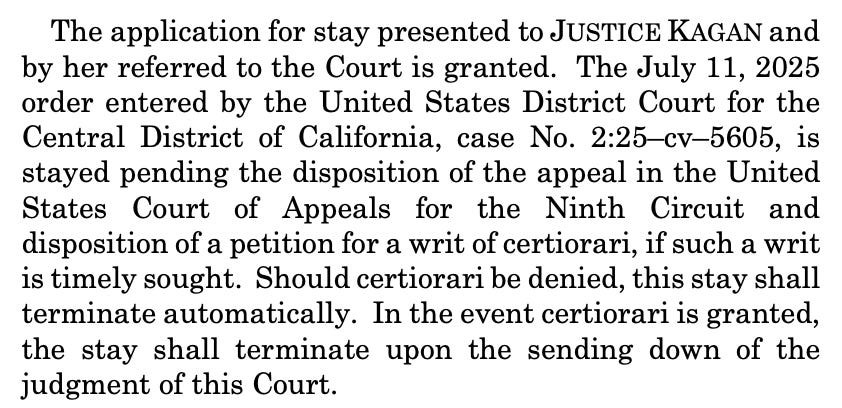
Additionally — and infamously at this point — we do know that Justice Brett Kavanaugh agreed with the Supreme Court’s order, writing a nine-page opinion concurring in the order granting the stay. He was joined by no other justices.
A bill to shine sunlight on the shadow docket
Some members of Congress would like to change all of this. Senator Richard Blumenthal and Rep. Deborah Ross, both Democrats, are introducing the Shadow Docket Sunlight Act of 2025 on Wednesday.
The bill, provided to Law Dork in advance of introduction, is a slightly expanded version of a similar bill that had been introduced in the last session of Congress. The bill would require the Supreme Court to explain its shadow docket rulings and give a vote count for them.
From the bill:
In any case within the Supreme Court’s appellate jurisdiction, the Supreme Court may not issue any order granting, denying, or vacating preliminary injunctive relief or granting, denying, or vacating a stay of preliminary injunctive relief unless the Supreme Court publishes a written explanation of reasons supporting such order and indicates in writing how each participating justice voted regarding such order.
The contours are outlined a little more in the six-page bill, including providing specifics on what needs to be in the written explanation and setting a requirement that the Federal Judicial Center provide regular reports to Congress on “compliance or noncompliance” with the bill’s explanation and vote-count requirements, but that’s the meat of it.
For example, the bill would require a shadow docket stay to “include an evaluation of the following criteria“:
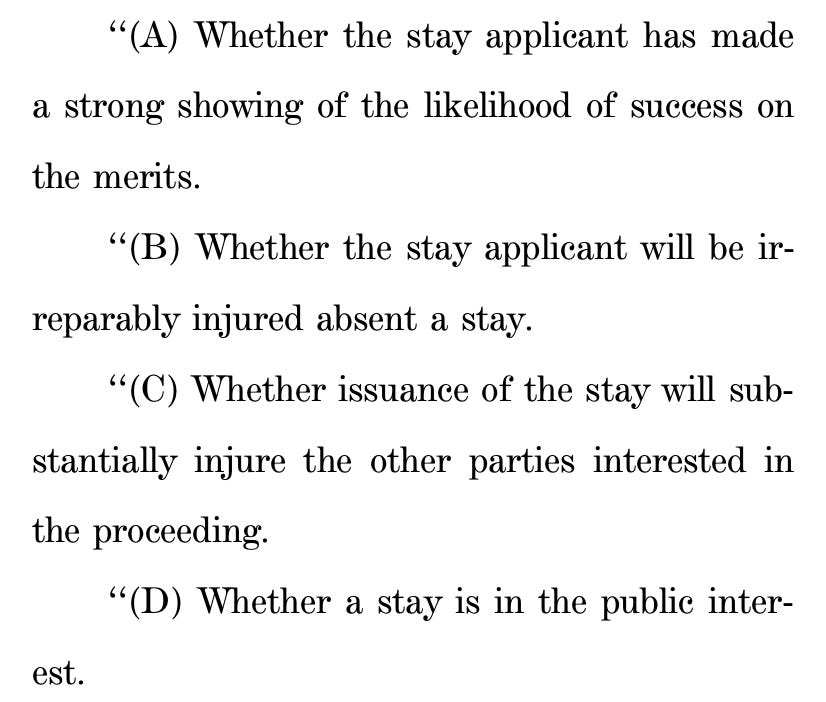
Such specificity of what needs to be included in the Supreme Court’s explanations is new to this year’s version of the bill and — despite drawing from the Supreme Court’s own decisions setting forth those standards — is likely to garner some pushback from backers of judicial independence.
Blumenthal is joined by Sens. Cory Booker, Dick Durbin, Amy Klobuchar, Alex Padilla, Jack Reed, Bernie Sanders, Adam Schiff, Chuck Schumer, Tina Smith, Peter Welch, Sheldon Whitehouse, and Ron Wyden as initial co-sponsors, and Ross is joined in the House by Reps. Jamie Raskin and Hank Johnson as the initial House co-sponsors. Yes, all the co-sponsors — like the sponsors — are Democrats.
Although the bill will almost certainly not be passing this Congress, it is important for members of Congress to be showing what they can — or could — do to confront an increasingly out-of-control Supreme Court.
In a statement provided to Law Dork, Blumenthal referenced the September 8 Supreme Court order as a reason why the bill is needed.
“The shadow docket decision in Noem v. Vasquez Perdomo, a highly chilling legal landmark, condones racial profiling in Trump’s immigration enforcement. Shockingly, this very significant ruling was issued without any public argument or majority opinion,” Blumenthal said in the statement. “The Shadow Docket Sunlight Act shines light on the Supreme Court’s emergency docket rulings, like Vazquez Perdomo, and requires the Supreme Court to be accountable and explain its rulings.“
Ross, in her own statement, highlighted the fact that the problem with the shadow docket extends far beyond one case.
“From allowing DOGE to access sensitive data to permitting the illegal mass firings of federal employees, the Supreme Court has used the shadow docket to hand down major decisions that impact millions of Americans’ daily lives,” Ross said in her statement. “This important legislation will require the Court to operate with the transparency that the American people deserve.”
Blumenthal echoed that, adding, “Americans deserve clarity from the nation’s highest Court—especially as the Court increasingly uses the shadow docket to issue far-reaching consequential decisions. Recent shadow docket decisions demonstrate the dire need for our legislation’s enforceable guidelines that hold the Court accountable.”
Then there’s Kavanaugh
Of course, Kavanaugh did write in Vazquez Perdomo.
Moreover, because he was the only person in the majority to write, his opinion — and his callous disregard for the consequences of the order — has led in the time since to the interactions that followed being referred to as “Kavanaugh stops” — a term coined by law professor Anil Kalhan.
As Kavanaugh wrote in supporting the September 8 order:

Kavanaugh wrote of “the brief encounter” that U.S. citizens and people otherwise legally in the United States might face due to such racial profiling, later stating that such people “promptly go free” after immigration officers are “clear” they are here legally:
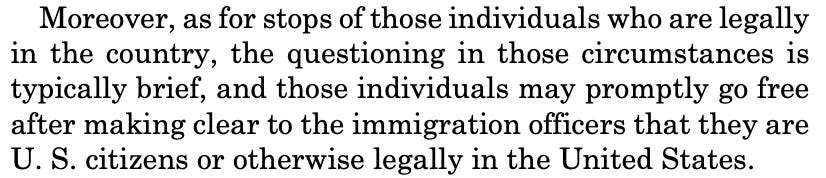
That, it has been clear, is a lie.
As such, Law Dork has repeatedly requested comment from Kavanaugh through the Supreme Court’s Public Information Office. Fifty days ago, Law Dork covered some of those requests — which included a final request to Kavanaugh that followed Pro Publica’s report on the “more than 50 Americans who were held after [immigration] agents questioned their citizenship” since Trump re-took office.
Kavanaugh did not respond at that time.
In the months since, the Kavanaugh stops have not stopped.
Just this week, 404 Media and Reveal reported on Jesus Gutiérrez, a 23-year-old U.S. citizen who was stopped on the street in Chicago, put in an SUV, handcuffed, and only then identified as a U.S. citizen — and by agents who scanned his face and then used facial recognition software to “confirm” his citizenship.
Less than week before that, Sahan Journal reported on Mubashir, a 20-year-old U.S. citizen who was reportedly chased, tackled, and handcuffed — then taken to an immigration facility in Minneapolis before being allowed to show his I.D.
In Law Dork’s email requests, Kavanaugh was asked whether — in light of what happened to Mubashir and Jesus — he still thinks he was correct when he wrote that U.S. citizens questioned by immigration authorities would “promptly” be able to go free after making clear their legal status.
He has not responded to the requests.
The Kavanaugh stops, however, continue unabated.
Kavanaugh really screwed the pooch with his opinion in *Perdomo*, he knows he bollixed it, and he knows that the DHS masked hoodlums took that opinion and are abusing the fuck out of it. Now what's he going to do about it? When will the case reach Scotus on the merits?
If Kavanaugh is who I think he is, he's indignant at the notion that anyone would attempt to hold him accountable for anything he's said or done. The man reeks of privilege.